Noah Feldman: Populists have always hated the Senate. How does it survive?
Published in Op Eds
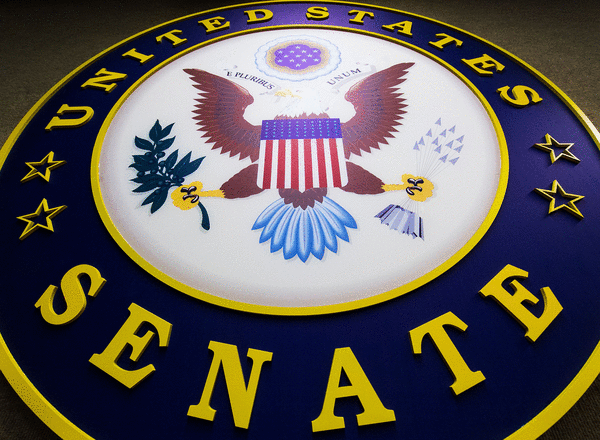
As the Democratic Socialists of America bash the Senate, calling for its abolition, many Republicans and conservatives are bashing the DSA, for daring to question James Madison’s constitutional design. Surprisingly, both are partly right.
Madison certainly planned for a Senate to be composed of the wisest and most nonpartisan men the United States could produce. But he expected the Senate to be apportioned based on the population of each state, the way the House of Representatives is. He viewed a Senate that gave the voters of tiny states wildly disproportionate power over voters from big states as a distortion of republicanism.
Madison’s constitutional plans for the Senate were foiled. Exactly how it happened is a timely reminder of how the unrepresentative nature of America’s constitutional system is a both a bug and a feature of our democracy.
The idea of a bicameral legislature was already old by the time it was incorporated into the Virginia plan that was introduced near the outset of the Constitutional Convention in Philadelphia in the summer of 1787. In the mother country, the House of Commons was elected. The House of Lords was hereditary, although the Crown could always create new peers.
In a constitutional monarchy such as the United Kingdom’s of the late 18th century, the theory behind bicameralism was that the two houses represented different segments of the population: ordinary people and aristocrats. (1) Madison was enough of a believer in the Jeffersonian ideal of citizens’ equality to reject the notion of separate houses to represent each class. But he still believed there was a benefit in having two legislative houses — not because they would represent different kinds of leaders, but because he expected their composition to be different.
The members of the House would be directly elected by the public and could be expected to reflect public attitudes. Madison had seen enough of the Virginia state legislature to fear that a directly elected house would favor the interests of debtors over creditors, which militated in favor of printing money to spur inflation and reduce debt.
The senators were to be elected by the state legislatures. Madison believed in the existence of political virtue — in fact, he considered it the necessary precondition for republican government. He expected that the senators would be people of higher repute than ordinary politicians. He imagined a sifting process, in which those who wished to rise to higher office would develop a reputation for being above politics. The result would be a Senate that would temper whatever populist tendencies might emerge in the House.
In essence, Madison wanted senators to be aristocrats of the spirit, people who paid attention to the greater good and counterbalanced the enthusiasm and inflation-seeking behavior of popular elected legislatures.
This expectation might sound naïve in today’s populist era, with our directly elected Senate and a massive decline in what Madison would have recognized as political virtue. Madison was a genius, but he wasn’t a prophet. He also thought he had designed a system that would eliminate the need for national political parties; yet within a decade he realized he had been wrong and had helped found one of the first.
But even Madison’s idealized Senate was still supposed to be apportioned based on population. As a Virginian, Madison wanted the big states to maximize their power in the system. As his participation in the three-fifths compromise shows, he was prepared to advance the self-interest of slaveholding states by affording them representation based on the population of enslaved people who would never themselves get to vote. (Madison was also a lifelong slave owner whose primary livelihood came from the family plantation.)
So there was political motivation in Madison preference for a popularly apportioned Senate. But there was also principle — the principle of equal representation among equal citizens.
The trouble with Madison’s plan was that the small states were not having it. They had been represented equally in the Congress that existed under the Articles of Confederation. For that reason, small states were also represented equally in the Constitutional Convention.
Given that structure, the small states had neither interest nor incentive in reducing their already disproportionate power. When Madison and the representatives of the big states insisted that giving small states equal power violated the principles of republicanism, the small states simply disagreed. Representatives of large states fulminated against them and used rhetoric disturbingly close to a threat of invasion and violence. (2) The small states called their bluff.
Ultimately, the small states staged a walkout, threatening to shut down the convention permanently unless the large states gave in. The so-called “great compromise” that emerged was really more of a capitulation by the big states, who found they had no choice but to acquiesce.
Fearing that larger states would always want to reduce the power of small states in the Senate and might try to amend the Constitution to do so, the small states demanded — and got — Article V, which lays out the amendment process. Among other provisions, it specifies that “no state, without its consent, shall be deprived of its equal suffrage in the Senate.” That consent is never going to be granted, which is why nothing is going to change with respect to the Senate as long as the Constitution of 1787 remains the law of the land.
The takeaway for the current debate is that no constitution, including the US Constitution, is written on a blank slate. Constitutions are created by actual people with political involvements and interests who inherit distinctive political arrangements. Over time, a successful constitutional polity evolves. This process of evolution is not always pretty. It involves insults, crises and sometimes even civil wars. Constitutional amendments are rare, but not unthinkable.
The survival of the whole is not proof that it is just. It is not even proof that it is wise. It is, however, a demonstration that it is succeeding in its most basic task, which is holding the country together.
____
(1) Sometimes the church was counted as a “third estate,” with its own representation, which is where the metaphor of the press as the so-called fourth estate comes from.
(2) To quote Gouverneur Morris from constitutional debates in July 1787: “This Country must be united. If persuasion does not unite it, the sword will. … The scenes of horror attending civil commotion can not be described, and the conclusion of them will be worse than the term of their continuance.”
_____
This column reflects the personal views of the author and does not necessarily reflect the opinion of the editorial board or Bloomberg LP and its owners.
Noah Feldman is a Bloomberg Opinion columnist. A professor of law at Harvard University, he is author, most recently, of “To Be a Jew Today: A New Guide to God, Israel, and the Jewish People."
©2026 Bloomberg L.P. Visit bloomberg.com/opinion. Distributed by Tribune Content Agency, LLC.





















































Comments