Commentary: The FAA just protected more than O'Hare's runways
Published in Op Eds
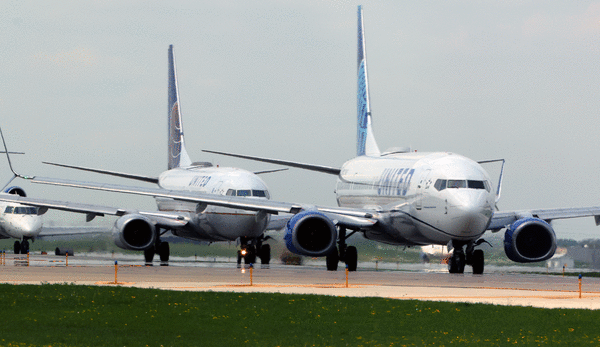
Anyone who has visited Chicago has heard locals loudly praise the city — with good reason. This summer alone, we’re flooded with visitors excited to see the new Obama Presidential Center, enjoy Taste of Chicago and Lollapalooza, or just visit the museums and hang out by the lake.
While it rarely makes the cut for Instagram posts, O’Hare International Airport is central to all of this. It’s the busiest airport in the world — and the nation’s only dual hub, with both American and United Airlines serving tens of millions of passengers a year. That dual hub also boosts airport jobs and investment, helps keep fares competitive and provides more air service options than other single-hub airports. The robust air service that results from the dual hub is one of the reasons global businesses and visitors choose Chicago, and why residents have easy access to flights around the world.
But lately, O’Hare has become known for something not so positive: It has the longest taxi times in the nation, which persistently contribute to delays, cancellations and all-around traveler frustration.
That’s why I was seriously concerned when, earlier this year, United Airlines published a summer schedule that would have ramped up flights to unsustainable levels, all but guaranteeing gridlock if not total chaos.
Thankfully, the Federal Aviation Administration stepped in to require flight cuts that preserved last year’s levels and ensured airlines did not exceed the airport’s available runway capacity. And this month the FAA made the wise decision to extend that freeze until Oct. 30, 2027, protecting holiday and future travel as well.
But it’s worth asking: With obvious capacity concerns, why was United pushing this plan in the first place? The answer is to attack that unique dual hub. United CEO Scott Kirby has said plainly that United would add “as many flights as are required” in its campaign against American, predicting the schedule surge would mean its competitor will “have to de-hub.”
Monopolizing the busiest airport might help one airline’s profits, but it would be a losing proposition for other stakeholders, including the city of Chicago, business attraction efforts and consumers in Chicagoland and throughout the country. The dual hub enables competitive fares and a multitude of options for travelers who only have so much time and money to spend on a vacation.
A functioning, efficient O’Hare is essential to bringing in the visitors who deliver significant economic benefits for our city’s businesses. According to Choose Chicago, the city welcomed 55 million visitors in 2024 who spent $20.9 billion, generating state and local tax revenues of $2.8 billion, which help fund vital city services. We risk losing visitors to other cities if fares, delays and cancellations rise from gridlock, or if we are reduced to a single hub with fewer options. And when visitors choose to go elsewhere, businesses lose out on billions in valuable spending. Even when passengers are just connecting at O’Hare, they will often buy food, drinks or other goods during their layover. This helps local businesses and generates valuable tax revenue.
As Nancy Rose, a former Department of Justice economic official, told a congressional panel last month: “Chicago has long benefited from competition between two hub airlines at O’Hare, giving them the benefits of that intense set of offerings, but constraining the anti-competitive effects, and I think the evidence shows that United seems to be working to reduce those competitive constraints. Unchecked, I think it could have enormous adverse consequences for Illinois travelers.”
The FAA’s freeze does not need to be permanent — thanks to billions of dollars of investment, O’Hare will soon have more capacity and be equipped for busier schedules. But in the interim, ruining Chicago summers, holidays and other travel isn’t worth it, no matter how much money United would make from forcing out the competition.
____
Ray LaHood was a Republican member of Congress from 1995 to 2009 and U.S. secretary of transportation under President Barack Obama from 2009 to 2013.
___
©2026 Chicago Tribune. Visit at chicagotribune.com. Distributed by Tribune Content Agency, LLC.

















































Comments