Editorial: Voters must demand candidates talk about debt
Published in Op Eds
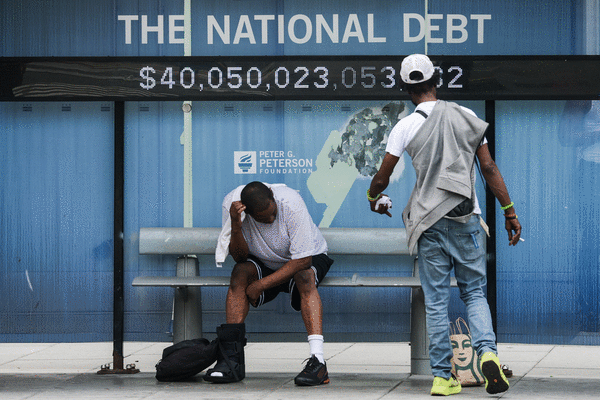
America's national debt climbed above $40 trillion for the first time on Thursday, Aug. 20, an obligation that is impossible to pay off and one that should be dominating the political conversation this season.
Let's put $40 trillion into perspective. If the debt were called today, it would require $116,800 to $119,907 from every man, woman and child in the country. The imprecision of the pay-off number is because it is constantly fluctuating due to the large amount owed.
Household income in the United States averages $121,000 annually. So it would take almost every dollar every American earns to get us out from under the burden in a year. Even if not another dollar of deficit spending is added to the total and the nation committed to paying off the debt over the next 20 years, it would demand payments of $2.69 trillion a year, more than one-third of all federal spending.
As things stand, servicing the debt requires $1 trillion a year of taxpayer dollars.
Deficit spending is one of the few things that unites Republicans and Democrats. So far in President Donald Trump's second term, $3.8 trillion has been added to the national credit card. During Joe Biden's presidency, the IOU increased by $8.4 trillion.
But so far in this election cycle, we haven't come across a single candidate who has made attacking debt and deficit his or her top priority.
Instead, Democrats are promising voters massive new entitlements such as Medicare for all and Republicans are avoiding the conversation about the cost of Trump's war with Iran.
If you're looking for someone to blame for this fiscal mess, look in the mirror. Voters reward politicians who promise them government cheese, and not those who talk about the sacrifice required to live within our means.
Those clinging to the notion that the problem would disappear if the wealthy simply "paid their fair share" are recklessly detached from economic reality. The non-partisan Joint Committee on Taxation calculates that the current top income tax rate of 37% is producing near-optimal results in terms of raising revenue through taxes without slowing growth.
Increasing the top rate, the committee estimates, would slow GDP growth, ultimately resulting in higher unemployment and less tax revenue.
Taxing the rich, as the Democratic Socialists vow to do, won't buy us any new goodies.
We don't have a revenue problem. Federal income has grown 3% so far this year, even with the 3.4% inflation rate. We have a spending problem. Federal outlays are up 5.2%
The only solution to a spending problem is to do what Trump promised and didn't deliver: Scrutinize every dollar the federal government spends and cut out every dime that isn't essential to the well-being of the nation and its people.
That's the debate we should be having in this election cycle.
_____
©2026 www.detroitnews.com. Visit at detroitnews.com. Distributed by Tribune Content Agency, LLC.



















































Comments