John M. Crisp: The USS Abraham Lincoln finally heads home
Published in Op Eds
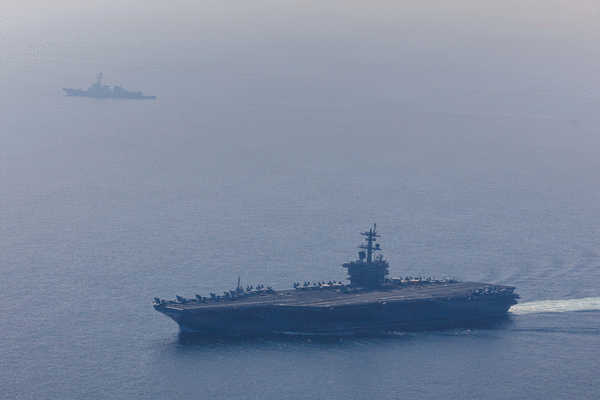
The USS Abraham Lincoln is on its way home. I feel some sympathy for its long-suffering crew, especially the young sailor who reportedly jumped over the side into the sea.
What kind of despair does it take to induce a mariner to step off the deck of his ship and plunge into the ocean?
I don’t know.
But I do know that in 1972 a sailor made his way from the depths of the engine room of the USS Bainbridge, carefully arranged his shoes on the deck and then stepped over the gunwale into the unfriendly waters of the South China Sea.
I didn’t know him. I was a radioman, and we topside sailors didn’t have much contact with the “nukes,” the science-minded sailors who operated Bainbridge’s nuclear reactor.
The ship’s scuttlebutt suggested that working conditions were challenging in the nuclear division. Or maybe the sailor was having long-distance troubles with his wife and family. Maybe he was struggling with depression or other issues. There’s no way of knowing.
But whatever his problems, they were likely considerably aggravated by life in the military and life at sea.
The transition from civilian to sailor or soldier, especially in the shadow of an unpopular war and a draft, is probably underappreciated by the public at large. It’s a demanding adjustment.
In 1969, a seaman recruit had a panic attack in our boot camp mess and had to be physically restrained. During our swim test, one hapless non-swimmer, pressured into deep water for perhaps the first time in his life, drowned. A few months later, in radio school, a young sailor flashed past our second-floor classroom window as he jumped from the third floor into the courtyard below.
Some sailors drank too much. Some took drugs. A few went AWOL.
But most young sailors and soldiers manage the transition. Still, deployment, especially at sea, takes a toll. Isolation, boredom, cramped quarters and unrelenting routine aggravate the considerable stress that accompanies many jobs on a ship at sea.
Some sailors—like me, when I was young—welcome going to sea. But after a few weeks, all sailors want a port call, and after a few months, all sailors long for their homeport, especially sailors with families ashore.
I was on the Bainbridge for 18 months; 15 were spent at sea. Underway, radiomen stood port-and-starboard watches: eight hours on watch and eight hours off, around the clock, seven days a week. Sometimes during “off” hours we were assigned to working parties.
But everybody works hard at sea. And every two or three weeks, the Bainbridge would dock in the Philippines, a break in the routine and a chance to get off the ship. We also knew that in six months we’d be headed home, with, maybe, a stop in Singapore, Hong Kong, Japan and Pearl Harbor.
And then there was the food. Napoleon said an army marches on its stomach; the Navy puts to sea with great food—I had my first lobster tail in the Navy! Apart from sailors jumping overboard, the most disquieting reports about conditions aboard the Lincoln involve food shortages. The Navy understands the connection between food and morale, and it works hard to make arduous voyages endurable.
Still, lobster tails and port calls can get a crew only so far. The Bainbridge’s longest stint without a port call was 45 days; by the time the USS Lincoln returns to San Diego, its sailors will have endured a 275-day deployment. That’s too long. This is incompetent logistical planning, the consequence of putting amateurs such as Pete Hegseth in charge.
President Donald Trump’s take on the USS Lincoln? It was more ham-handed than when—according to very reliable sources—he called the soldiers who died in World War I “suckers and losers.”
His response was as clueless as when he dissed the courageous John McCain by saying that he prefers war heroes who “weren’t captured.”
When Trump was asked if the USS Lincoln had been deployed too long, he said, “No, no, no. Not nearly long enough.”
But, Mr. President, how could you possibly know that?
_____
_____
©2026 Tribune Content Agency, LLC





















































Comments