Commentary: The 'war on fraud' is targeting the wrong crimes
Published in Op Eds
The Trump administration’s so-called war on fraud is, well, a bit of a fraud.
The White House earlier this year launched a task force to eliminate fraud, helmed by Vice President JD Vance. The administration even gave those efforts their own government website — “The Fraud Tracker,” where you can find data about federal agencies that are “crushing fraud in your direct vicinity.” But the Department of Justice appears to be using its dwindling resources to prosecute the wrong kinds of people and cases.
Rather than tackling large-dollar fraud cases that historically have been the focus of federal prosecutors, the DOJ is shifting its resources to smaller cases, such as food stamp fraud. One key marker of the new approach to white-collar crime is corporate fraud. For each of the past few years, the DOJ obtained guilty pleas from about 60 corporations per year, according to data obtained by the Wall Street Journal. This year to date, it’s been only 12.
Prosecutors now, in fact, have a quota requiring them to carry at least 25 cases at all times, the New York Times recently reported. That number may be reasonable for prosecutors who focus on simple, one-count cases, but it makes it virtually impossible for them to tackle long-term, complex cases. The quotas are a perverse incentive to go after low-hanging fruit, rather than sophisticated fraud schemes that can take months or even years to investigate. As Vance has said, “No fraud is small enough or big enough to look away from.”
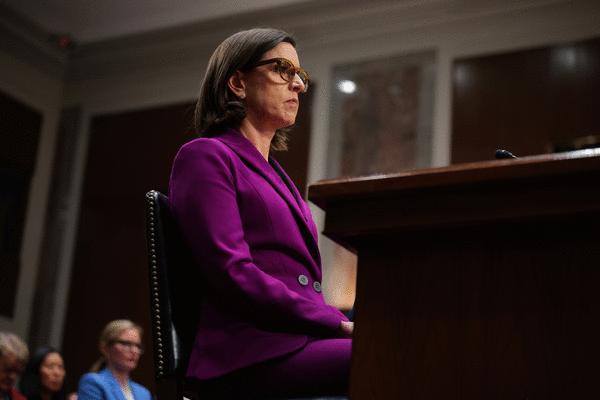
But looking at small fraud cases comes at the expense of big ones. When I served as a federal prosecutor for the Eastern District of Michigan from 1998 to 2017, under presidents of both parties, my office dedicated our scarce resources to larger fraud cases. We typically handled food stamp cases as civil enforcement matters rather than criminal cases. Small mom-and-pop businesses, such as gas stations and convenience stories, often ran these schemes. Owners would trade cash for food stamps from customers at a discount and then redeem them for full value. Handing off those crimes, which often amounted to thousands of dollars, left resources for prosecuting crimes that can reach into the billions.
My office also referred some low-dollar fraud cases to state attorneys general or local district attorneys. They have the capacity to effectively handle important but straightforward cases but lack some of the tools of federal prosecutors, such as wiretaps; nationwide jurisdiction; access to international resources; and, in most states, grand juries. These legal authorities allow federal prosecutors to conduct long-term investigations and amass evidence to take down large corporate schemes that would otherwise go unpunished.
When I served as a federal prosecutor… my office dedicated our scarce resources to larger fraud cases.
This shift in focus has also driven structural change. Since Trump took office for his second term, the DOJ has disbanded its National Cryptocurrency Enforcement Team, which investigated the use of digital currency to perpetrate fraud and money laundering. It has also limited enforcement of the Foreign Corrupt Practices Act, which prohibits bribery of foreign governments, and reportedly gutted the Public Integrity Section, which prosecutes corrupt officeholders.
The DOJ’s shrinking workforce has further diminished its efforts. Since Trump was sworn in for his second term, more than 20,000 employees, including one quarter of its attorneys, have left through firings, resignations and retirements, according to the Justice Connection, an organization founded by DOJ alumni.
At the same time as the administration is cutting back on complex fraud prosecutions, Trump has granted clemency to more than 70 defendants convicted of serious fraud schemes, according to the Times, such as Lawrence Duran, a Florida man who pleaded guilty to a $205 million Medicare fraud scheme for submitting bills for mental health services that were either unnecessary or never provided at all.
The DOJ has also dismissed corporate cases that had already been investigated and charged, such as the allegations against Halkbank, the Turkish financial firm accused of violating sanctions with Iran to tune of billions, and Boeing, charged with misleading regulators about the safety of its aircraft, after two of its 737s crashed in 2018 and 2019. Boeing had even agreed to pay a $1.1 billion fine before a plea deal was scuttled. Of course, it’s impossible to know all the reasons a case is dismissed, and in some instances, a dismissal is warranted. But it’s rare for cases to be dismissed after most of the hard work has already been done.
Sidelining the prosecution of corporate crime comes at a cost — and not just in dollars and cents. As a U.S. attorney, my office successfully prosecuted the automotive airbag manufacturer Takata Corporation for wire fraud that resulted in the deaths of 27 individuals and injuries to hundreds more. The company sold faulty bags to automakers, which installed them in cars. Takata’s conviction included a fine of $1 billion that was used to compensate victims.
Another case involved Volkswagen, which was convicted of fraud for falsely asserting that its diesel vehicles complied with federal emissions standards. In fact, engineers had designed a “defeat device” to cheat the testing process, concealing emissions as high as 35 times the legal limit. Volkswagen paid $2.8 billion in criminal fines, another $1.5 billion in restitution to consumers and was ordered to undergo monitoring to ensure ongoing compliance.
Holding wrongdoers accountable isn’t the only goal of prosecution, though. Another is deterrence — when would-be fraudsters see the steep price paid for violating the law, they can be dissuaded from engaging in similar criminal conduct. On the other hand, when such conduct goes unaddressed, bad actors are more inclined to pursue the money grab, to the detriment of consumers and competitors who play by the rules.
Allowing complex white-collar crime to go unpunished tends to normalize it and gives a symbolic green light to offenders who know that the likelihood of being charged is greatly reduced. When there is a perception that “Everyone is doing it,” then more do. Failing to aggressively pursue corporate fraud further creates the impression of a two-tiered system of government: one for the ultra-wealthy and another for the rest of us.
Perhaps former U.S. pardon attorney Liz Oyer summed it up best. She was fired after declining to restore firearm possession rights to Mel Gibson, a vocal supporter of Trump who lost those rights after abusing his girlfriend. Oyer told the Times, “The war on fraud seems like a war on specific fraud committed by a specific kind of people.”
____
This column reflects the personal views of the author and does not necessarily reflect the opinion of the editorial board or Bloomberg LP and its owners.
Barbara McQuade is a professor at the University of Michigan Law school, a former U.S. attorney and author of the forthcoming book, "The Fix: Saving America from the Corruption of a Mob-Style Government."
©2026 Bloomberg L.P. Visit bloomberg.com/opinion. Distributed by Tribune Content Agency, LLC.
















































Comments