Mary Ellen Klas: A voter enthusiasm gap is steering the midterms
Published in Op Eds
We’re near the end of the 2026 primary election season and the state of American democracy is looking — sigh of relief — better than expected.
As the Trump administration has trampled on the rule of law, tried to undermine elections and pursued a self-enriching agenda, Americans are pushing back and demanding change — from both parties. Democracy depends on trusting ordinary people to make consequential decisions and, this election cycle, voters have reminded us they’re doing just that.
Democratic voters have been especially engaged. In primaries and special elections in the last 18 months, they voted in numbers the party hasn’t seen in decades. Democrats broke voter turnout records in the key states of Wisconsin, Michigan, Texas and Georgia. They’ve made 37 safe Republican seats competitive and signaled a blue wave may be coming in November.
As of late June, about 12.6 million votes had been cast in Democratic House primaries, compared with 8.6 million in Republican primaries, according to a Washington Post analysis.
The reasons are many. Midterm elections always favor the party out of power. Highly educated voters are more reliable voters in primary and special elections than the rest of the electorate and, in the Trump era, these voters are more Democratic-leaning than the electorate at large. And perhaps the most obvious reason: Trump’s poll numbers are so low, his war with Iran is so unpopular and his handling of the economy is so disappointing that Republican voters are staying home.
But Trumpism — by which I mean the personalized, transactional, strongman way Trump governs — is also playing a role. While Democrats can run hyper-local campaigns, focused on their plans to address housing costs and gas prices, Republicans are yoked to a domineering president with unpopular policies. If they step out of the circle and criticize Trump, his war, or his policies, they get shamed by his shrinking base, called out by the president on social media, or confronted with a primary opponent backed by the president.
That’s all led highly motivated voters to support Democrats over Republicans 53% to 45% in recent polls.
This Democratic overperformance has already had results. The Down Ballot, an election analysis website, examined the results of 110 special elections since January of 2025 and determined that Democrats have done better than their 2024 margins by an average of 12.5 points.Of course, voter turnout in primary elections is not a perfect predictor of general election results, especially in key states like Pennsylvania, Iowa, Ohio and Florida, which have closed primary systems that strand millions of independent voters. In 10 states with semi-closed primaries, like North Carolina, unaffiliated voters can vote if they meet certain criteria. These independent or no-party-affiliated voters are likely to determine the outcome of key races across the country, and 47% of all Americans say they don’t consider themselves a part of either major political party.
“The big unknown moving forward is: To what degree are disaffected Trump voters going to show up and vote, and who will they vote for?” said Michael McDonald, a political science professor at the University of Florida who studies voter turnout. “We know that Republicans are less enthusiastic. We suspect that they’re not going to show up.”
And if that happens, he told me, it could be like the midterms of 2018 when Democrats had an 8.5-percentage-point margin in the national vote for Congress and picked up over 40 seats. (To clinch control of Congress in November, Democrats need to flip four House seats and four Senate seats. They’ll need those margins to hold.)
Aware of this, Republicans have attempted to mitigate some of the backlash. At Trump’s urging, they launched a national redistricting war that netted them, on paper, a six- to nine-seat advantage in the US House. But by creating more competitive districts, Republicans may have also inadvertently contributed to the turnout surge by giving Democrats more reason to participate.In Texas, for example, where Republicans redrew the map to give themselves five additional seats, more votes were cast for Democrats than Republicans in primaries for three of the five redrawn districts.
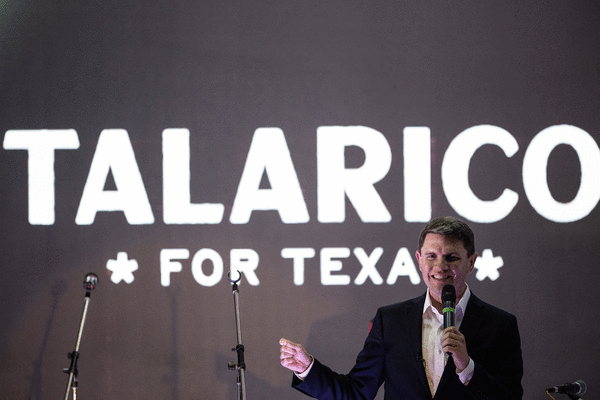
Meanwhile, Democratic candidates have made some calculated overtures to Republicans to demonstrate to swing voters they can straddle party differences. In Georgia, Democratic Senator Jon Ossoff was endorsed by the GOP mayors of Valdosta and Tifton. In Arizona, Democratic Governor Katie Hobbs named former Republican and Mesa Mayor John Giles as her running mate in her re-election bid. And in Texas, Democratic Senate candidate James Talarico hired a staffer from Republican Senator John Cornyn’s Senate office to serve as deputy policy director.
The 2026 field of Democratic nominees also reflects these pluralistic sensibilities. Voters have elevated Democratic candidates with a variety of views — from pro-Israel centrists to members of the Democratic Socialists of America. There may be risks to this for the party — as I’ve noted before, big tents can get big rips — but it’s surely better for elected officials to reflect Americans’ diversity of views than to merely repeat the talking points of one retributive president.
Republicans have already started to portray this election as a choice between the status quo and communism, labeling a socialist every Democrat who demands better healthcare, lower housing costs and affordable groceries. But to get people to turn out to vote, you’ve got to give them something to vote for. If Democrats listen to voters, they’ll conclude that voters don’t want the status quo. They want results.
____
This column reflects the personal views of the author and does not necessarily reflect the opinion of the editorial board or Bloomberg LP and its owners.
Mary Ellen Klas is a politics and policy columnist for Bloomberg Opinion. A former capital bureau chief for the Miami Herald, she has covered politics and government for more than three decades.
©2026 Bloomberg L.P. Visit bloomberg.com/opinion. Distributed by Tribune Content Agency, LLC.



















































Comments