Commentary: Mandatory service can renew young people's faith in America
Published in Op Eds
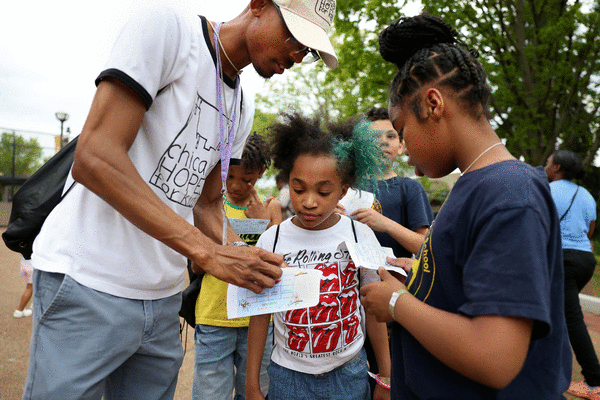
A transfer of wealth from young to old, an education system that ill-equips young people for today’s economy and technology platforms engineered to polarize us have produced a generation of Americans who no longer believe in America. According to Gallup, 75% of baby boomers feel very or extremely proud to be an American, compared with just 41% of Gen Z. We are raising the most isolated, anxious and disconnected generation in our history.
The solution is each other.
Just as the World Cup showed millions of visitors how wonderful America can be, a mandatory year of national service would show our own young people the same thing — while equipping them with the civics, skills and on-ramps to the middle class that a fractured education system and a polarized political culture have failed to provide.
Under our proposal, every young American would choose one of three pathways: an AmeriCorps-style civilian service, a new “Skills Through Service” program or military service.
As we mark 250 years of American independence, we rightly celebrate the accomplishments and uniqueness of this nation. In that same patriotic spirit, we must also confront what is pulling us apart.
Three compounding forces are dividing America, and national service would address all three: isolation, eroding trust in institutions and income inequality.
Isolation: This generation is lonelier, more anxious and more depressed than any before it. Young people are just not mixing anymore. National service would close that distance by physically bringing young people together, the way it did for the generation that returned from World War II having served alongside Americans of every background, geography and faith and went on to build the American century.
There’s reason to believe this works, and not just as nostalgia. Research shows that intergroup contact promotes national identity. A study of service members in Spain found that being assigned to military service in a different region substantially increases “self-identification as Spanish” and increases the likelihood of voting. Singapore pairs national service with integrated public housing, creating exactly the kind of structured contact between groups that a meta-analysis of more than 500 studies shows reliably reduces prejudice.
And one of the toughest critiques — that service damages mental health — doesn’t hold up. A 2025 study using nationally representative U.S. data found that military service was actually a protective factor against depression once researchers controlled for socioeconomic background. Service, it turns out, builds the very coping skills and sense of purpose that isolation erodes.
Eroding trust: Americans have lost faith in their institutions and increasingly channel that disillusionment into contempt for government itself. The youngest Americans now rank as the least patriotic in the country’s history. National service would reinvigorate civics — not the kind taught from a textbook, but the kind learned shoulder to shoulder with a fellow citizen who likely doesn’t share your ZIP code, income or politics.
Income inequality: Young Americans are being crushed by stagnant wages, soaring costs and a wilting middle class, as the country has presided over the largest generational wealth transfer in our history — from young to old. Meanwhile, we need millions of new skilled workers. Much as President Bill Clinton promised “100,000 new police officers,” America now needs 47,600 new welding professionals — annually — to replace retiring or departing workers. For every five welders retiring, only two are entering the field to replace them.
That is just one example. By 2030, over 1 million nurses will retire. We need a fresh generation of electricians, carpenters and teachers to meet the surging demand created by the artificial intelligence buildout and the reshoring of manufacturing.
The “Skills Through Service” pathway would fast-track the 60% of Americans who don’t graduate college — and many who do — directly into the jobs this economy actually needs.
Over time, our goal is to build a culture where the default question shifts from “Did you serve?” to “How did you serve?”
If we want our young people to love their country — and each other — again, the country has to invest in them first. That investment pays for itself: National service programs return an estimated $17 for every $1 the federal government spends.
Big ideas invite resistance, and this one will be no exception. America has a massive problem: a generation isolated by algorithms and divided by identity politics. Addressing it will require an equally big, but simple, idea: common experience. Ask one generation to serve, and the next 250 years have a fighting chance of looking like the best of the last 250.
We will release our full proposal in the coming months, and we’ll need voices from across American society to build it. Join us.
_____
U.S. Rep. Tom Suozzi represents Long Island and Queens in New York. He serves on the Ways and Means Committee and the Select Committee on Strategic Competition with the Chinese Communist Party, and is the Democratic co-chair of the bipartisan Problem Solvers Caucus. Scott Galloway is a professor of marketing at NYU Stern, a serial entrepreneur and podcaster, and the author of the No. 1 New York Times bestseller “Notes on Being a Man,” and he serves on the University of California Board of Regents.
___
©2026 Chicago Tribune. Visit at chicagotribune.com. Distributed by Tribune Content Agency, LLC.





















































Comments