Ronald Brownstein: The real reason moderates keep losing to progressives
Published in Op Eds
The tumultuous 2026 primary season has made at least one thing clear: Democratic centrists are pursuing a losing strategy in their struggle with the left. Until the moderates change course, they will remain on the defensive.
Almost without exception, centrist Democrats in competitive primaries this year have chosen to challenge only the viability, not the desirability, of the left’s core policy ideas. Hardly any centrists have tried to convince Democratic voters that progressive proposals such as abolishing Immigration and Customs Enforcement, creating a new wealth tax, and above all, establishing a government-controlled single-payer healthcare system are misguided. Instead, when moderates have addressed these ideas at all, they have argued that the proposals lack enough congressional support to win passage and enough public support to win elections.
There’s truth in both assertions. But opposing progressive ideas solely on feasibility cedes the inspirational high ground to the left. It allows progressives to position themselves as pursuing big, bold change — and to portray the centrists as incrementalists too timid or corrupt to challenge the status quo.
The centrists believe they are offering pragmatism, but the left’s strong primary showings make clear that many Democratic voters instead see defeatism.
The failure of the center’s approach is most evident in the Democratic debate — or lack thereof — over healthcare. The proposal to replace private health insurance with a government-run Medicare for All system is the central arch in the progressive policy agenda; Senator Bernie Sanders of Vermont, the spiritual father of today’s resurgent left, recently said M4A, as its advocates sometimes call it, stands as the “one litmus test” for his endorsement.
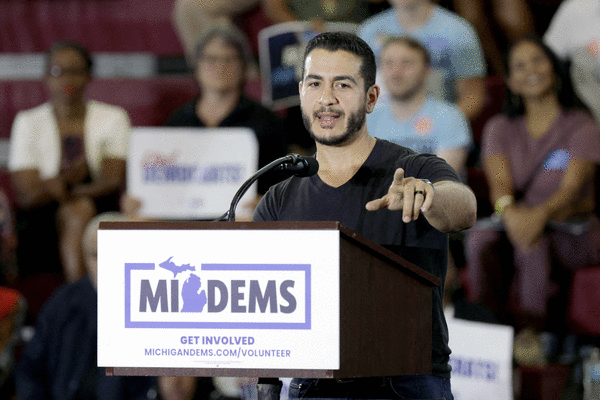
All the breakthrough progressive candidates in 2026 have endorsed M4A — including Senate nominees Abdul El-Sayed in Michigan, Peggy Flanagan in Minnesota, Angie Nixon in Florida and Troy Jackson (and before him Graham Platner) in Maine. House nominees in New York, Pennsylvania, Colorado, Montana and elsewhere have also thrown their weight behind it. These progressives all beat centrists who did not support single-payer healthcare.
But those centrists consistently chose not to contest the idea. Running against El-Sayed in Michigan, for instance, Representative Haley Stevens and her team concluded that talking about healthcare at all — even to critique his plans — benefited him, advisers tell me. That was typical.
But in choosing not to challenge the idea, the centrists left on the table powerful arguments against single-payer healthcare that are relevant to Democratic voters.
Those start with its cost. In 2019, the center-left Urban Institute calculated that single-payer plans like those promoted by Sanders and Senator Elizabeth Warren would increase federal spending by $34 trillion over the next decade. But now, Urban Institute senior fellow John Holahan says that because overall medical spending has increased so much since 2019, a Sanders-like single-payer plan today would cost well over $50 trillion in new spending over the next 10 years. (The cost is so high because single-payer plans would shift to taxpayers the roughly two-thirds of total national health spending now contributed by businesses, individuals and state governments.)
But the centrist refusal to engage on Medicare for All has allowed progressives such as El-Sayed to claim that implementing it would require Americans only to pay “a little bit more” in their payroll taxes.
“I have no idea how he can say that,” Holahan told me.
In fact, to cover M4A’s 10-year price tag, the federal government would need to nearly double the $58 trillion in revenue the Congressional Budget Office expects it to collect from both personal income taxes and payroll taxes over that period. There’s no way to raise nearly that much money just by taxing the rich.
And while some analysts believe middle-class families might still come out ahead with a single-payer plan that eliminates premiums, co-pays and deductibles, Kenneth Thorpe, a top healthcare official under former President Bill Clinton, has calculated that under such a system, about 70% of Americans would pay more in new taxes than they currently spend for healthcare.
Choice looms as another vulnerability for single-payer healthcare. Though some advocates, like El-Sayed, say they would allow private plans to exist alongside M4A, even many sympathetic policy analysts believe few such plans could survive against a nonprofit government competitor. Over time, that would undermine the generous health plans many unions have negotiated — which is why some labor leaders fervently oppose the idea. “Forcing everybody into one-size-fits-all,” for health insurance, says Ted Pappageorge, the secretary-treasurer of the powerful Culinary Workers Union in Nevada, “will guarantee the Republicans win the presidency in 2028.”
When Joe Biden and Pete Buttigieg aired these arguments against single-payer care in the 2020 Democratic presidential primaries, the idea rapidly deflated. Sanders and Warren struggled to explain how they would fund it. Several other contenders who initially endorsed the idea (including then-Senator Kamala Harris) backed away.
Single-payer skeptics also have a powerful new argument after watching Robert F. Kennedy Jr. rampage through the public health system. Democratic voters may now be understandably more leery of providing the federal government total control over what medical treatments health insurance will — and will not — cover.
And yet no Democratic primary voters this year heard any of these arguments against M4A. Nor did they hear why a wealth tax on assets might prove a convoluted and legally vulnerable way to raise more revenue than closing loopholes and raising rates on income. Nor why abolishing ICE would require a massive legislative fight that would inevitably end with the creation of another agency to do the same things.
Democratic centrists are formulating expensive plans to blunt the rise of the socialist left. They might start by finding more candidates, especially in the approaching 2028 presidential primaries, willing to debate whether the left’s ideas are really the best way to advance the party’s goals.
____
This column reflects the personal views of the author and does not necessarily reflect the opinion of the editorial board or Bloomberg LP and its owners.
Ronald Brownstein is a Bloomberg Opinion columnist covering politics and policy. He is a CNN analyst and the author or editor of seven books.
©2026 Bloomberg L.P. Visit bloomberg.com/opinion. Distributed by Tribune Content Agency, LLC.




















































Comments