James Stavridis: Saudi Arabia can break the Houthis' grip on the Red Sea
Published in Op Eds
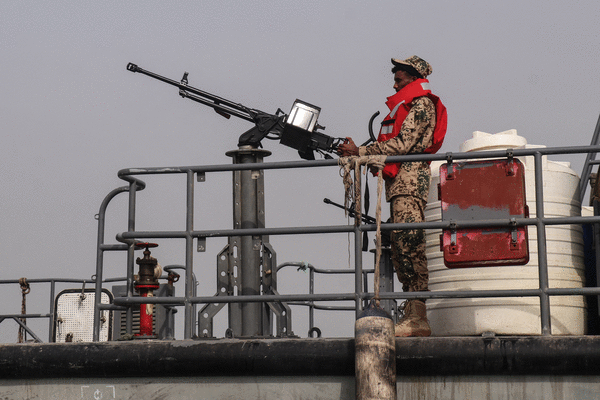
The Strait of Hormuz isn’t the only Middle Eastern naval chokepoint under threat: In the Red Sea, vital shipping is being disrupted by an Iranian proxy, the Houthis of Yemen. Now Saudi Arabia, the nation most affected by the Houthis’ threats to commercial traffic, is forming a naval coalition to restore order in the waterway.
What will this new group look like and what are its likely capabilities? Can it be more effective in keeping the Red Sea open than the U.S. has been in protecting shipping through Hormuz? And will America and its European allies inevitably have to play a role?
The civil war in Yemen has been raging for over a decade, and Saudi Arabia (as well as the United Arab Emirates) has been intermittently involved in combat against the Houthi rebels. Now Iran wants to put greater pressure on the Saudis, the U.S. and Israel, so it has encouraged the Houthis to blockade and threaten attacks on Saudi supertankers carrying crude oil south through the Bab el-Mandeb Strait or north through the Suez Canal. These ships carry a significant percentage of the world’s petroleum products, up to as much as 15% since the Strait of Hormuz crisis began, and the route handles up to 30% of containerized shipping.
I’ve sailed the Red Sea many times. It is normally a sleepy leg in a transit from the Mediterranean to the crowded, high-tempo Persian Gulf. When I was a destroyer captain in the 1990s, the 1,300 nautical miles around the Arabian Peninsula were an excellent time for planning and training for combat. It was hard to imagine that someday they would become such dangerous waters.
The Saudi coalition has drawn an interesting mix of partners. According to an announcement following a meeting last week in Riyadh, 14 of the nearly 50 countries and organizations at the gathering signed on. These range from large naval powers — including Egypt, Turkey and Pakistan — to a collection of small but capable maritime forces from Arab states including Kuwait, Bahrain, Qatar and Jordan.
The Gulf Arab navies have demonstrated, in U.S.-led exercises and operations by the Gulf Cooperation Council, that they are comfortable working together. But it’s the Saudis who have to take the lead, and logistical support from their Red Sea bases will be the backbone of the effort.
Saudi Arabia has more than 30 modern warships manned by well-trained sailors, including guided-missile frigates, corvettes and patrol craft. Its air force has a dedicated maritime component and a strong helicopter wing. The problem, however, is that Saudi ships are split between an eastern fleet in the Persian Gulf and a western fleet based in Jeddah on the Red Sea. The latter will have to suffice for now.
Egypt, which has a major interest in keeping the profitable Suez Canal routes open, has perhaps the largest navy in the Arab world, including two Mistral-class helicopter carriers and eight submarines.
Turkey has a very modern blue-water fleet, with at least 10 diesel submarines, 17 frigates and nine corvettes. Its massive amphibious assault ship, TCG Anadolu, is considered the world’s first operational drone carrier, and has significant command-and-control capabilities. It could quickly deploy through the Suez Canal to serve as the flagship for the Red Sea operation.
Pakistan, which often cooperates with the Gulf Arab states on military and other issues, has around 10 good-sized frigates with air-defense capability, five modern diesel-electric submarines, and a capable maritime patrol wing. Kuwait, with a sizeable fleet of high-speed patrol craft, and Bahrain, which has two Oliver Hazard Perry-class frigates that were formerly in the U.S. Navy, are constrained by the blockades at Hormuz.
Notably absent from the coalition is the United Arab Emirates, which has several dozen warships including advanced corvettes and patrol craft well suited to patrol the Red Sea. But the Saudis and Emiratis have been feuding for several years, and the UAE currently has its hands full with Iranian drone and missile attacks. Oman, which often mediates in Middle Eastern conflicts, hasn’t signed on either.
So how would this coalition work? First would come a major intelligence-collection effort, mapping the Houthis’ operational patterns from the Bab el-Mandeb up to the central Red Sea, and tracking their missile and drone launches. This would best be accomplished with help from the U.S. satellite constellation and the EU naval task force in the region, Operation Aspides.
Next comes establishing a centralized intelligence operation, either aboard the Anadolu or ashore at the Saudi naval base in Jeddah. This could be staffed by experienced naval and marine officers from across the coalition, with the U.S. and EU providing liaisons to help coordinate the multinational staff. Such an operations center would organize real-time responses and longer-range planning, and coordinate air traffic control for maritime patrol planes.
Then there is the most practical step: deploying high-speed patrol craft to help shepherd the huge tankers into convoys. Each grouping would also have at least one guided-missile frigate in company. The commercial ships themselves could embark small defense teams — perhaps a company of around a dozen sailors or marines led by a lieutenant, with shoulder-fired air-defense weapons and .50-caliber machine guns to repel boarders.
This unlikely coalition should be capable of all these tasks — if it is well led by the Saudis with some help from the U.S. and EU. The question is whether this maritime approach alone would sufficiently deter the Houthis and their Iranian backers. If not, the next step would be air attacks on Houthi bases ashore, which risks retaliation and escalation. The western front in the Iran war is getting more heated; the question is whether the Saudis and their new partners can cool things down enough to keep the Red Sea open.
_____
This column reflects the personal views of the author and does not necessarily reflect the opinion of the editorial board or Bloomberg LP and its owners.
James Stavridis is a Bloomberg Opinion columnist, a retired U.S. Navy admiral, former supreme allied commander of NATO, and vice chairman at Carlyle.
_____
©2026 Bloomberg L.P. Visit bloomberg.com/opinion. Distributed by Tribune Content Agency, LLC.





















































Comments