Commentary: Don't curtail access to weight-loss drugs
Published in Op Eds
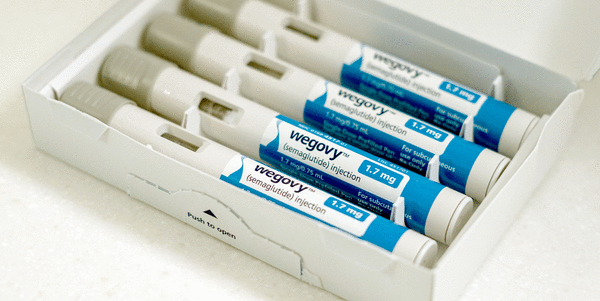
Last November, a patient of mine — 19 years old and established in our primary care clinic in Massachusetts — came in for her annual physical. She’d done everything we’d asked for her chronic obesity. She’d traded the bus for a mile-long walk to school, every day, both ways.
She and her grandparents, who do the family’s grocery shopping on an EBT card, had stretched what they could afford into more balanced and nutritious meals. Yet the number on the scale hadn’t moved. She asked, quietly and with exhaustion, if there was anything else we could try.
There was. But getting there wouldn’t be simple. Before MassHealth, Massachusetts’s Medicaid program, would even consider a prior authorization for a GLP-1 medication, it required an initial six-month trial of phentermine — a clinical cousin of amphetamines. This step-therapy trial was required despite the 2026 American College of Physicians guideline recommending GLP-1s as the first-line treatment for obesity, ahead of phentermine, on the basis of both superior efficacy and toleration. So, if only as the means to an end, we started phentermine.
My patient returned in May having taken phentermine at the highest dose she could tolerate. To neither of our surprises, her weight remained unchanged. She was finally ready — clinically and bureaucratically — for the medication most likely to help.
And that’s when we heard that MassHealth would stop covering GLP-1s for obesity entirely, effective July 1, 2026. Massachusetts is not alone — from 2025 to 2026, an estimated 12 million Americans lost coverage for Zepbound and another 12 million lost coverage for Wegovy. Only 13 state Medicaid programs covered GLP-1s for obesity at the start of 2026, down from 16 the year before.
But here’s the thing: When effective medication disappears, patients don’t stop needing treatment. They find another way. And the way that many people have been finding it is dangerous. Up to 2 million Americans received compounded versions of semaglutide — cheaper, unregulated copies produced outside the FDA approval process — between November 2023 and November 2024.
As of early 2025, the FDA received more than 455 adverse event reports linked to compounded semaglutide. Many of these involved dosing errors from patients who are self-administering incorrect doses; some of these errors led to hospitalization.
The FDA has since submitted a proposal that would close the last remaining legal pathway for large-scale compounded GLP-1 production. The cheaper drugs that millions of patients have come to rely on are disappearing from the market, with nothing safe and affordable to replace them.
Other patients are rationing doses across two or three weeks, undermining their clinical effectiveness. Some are simply stopping, leading to what studies show is rapid regains, with patients recovering 60% or more of lost weight within a year of discontinuation, along with reversal of the metabolic benefits gained during treatment.
America has always been better at treating disease than preventing it, and GLP-1s have exposed that logic at its starkest. Medicaid will cover a patient’s diabetes once they develop it. It will cover bariatric surgery, an invasive and permanent intervention, while refusing to cover the medication that could make bariatric surgery unnecessary for many patients.
This isn’t an oversight. It’s written into law. A federal statute explicitly allows Medicare and Medicaid to preclude coverage of any drug “used for anorexia, weight loss or weight gain,” a provision designed decades ago for amphetamines and appetite suppressants with limited evidence and real risks.
Congress and the U.S. Centers for Medicare & Medicaid Services have since interpreted that exclusion to apply to GLP-1s. That makes treatments which reduce cardiovascular mortality by 20 percent and produce weight loss comparable to bariatric surgery legally inaccessible to the patients who need them most.
A system that covers the consequences of a disease while refusing to cover its treatment isn’t making a cost-effective decision. It is simply moving costs downstream — into emergency rooms, dialysis centers and cardiac units — where they are larger, harder to reverse and paid by future budgets. Congress should remove that exclusion and treat obesity the way we treat every other chronic condition — before the complications arrive, not after.
My 19-year-old patient doesn’t have diabetes or chronic kidney disease or heart disease yet. She came to us early, while prevention was still possible, and did everything we asked. The system is waiting for her to get sicker. She shouldn’t have to.
____
Shria Bucha is a third-year medical student at Harvard Medical School and a health policy researcher at the Program on Regulation, Therapeutics and Law at Brigham and Women’s Hospital. She also serves on the board of Healthcare for Action. This column was produced for Progressive Perspectives, a project of The Progressive magazine, and distributed by Tribune News Service.
_____
©2026 Tribune Content Agency, LLC.



















































Comments