Commentary: Women's pro baseball returns, built on the shaky foundation of Title IX
Published in Op Eds
The last at bat for my mom, Helen Callaghan, in the All-American Girls Professional Baseball League was in 1949. She was a speedy center fielder playing for the Kenosha Comets, and sports writers of the ’40s called her the “Feminine Ted Williams.”
On Saturday, in the debut of the Women’s Pro Baseball League, I watched a new generation of pioneers pick up where the original league left off more than 70 years ago. The Los Angeles Queens took on the New York Heights in the opening game, in Springfield, Ill. The Queens — named after Lizzie Murphy, who played against male professional ballplayers in the 1920s and called herself the “Queen of Baseball” — won 10 to 8 with a thrilling comeback in the last inning. Two other teams complete the league: the Boston Hunters and the San Francisco Firebells.
Maggie Foxx, a 20-year-old outfielder for the Queens, told me before the game that playing pro ball felt surreal. “It’s the culmination of everything I’ve worked towards, and this league will have a tremendous impact on younger girls because we are role models that can inspire them,” she said. On Saturday, Foxx drove in two runs in her first professional at bat.
Many presidents and pundits have long admonished athletes to leave politics at the locker room door — “Just dribble” or “play baseball and keep your mouth shut” have been common refrains. The desire for sports to be a respite from a socially polarized world is understandable, but in the case of women’s athletics, we should not ignore the fact that the Women’s Pro Baseball League exists because of a decades-long political struggle that continues.
Growing up, I witnessed the birth of Title IX, the federal civil rights law signed by President Nixon in 1972. The law said that “No person in the United States shall, on the basis of sex, be excluded from participation in, be denied the benefits of, or be subjected to discrimination under any education program or activity receiving Federal financial assistance.” The law was bolstered by a thriving feminist movement and a broader recognition that tens of thousands of female athletes were just waiting for the opportunity to join a team.
Some school districts and colleges embraced the law enthusiastically while others dragged their feet. Thousands of women’s teams were formed and new facilities were built to accommodate the girls who flocked into competitive sports. Girls showed they loved competition as much as boys did.
Justine Siegal, the commissioner of the Women’s Pro Baseball League, was one of those young women. “I don’t know what I would be without Title IX,” she said. “Sports are my whole life, and Title IX forced institutions to create more opportunities for girls to play, and I’m filled with gratitude about that.”
According to a progress report published by the Women’s Sports Foundation, a nonprofit founded by tennis champion Billie Jean King, only 7% of the high school athletes playing a varsity sport in 1972 were female. Over the next 10 years, there was a 500% increase in female participation in high school sports rising to 1,780,000 participants during the 1982-83 year, according to the National Federation of State High School Assns. The same report shows that during the 2024-25 academic year, the number of girls on high school sports teams had risen to over 3.5 million nationwide, 43% of the total participants.
Some of those girls recently graduated high school and are now paid to play baseball. Foxx started for two years as a catcher on her New Hampshire high school varsity baseball team before moving on to play softball at Brown University in Rhode Island. At Brown, she took a class in the history of Title IX. “History is understanding that past and how it has shaped the present,” Foxx reflected.
Despite all of the progress in women’s sports, with fans filling college and professional basketball arenas to watch women play, four women’s soccer World Cup championships for the U.S. and girls flag football exploding in California high schools, there are strong conservative forces attempting to turn back the clock.
In a recent article published by the conservative Heritage Foundation, researcher Scott Yenor argues that Title IX is a failed experiment in “feminist social engineering” that is designed to erase “genuine differences between the sexes” that are a product of human nature. This sinister plot, Yenor announces, has produced women who are “aggressive, assertive, dominant” and less inclined toward motherhood.
Legal battles against Title IX could undermine the proportionality standard that has anchored compliance for decades: Athletic opportunities should roughly match each sex’s share of student enrollment.
Title IX attorney Linda Correia, who recently settled a discrimination case at Christopher Newport University in Virginia, agrees that significant progress has been made, but the battle over interpreting and implementing Title IX is ongoing. “The vast majority of people may have embraced female participation in team sports, but there are places in the country where it’s still very much an uphill battle,” she said. “Often schools that are struggling with limited resources pit one group against the other and make a decision not to provide resources to women’s athletics.”
Yenor wants regulatory changes that would make dance, yoga and exercise classes qualify as meeting the athletic opportunity requirements of Title IX. Backed by well-funded conservative legal organizations, the long-term litigation strategy is to engineer a test case that reaches a sympathetic Supreme Court that could dismantle Title IX’s proportionality standard.
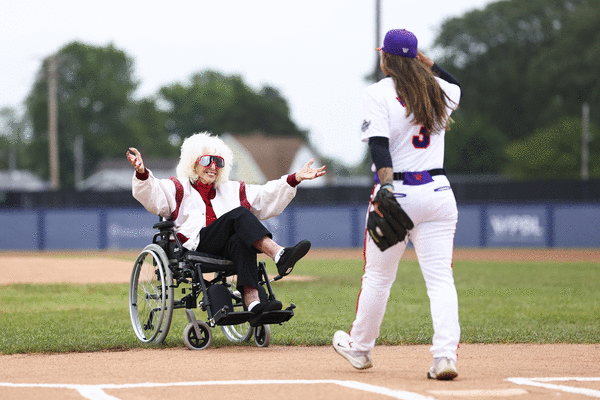
In Springfield on Saturday, a sold-out crowd watched 99-year-old Maybelle Blair, who played in my mother’s league, throw out the first pitch from her wheelchair. “This is a dream come true. Ever since our league folded in 1954, I’ve been waiting for this day,” she said. “These players are wonderful, but they have to keep their head on straight and keep this league going because the good ol’ boys want women to play softball not baseball,” she added. “And I don’t think there is going to be any crying in baseball on the field today.”
My mom passed away in 1992, the same year the movie about her life, “A League of Their Own,” appeared in theaters. She wasn’t a self-described feminist or any kind of political radical, but she came to understand the purposes and goals of the fight for women’s rights. She understood that social rights that took decades to win could be taken away a lot quicker.
Siegal, the new league’s commissioner, says Women’s Pro Baseball is already planning for next season, but it’s not guaranteed. The league will need a continuing pipeline of athletes — as Title IX has created.
“I know it’s a cliché,” said Foxx, the Queens outfielder, “but all we want as women ballplayers is a league of our own.”
____
Kelly Candaele produced the documentary “A League of Their Own.”
_____
©2026 Los Angeles Times. Visit at latimes.com. Distributed by Tribune Content Agency, LLC.





















































Comments