Commentary: The Fed needs to start listening to normal people
Published in Op Eds
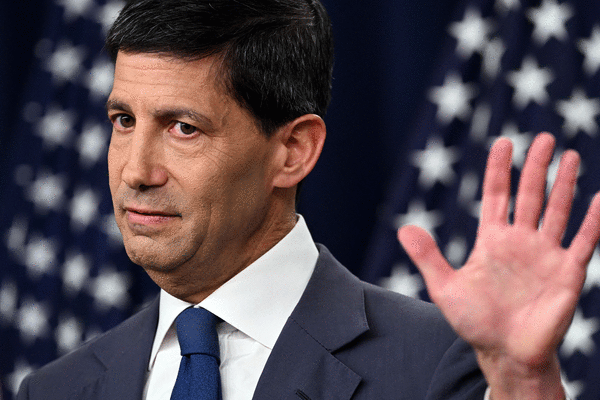
In his campaign to remake the Federal Reserve, Chair Kevin Warsh has engaged what he calls the “very best minds.” Yet there is a conspicuous absence from the various task forces he has created: anyone representing regular people or labor organizations.
Fortunately, the Fed does not need a new task force to hear from the public — it just needs to listen to the Americans it is already talking to. Unfortunately, the signals they’re sending are not very encouraging: consumer resilience purchased through costly adjustments, a “stable” labor market that workers experience as survival, and early signs of wages chasing prices.
The Fed has a variety of ways to gather public input, and it is very good at using these conversations to reveal macroeconomic trends. The Beige Book collects what businesses and community organizations see every day. Community development staff run in-depth studies of low- and moderate-income families. Presidents of the 12 regional Fed banks test their outlook with local leaders.
The most recent Beige Book adds texture to several themes in the aggregate data. One is how consumers are adjusting to increased prices. Some costs are direct: Nearly half of the regional Fed banks reported that consumers were taking on more debt to make ends meet. Atlanta highlighted buy-now-pay-later loans, Boston flagged the added use of “credit card debt to pay for essential goods,” and St. Louis noted more “small-dollar loan activity to highly cash-constrained customers.” Other costs are indirect: consumers in Atlanta “buying less but shopping more frequently,” people in Boston “trading down” to chicken and pork from beef. The time and effort that people put into managing higher prices wears on them and helps explain how resilience coexists with frustration.
Overall resilience masks the growing strain on the buffers lower-income households depend on. The pickup in inflation this year, especially higher energy and food costs, has coincided with reductions in federal and state assistance programs. The Dallas Fed reported that a local nonprofit faced demand for food assistance that “surpassed levels experienced during the financial crisis and the pandemic.” Similarly, a nonprofit in St. Louis said demand for food rose about 30% over the past two months. If these buffers break, the resilience could be short-lived.
The Fed’s Worker Perspectives report, based on 11 focus groups held late last year with workers with household incomes at or below the median, shows the potential downsides of a “stable” labor market in a way that neither the trend in payrolls nor the unemployment rate can.
Rather than “stable,” they described their work lives as “survival.” Those who had jobs were thankful to have their paychecks, but as one remarked, “Life is kind of like always been a struggle for me … always looking for ways to make money or get by or feed myself.” Rising prices are more common than rising wages: “Sometimes when you get a job, salaries are frozen for two or three years. Meanwhile, expenses keep rising, and you keep chasing the same salary for a while.” A stable paycheck doesn’t guarantee comfort.
The most dire views, though, came from those without steady work — the unemployed and participants in the gig economy.
The coping strategies of workers in the prior 2022 report were different. Rising prices were a strain then, too, but workers were switching jobs to find higher pay. That shift is also seen clearly in wage data split between job stayers and job switchers.
With few opportunities and more uncertainty, workers are “staying put.” That limits people’s ability to climb the career ladder, and it may mean lower job satisfaction. As one person said: “Hey, I need to work. So in order to work, there are some things I’m going to have to deal with [on the job] that I would not ordinarily deal with.” Otherwise, the strategies for dealing with higher prices were much like those in the Beige Book: shopping around for deals, taking on debt, and relying on assistance programs.
Conversations that the regional Fed presidents have can also shape their economic outlook. Aggregate data offer a critical read on where the economy is, but these discussions can alert them to emerging trends and risks to the outlook.
Lorie Logan, the Dallas Fed president and one of the three dissenters last week in favor of a rate increase, made her case earlier this month by appealing to conversations with local business leaders. She voiced concerns that the labor market might be poised to amplify energy- and tariff-driven inflation, saying that “CEOs at a few Texas companies have told me they are raising workers’ pay to help them manage a higher cost of living.”
Of course, US monetary policy cannot hinge on a few companies, and those pay raises sit uneasily beside the frozen salaries workers described in the focus groups. But she also pointed to the Dallas Fed’s latest Texas Business Outlook Surveys, which show “a pickup in actual and projected wage growth.” That’s not dispositive of a US wage-price spiral, but against the backdrop of elevated inflation for five years and counting, it illustrates an upside risk. Last year, the Fed cut rates in response to a downside risk to employment; it makes sense to monitor upside risks to inflation now.
The Fed is a data-driven institution, and its data reach well beyond the aggregate statistics — many of them gathered by the regional banks themselves. One voice from the focus groups deserves a wider hearing: “Everything has gone up in prices. I don’t understand why they say that inflation is not a thing, because it is a thing.”
The Fed decided last week that its response to this sentiment was not to raise rates, and offered almost no explanation. But it needs to show that it has heard: Inflation is a thing, and controlling it is the Fed’s responsibility. The very best minds on inflation include the people paying the higher prices.
____
This column reflects the personal views of the author and does not necessarily reflect the opinion of the editorial board or Bloomberg LP and its owners.
Claudia Sahm is the chief economist at New Century Advisors and a former Federal Reserve economist. She is the creator of the Sahm rule, a recession indicator.
©2026 Bloomberg L.P. Visit bloomberg.com/opinion. Distributed by Tribune Content Agency, LLC.



















































Comments