Commentary: Mail-in ballots are still under attack. Mobile voting can protect access to the ballot box
Published in Op Eds
Late last year, I became CEO of The Mobile Voting Project. Previously, I served as chief of staff to two United States senators, chief of staff at the U.S. Department of Education, and chief of staff for Vice President Kamala Harris's presidential campaign. At every step in my public service career, I have always had one clear goal: making government work better for everyday people.
I believe that we cannot make government work better if we do not start at the very foundation of our government itself: democracy and voting. In my current role with The Mobile Voting Project, we are focused on making voting more seamless, secure, and accessible. We believe that putting democracy — literally — into the palms of every American’s hand is how we can boost turnout, reduce extremism, and strengthen our democracy.
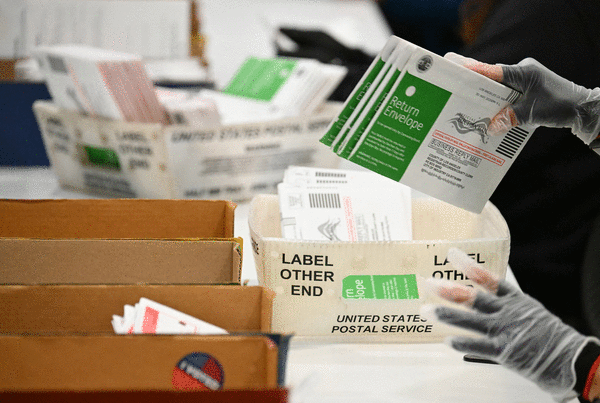
Our efforts are even more critical as the main option for accessible voting right now — mail-in ballots — is under attack. President Donald Trump has issued multiple executive orders aiming to restrict vote-by-mail.
One of these orders seeks to turn the U.S. Postal Service into a political arm that can decide who can and cannot use a mail-in ballot. It would require the USPS to create a federal list of approved voters and only permit states to send ballots to these voters. Considering this is such a radical overhaul to how we vote, it is no surprise that a federal judge recently blocked the order from taking effect. Yet Trump has appealed, demonstrating how dead set he is on making it harder to vote by mail.
At the moment, it seems as if the only guardrail protecting accessible voting is the judicial branch. But it remains fragile. In late June, the Supreme Court, in a narrow 5-4 decision, upheld state laws that allow for mail-in ballots postmarked by Election Day to be counted after. While this is good news, if just one justice had ruled the other way, millions of mail-in ballots could have been invalidated and millions of Americans disenfranchised in upcoming elections.
Imagine you are serving in the military, defending our democracy abroad, a rural voter living far from an in-person poll site, or a home-bound voter with limited mobility. You have applied for a mail-in ballot. You fill it out before Election Day and find the time to physically send it back to your local Board of Elections. But through no fault of your own, delivery is delayed, and your ballot arrives late. The Supreme Court could have invalidated your ballot and disenfranchised you.
But what if there was a way for Americans to vote from wherever they are, no matter their circumstances, without relying on the postal service? The solution is secure smartphone voting.
Mobile voting isn't a radical idea from the future. Millions of Americans already conduct highly sensitive transactions, from banking to healthcare, on their phones every day. Mobile voting is an option in Canadian local elections and has been piloted for limited groups of voters in dozens of states in the U.S., like for voters in the military from West Virginia or Utah.
In April 2026, some cities in Alaska used a version of mobile voting in their local elections too. And the results have been promising. Turnout skyrocketed in a water district election in Seattle. One hundred percent of voters preferred mobile voting over other methods in Denver.
With recent advancements in technology, we are now at a point where we can safely expand mobile voting to many more voters and cities. The technology that exists is end-to-end verifiable and end-to-end encrypted. It verifies voter identity in the same ways it’s done at poll sites, whether through a signature match or ID verification. Every ballot cast on a smartphone would only be tabulated once taken offline at the Board of Elections, and a paper copy is printed out and mixed among traditional mail-in ballots.
While mobile voting is an important additional option and never a replacement for all the other ways we vote now, it can uniquely meet the realities and challenges of modern life in ways that other methods cannot. It's for the nurse who works a double shift on Election Day. Families displaced by wildfires or hurricanes who cannot access their mail or poll site. The person recovering from surgery who is in an extended hospital stay. Blind voters who cannot fill out a mail-in ballot but have accessibility tools built into their smartphones.
Right now, our organization is working in cities and states to provide mobile voting as a secure additional option in municipal elections. We believe that starting small, and in elections that have long suffered from much lower turnout than presidential contests, is where we can have the greatest impact and build public trust as we grow.
Mobile voting is an overdue evolution of how we vote and ensure access. If we want our government to work better and a democracy that is fully representative, we need to build voting systems that meet people where they are. Mobile voting is how we do that, and especially in light of the attacks on voting, we are working to make it a reality.
____
Sheila Nix is the CEO of The Mobile Voting Project, a nonpartisan nonprofit working to make secure mobile voting an option for all Americans. With nearly three decades of leadership in political, domestic policy, and innovative nonprofit operations, Sheila previously served as Chief of Staff to Vice President Kamala Harris, Chief of Staff at the U.S. Department of Education, and U.S. Executive Director of Bono’s ONE campaign.
_____
©2026 The Fulcrum. Visit at thefulcrum.us. Distributed by Tribune Content Agency, LLC.

















































Comments