Martin Schram: De-faking the news
Published in Op Eds
We’ve all got the same problem these days. No matter which news screen we are watching – or which news silo site our screen is tuned to – we are finding it is harder than ever to tell the trustworthy newsmakers from the news-fakers.
Everyone on every news screen seems to have an angle these days. And we need to admit there’s one thing more: Too many of my journalistic colleagues just don’t seem as good as they need to be at making sure today’s newsmakers are showing and telling it like it really is.
That’s why we need to scroll back a couple of weeks and take a fresh look at a recent news-making happening. It was a moment in which solid journalism pierced what was about to become yet another trial balloon of opinion-warping fake news – just as it was being made. And frankly, most in my business seemed to have missed the significance of the moment. Which means you may have, too.
So let’s look back at what happened back on Sunday, July 19, on CBS News’ Face the Nation. Perhaps it will help both Washington’s newsmakers and news-chroniclers recalibrate how we do our jobs.
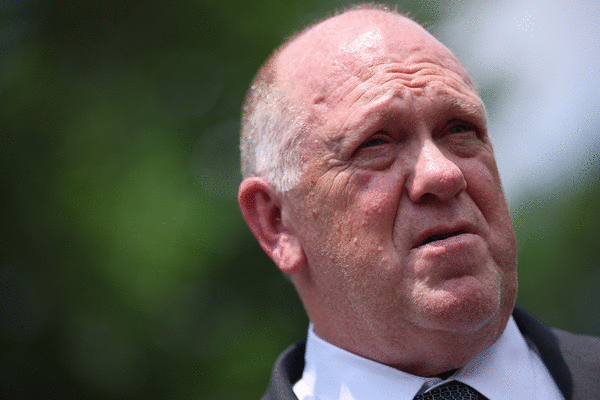
Moderator Margaret Brennan was interviewing President Donald Trump’s White House border czar, Tom Homan. (Yes, it’s really his title.) Homan clearly came to the interview locked and loaded with talking points intended to convince Americans that agents of Immigration, Customs and Enforcement (ICE) are misunderstood and underappreciated.
Homan, who formerly commanded ICE and may well have been born looking like the tough no-nonsense enforcement guy he is today, started by blaming the violence on politicians who say bad things about good ICE agents. Brennan started by truth-checking each of Homan’s assertions.
“I've done this since 1984,” Homan began. “My concern is… a lot of the rhetoric (from) … members of Congress saying ICE isn't a real law enforcement agency… emboldens some people to say, ‘I'm not going to comply with ICE.’ And I think no matter what people think of ICE… no matter what you think of immigration law, you should always comply with law enforcement.”
“Yes,” said CBS moderator Brennan, “but in the shootings in both Houston and Maine, the people who were killed were not the intended targets… These were fatal shootings… And in Houston, it was an unmarked car. So, when you're saying, don't resist, these individuals who were chasing the man who died… didn't have markings on that vehicle that would allow (the driver)… to know that they were ICE.”
“No, they have emergency lights,” Homan quickly countered. This was the first of several times he would insist the unmarked ICE car had flashing enforcement lights.
They are talking about the July 7 killing in Houston of Lorenzo Salgado Araujo, 52, a Mexican national who had been building homes in Houston for many years. He was driving his three-man crew in a white van. ICE agents were looking for a different Latino man in a different white van. But when they saw Salgado Araujo’s van in the same neighborhood they began aggressively tailing him in their two unmarked black SUVs. They caught him. He was killed by a gunshot to his right side. But we’ve seen no video of what happened.
Later Homan added suspects would “be alive today if they simply complied (when) stopped by federal law enforcement… If you don't think you're being treated right and (they) had no reason to stop you, then… take them to court. Just sue. Get a lawyer and argue in court.”
Brennan noted that “the family of the man in Houston said… he thought he was being robbed because it was an unmarked vehicle.”
“They had emergency lights,” Homan insisted yet again. “They activate emergency lights. Blue lights.”
Brennan challenged the czar: “You've seen that on video? Because we haven't?”
“Seen what on video, ma'am?” Homan asked.
“That there were lights,” Brennan replied. “Because in the videos that we've seen, there aren't. And because there weren't body cameras, it is hard to substantiate some of what you are saying.”
For the first time, Homan looked like a border czar who realized he hadn’t done his homework – and he was about to get caught. To his credit, Homan owned up to the inevitable.
“Well, I have not seen the videos,” Homan admitted. “Now, if they didn't activate the lights … then there's an issue there... So, let me just caveat that. They should have been equipped with lights and sirens. So, I do not know specifically if they activated those lights.”
This became a significant journalistic moment for Brennan and CBS News. But it fell just short of being game, set and match. It’s a reality I discovered way back in the late 1980s, while reporting for a book I wrote, “The Great American Video Game: Presidential Politics in the Television Age.” Back then, television journalists often overlooked the reality that they had one journalistic advantage that print and radio journalists just don’t have: They are TV.
Time and again, I saw that video images left influential impressions on voters that seemed to last forever. Brennan had done her pre-interview homework. She saw the videos from private security cameras: Two black SUVs chasing one white van – and no flashing blue lights on either unmarked ICE vehicle.
This was a made-for-TV news-making moment. CBS missed a chance to end its show by simultaneously showing Homan– and all of us – the video Face the Nation’s moderator had seen.
Better yet, this deserved to be a split screen moment. On the left: the unmarked ICE vehicles chasing through Houston with no lights blinking. On the right: Homan’s face as he realized the nation had just witnessed visual proof that the Trump border czar’s main news-making talking point did not have the added virtue of being true.
_____
_____
©2026 Tribune Content Agency, LLC.

















































Comments