Commentary: WIC use drop is a warning, not a success story
Published in Op Eds
For more than 50 years, the Special Supplemental Nutrition Program for Women, Infants and Children (WIC) has been a critical lifeline for millions of pregnant and postpartum women, infants and young children.
The federal program provides healthy food, nutrition education, breastfeeding support and connections to healthcare. WIC helps families build healthier beginnings during some of life’s most vulnerable moments.
But behind the program’s success, a troubling shift is taking place: The number of people receiving assistance through the program has dropped.
Between October 2025 and February 2026, WIC participation declined by nearly 250,000 people, according to a new report by the National Center for Children in Poverty. Every group served by the program shrank, whether it was for pregnant women, breastfeeding mothers, infants, postpartum women or young children. Programs serving children ages one to four experienced the largest decline.
While participation ticked up slightly for some groups in March, those modest gains recovered only a small fraction of the total lost participation.
Why are so many families dropping away from a program that we know works? These families did not suddenly stop needing WIC. Rather, they encountered new barriers to accessing it. For many immigrant families, fear of immigration enforcement, spurred by public charge policies from the Department of Homeland Security, has created a chilling effect that keeps eligible families from receiving the help they need.
The changes create new uncertainty about when accessing public benefits will be considered in decisions over whether to grant lawful permanent resident status. In fact, research shows that the proposed 2019 public charge rule led significant numbers of immigrant families to decide against enrolling in WIC.
But every drop in participation represents a family with diminished access to healthy food, nutrition counseling and other critical health and social services. These losses can increase stress during an already vulnerable period, while children who miss out on adequate nutrition in their earliest years face consequences that extend far beyond infancy. And who is reaching back to make sure these families are OK? When families disappear from WIC, they don’t disappear from need. They disappear from our systems, our data and ultimately our attention.
As a Black mother and policy advocate, I know healthy pregnancies and healthy babies require more than hope — they also require access to programs and supports that help families thrive. Research has long shown that early nutrition shapes cognitive development, school readiness, lifelong health and, ultimately, economic opportunity. This quiet decline in WIC participation represents an erosion of one of our nation’s strongest investments in healthy beginnings.
Moreover, these losses are not felt equally. Black women continue to be more than three times more likely to die from pregnancy-related causes than white women. Communities of color and immigrant communities also encounter longstanding barriers to healthcare, nutrition and economic security, making uninterrupted access to WIC especially critical.
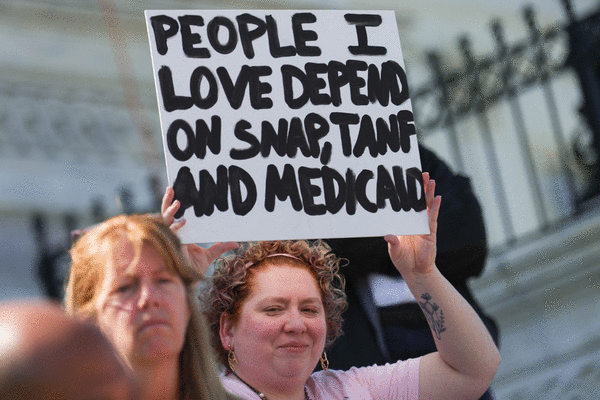
And, as families struggle to stay connected to WIC, millions of families are also losing access to SNAP (Supplemental Nutrition Assistance Program) and other critical support, while Congress considers additional cuts.
Let’s be clear: Children are still going hungry and families continue to navigate an affordability crisis that makes it harder to put food on the table, obtain healthcare and make ends meet. The consequences of these trends will shape the health, well-being and opportunities in our communities for generations to come.
We cannot afford to provide less for families when they need us most. Before we debate cutting essential supports further, we must first ask why millions of people are no longer accessing the programs that help them thrive. Families did not suddenly stop needing WIC, SNAP or other supports — they encountered new barriers to accessing them.
Today’s participation numbers are an urgent warning that access is eroding. Before making additional cuts, we owe families something much simpler: the commitment to understand why they are disappearing from these programs and to remove the barriers keeping them from the care they deserve. The erosion of WIC isn’t just a loss for today's families; it is a loss for our nation's future.
_____
Teon Hayes is a senior policy analyst at the Center for Law and Social Policy (CLASP ) in Washington, D.C., where she focuses on policies and programs that support nutrition, maternal health and recovery for mothers navigating substance use. This column was produced for Progressive Perspectives, a project of The Progressive magazine, and distributed by Tribune News Service.
______
©2026 Tribune Content Agency, LLC.





















































Comments