Allison Schrager: New York will regret going into the grocery business
Published in Op Eds
The market, as I have noted before, is a small miracle. All these people come together — sellers, buyers, go-betweens — with different preferences, needs and resources, and they manage to come up with a price. The market clears, and everyone is better off.
But not always. When a market fails, it is tempting for public officials to intervene with a policy to fix it. Sometimes these interventions work. Often they make the problem they are trying to solve worse — or create new ones. New York City Mayor Zohran Mamdani’s plan for government-run grocery stores, five of which are scheduled to open in 2029, falls into the latter category.
There is a genuine problem he hopes to address: Many households are struggling to pay for food. Groceries in New York City are especially expensive because food stores face logistical challenges, as well as high rents and labor costs, and pass them on to cash-strapped consumers. Poorer Americans often live in “food deserts” where it is almost impossible to buy fresh fruit and healthy food, or any food at all.
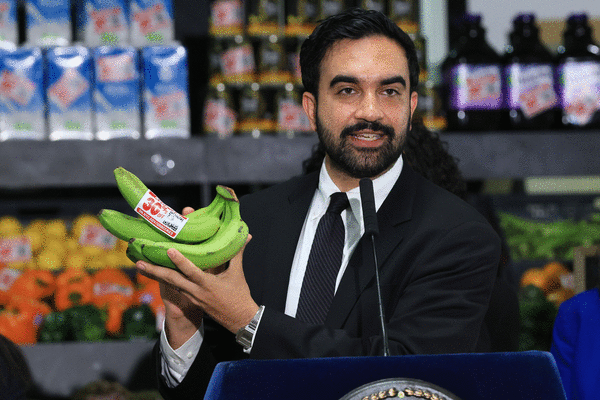
Mamdani’s solution seems simple: The government will sell groceries for lower prices. The plan is to open a government-owned grocery store in each borough, which will sell healthier food at a 30% discount.
This is the wrong answer to the wrong problem. Food deserts aren’t necessarily a market failure, or even a problem in New York. For one, the planned locations of the stores, such as in East Harlem, already have many options. And compared to other parts of the country, most New Yorkers have access to grocery stores.
What’s more, studies have found that when healthier food is made available in low-income areas, people don’t buy it. Local stores don’t sell highly processed, sodium-rich and sugary food because it is cheaper — they stock it because it’s what people want to buy. Perhaps that is a failure of public health policy or misguided farm subsidies. In any case, a government-run store does not fix the problem.
Mamdani’s plan won’t necessarily provide cheaper groceries to the people who need them. That’s in part because it is poorly targeted: Government-run grocery stores make food available to everyone, including people who could resell it at a markup. It would be more justifiable to spend limited taxpayer dollars to help those Americans who struggle to buy food. And there are already programs to subsidize food for low-income households, such as SNAP, which are means-tested. SNAP is not perfect, but the city or state could spend the money instead to expand or direct these benefits to healthier food at a lower expense to taxpayers.
And this will cost taxpayers. The five stores are projected to cost $70 million just to open. Going forward, that 30% discount will require some money to come from somewhere. Given the requirement that the stores pay “family sustaining wages and benefits,” it won’t lower labor costs. Perhaps these stores will be more efficient than the private alternative and pass those savings on, but grocery stores are a competitive, low-margin business. Lower costs could come from the stores not paying rent or property taxes, but that would also cost taxpayers, because the government would be forgoing the revenue.
Government-run stores would also undercut private competitors in the area, which could mean less tax revenue. Thankfully, this is unlikely because (so far at least) the plan is to have only five stores. If they sell groceries at below market prices, they will probably run out of the things people want, leading consumers back to the stores they used to shop in anyway — all at a higher expense to taxpayers.
What might the city do if it really wanted to deliver lower food prices for everyone? Well, it could relax regulations that make it extremely difficult to open a large retail business and prevent big-box retailers from entering the market.
Or it could be a bit less eager to increase labor costs of existing businesses. Instead, it has a plan for government grocery stores that is eerily similar to its system of rent stabilization — by which I mean, an expensive and inefficient way to provide some benefit to a few at the expense of the many.
_____
This column reflects the personal views of the author and does not necessarily reflect the opinion of the editorial board or Bloomberg LP and its owners.
Allison Schrager is a Bloomberg Opinion columnist covering economics. A senior fellow at the Manhattan Institute, she is author of “An Economist Walks Into a Brothel: And Other Unexpected Places to Understand Risk.”
_____
©2026 Bloomberg L.P. Visit bloomberg.com/opinion. Distributed by Tribune Content Agency, LLC.





















































Comments