Mark Z. Barabak: Democrats are at each other's throats -- this time over the 2028 calendar
Published in Op Eds
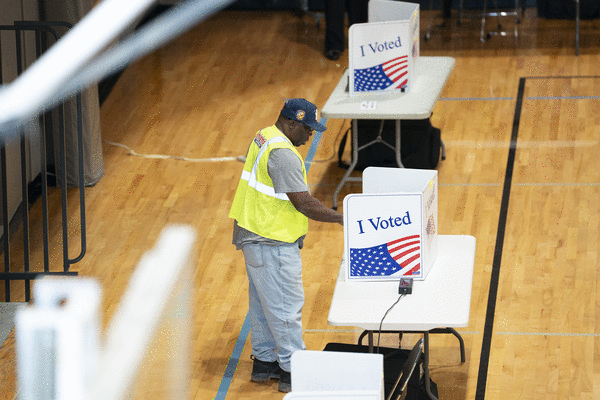
Come 2028, the Democratic presidential campaign promises to be a banger, with all sorts of intrigue and subplots layered within a wide-open fight for the nomination.
There's the prospect of same-state rivals going at it. (California's Gavin Newsom vs. Kamala Harris; Georgia's Sen. Jon Ossoff vs. Sen. Raphael Warnock.)
There's sure to be a generational divide, a split over how much time and energy Democrats should spend rehashing the Trump era, and, inevitably, a clash between standard-bearers of the left, the far left and the party's increasingly small center-left.
All that remains in the offing, however, as none of the major prospects have formally declared their candidacies. Political tradition, and self-preservation, require waiting at least until after November's midterm election to jump into the race.
In the meantime, Democrats have seemingly resolved at least one 2028 fight, a fracas marked by snarking, backbiting and plenty of acrimony — all the things that make our politics such a grand and glorious endeavor.
We speak of the contest to determine which state will hold the first vote of the 2028 nominating process. And the winner is … South Carolina!
This was a blow to Nevada, the runner-up in the calendar sweepstakes, and not a very sporting one at that. The state Democratic Party issued a huffy news release, insisting Nevada will be the candidates' first true test of 2028 — emphasis added — reprising the argument over which state offers the best starting path to reclaim the White House and, thus, deserves the coveted lead voting slot.
(California, a perennially frustrated onlooker, is not set to vote until March 7, several weeks into the balloting, which is supposed to start Jan. 22.)
For decades, the political calendar was unchanged and, mostly, unchallenged.
Iowa went first, holding its quaint and quirky precinct caucuses — neighbors gathered in church halls, school libraries and the like as they worked through arcane rules involving "realignment" and "viability thresholds" — followed by New Hampshire's first-in-the-nation primary.
In 2024, President Joe Biden shook things up.
He'd failed miserably in Iowa in his runs for president, so Biden had no problem slotting South Carolina first after the state resurrected his lifeless 2020 candidacy. (Iowa didn't help itself by making a thorough mess of its 2020 caucuses, taking nearly a month to certify a winner.)
The change set off a free-for-all this time around, as a dozen states bid for the chance to vote first.
(The two major political parties set the rules for choosing their presidential nominees, independent of one another. Republicans are expected to stick to the traditional lineup, starting with the Iowa caucuses and New Hampshire primary, followed by contests in Nevada and South Carolina.)
Last month, after nearly a year of consideration, the Democratic Party's Rules and Bylaws Committee voted for six states to hold their contests in a window between late January and the end of February. They are, in order, South Carolina, Nevada, New Hampshire, New Mexico, Michigan and Virginia. The lineup will be presented to the full Democratic National Committee to be voted on and finalized later this month.
Doubtless, you — a normal person — have paid little or no attention to any of this. You've got more important things to do, like binge-watching "Widow's Bay," or not melting.
But party leaders and political insiders take the process extremely seriously. At stake: bragging rights, a modest economic boost and the chance for local analysts and office-holders to make frequent appearances as experts on the cable-TV chat shows.
The jostling grew particularly fierce between South Carolina and Nevada.
More than 50% of the Democratic primary electorate in South Carolina is Black. In Nevada, Latinos are a substantial and increasingly powerful voting bloc. So, naturally, the competition between the two states assumed fraught racial overtones, which is unfortunate but not surprising, given Democrats' penchant for picking at sore spots and turning on each other at the slightest provocation.
It was also rather pointless. The order of the presidential calendar is consequential, but far from determinative.
South Carolina was vital to Biden's success. But so, too, was the onset of the COVID-19 pandemic, which sharply curtailed the Democratic nominating fight. Barack Obama's 2008 victory in Iowa gave him a huge lift, but he lost to Hillary Clinton the following week in New Hampshire and had to fight another six months before winning the nomination.
Presidential campaigns have changed drastically in the 50 years since a little-known Jimmy Carter quietly burrowed into Iowa, spent months bunking in folks' extra bedrooms, then burst to national fame by outperforming his more prominent rivals. Today, the race is a 24/7 affair, followed by voters in all 50 states.
While local concerns may come up here and there — the proposed Yucca Mountain nuclear waste dump in Nevada, beach erosion in South Carolina's Lowcountry — the same issues and controversies confront candidates and animate the contest regardless of whether a field of soybeans, a white church steeple or a Southern fish fry serves as the backdrop.
Obviously, the voting has to begin somewhere and the competition between states is well and good. But the trash-talking and, especially, antagonism over race and ethnicity is gratuitous and needlessly divisive. Candidates will show they have the stuff to win the nomination, or not, by building their best case and pitching it to voters.
No matter if it's a Black church in Las Vegas or a Latino neighborhood in North Charleston. Any location will do.
____
©2026 Los Angeles Times. Visit at latimes.com. Distributed by Tribune Content Agency, LLC.


















































Comments