Commentary: We can't fix America's schools without data
Published in Op Eds
At a time when both U.S. parties paint the other as a threat to the country’s future, both are ignoring one of the gravest threats of all: student achievement levels that are abysmally low.
The only thing worse than failing to teach students basic skills is not knowing how bad their test scores really are, because that ensures nothing will change. And yet that’s exactly where the country is heading, if the White House continues its efforts to shrink the Education Department’s research and statistics operation.
After decades of steady improvement, thanks to concerted bipartisan efforts to improve public schools, test scores plateaued in the 2010s, as both parties retreated from the issue. After the pandemic, scores fell through the floor. Some five years later, they remain dismal. The lack of political attention to this problem is a disgrace, but at least the data is there for all to see. That may soon change.
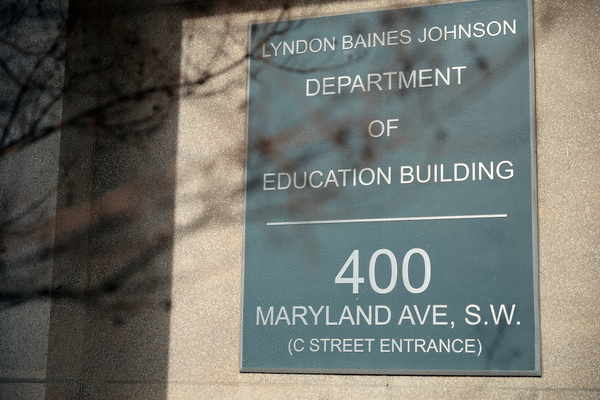
Among a barrage of executive orders issued last year was a directive to close the Education Department “to the maximum extent appropriate and permitted by law.” Half of the agency’s employees got fired, including almost 90% from the Institute of Education Sciences.
The institute was founded in 2002 by President George W. Bush as part of a broad effort to increase educational accountability. The goal was an independent, scientifically rigorous hub of education research, modeled after the National Institutes of Health.
It’s hard to overstate the office’s importance to education policy. It produces a congressionally mandated assessment known as the Nation’s Report Card, or NAEP (the National Assessment of Educational Progress), which provides a basis for measuring how students are faring in learning the three Rs, and whether they’re progressing or regressing compared to earlier years.
The administration has defended the NAEP rhetorically, but not operationally. Layoffs have left the suboffice responsible for the report with only a handful of employees. According to one former senior official, the center is “running on vapors,” and there are concerns that state data collection, which is absolutely essential for producing reliable national results, has been compromised.
Weakening this office couldn’t be more self-defeating. A functional federal data and research hub is needed for states to figure out what works and measure relative performance. How can states hope to replicate Mississippi’s major improvements in reading scores without gold-standard guides for teachers?
Politicians call it “the Mississippi miracle.” But it wasn’t divine intervention that led to the transformation. It was data-based reforms. No data, no reforms. No reforms, no student turnaround. No student turnaround, no turnaround to their career prospects — or to hopes of ending racial and ethnic inequalities across a broad range of measures.
A functional federal data and research hub is also needed for education officials to identify troubling trends and adopt interventions — and for parents to hold their elected officials accountable.Reliable data was essential to our efforts to transform New York City’s public schools. Without it, we would not have been able to raise graduation rates 42%, or cut racial and ethnic achievement gaps by a quarter, or go from having none of the state’s 25 top-performing schools to having 22 of them.
The White House is correct that the Institute of Education Sciences can be improved. Its processes for data collection, grantmaking, peer review and testing are outdated. Its statistics are difficult to parse. Many of its now-terminated contracts were expensive and inefficient. And its research library is cumbersome.
All of those areas are ripe for reform, and to its credit, the White House commissioned an independent review of IES that called for a massive data-modernization effort. But barring a serious, well-funded commitment from the administration, the review’s recommendations are unlikely to be fulfilled.
The institute hasn’t had a permanent director in more than two years, it now has only two dozen or so staffers, and — like other core functions of the Education Department — it may well be moved elsewhere in the federal government. It’s impossible to do big things when leadership is absent and employees are focused on survival.
The White House’s appetite for disruption will end in failure unless it is paired with a commitment to the hard work of reform. Allowing research and statistics to deteriorate in the meantime would be a grave mistake that will harm students and the future of the American economy.Parents are rightly frustrated with the state of education, but change will only come when voters hold elected officials accountable for progress — and that can’t happen without reliable data.
____
Michael R. Bloomberg is the founder and majority owner of Bloomberg LP, the parent company of Bloomberg News, and the founder of Bloomberg Philanthropies.
©2026 Bloomberg L.P. Visit bloomberg.com/opinion. Distributed by Tribune Content Agency, LLC.




















































Comments