Commentary: Why are we still pretending Big Tech cares about our classrooms?
Published in Op Eds
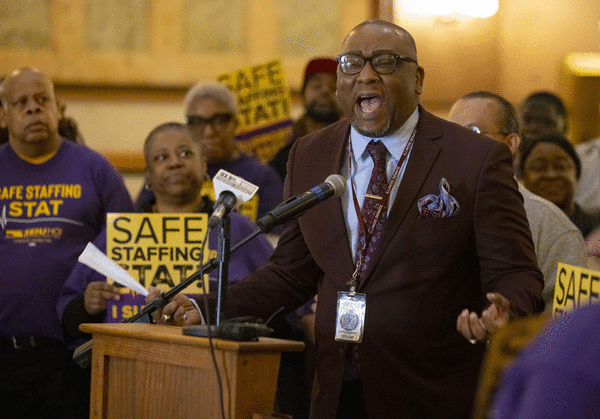
“I believe that our teachers should be judged based on actual observations and professional judgment, not by AI software,” Illinois state Sen. Christopher Belt of Swansea said of Senate Bill 2909, passed July 10, prohibiting the use of AI in teacher evaluations. “Our educators deserve a transparent and fair evaluation process that demonstrates their actual work in the classroom and protects their privacy.”
How great for teachers that the human work we do in the classroom — helping students learn and grow to their fullest potential — won’t be assessed by a machine. The field of education depends on human interaction, and the quality of instruction kids get should depend on an administrator’s human assessment rather than a machine’s.
With this bill, Illinois has concluded AI harms teacher-administrator relationships and privacy. It’s good news, but it’s not enough.
AI is even more of a danger to kids.
Illinois needs to also conclude that AI poses an unacceptable danger to the student-teacher relationship and to students’ privacy, and that it’s harming students’ ability to think and problem-solve. Students say so themselves, according to the RAND American Youth Panel, which recently reported 7 out of 10 middle and high school students worry AI hurts their critical thinking skills.
All kids deserve protection in school. Instead, AI companies are furiously signing contracts with school districts, equipping classrooms with surveillance technology to gather data on K-12 students, and offering free “services” to students and educators, a classic advertising tactic to become dependent on their products — Big Tech’s version of a gateway drug.
The real cost to kids is high. School districts continue to suffer financially while tech companies make billions of dollars infiltrating the classroom.
If Big Tech companies truly cared about kids and educators as they claim to, they would give money to public schools (beyond free Chromebooks and access to AI), which remain massively underfunded in practically every state in the U.S. Chicago Public Schools, already stretched thin, is experiencing even more cuts. Its leaders recently proposed firing 760 teachers, and 800 support staff, in an effort to close its budget deficit.
Instead of helping kids, Big Tech companies actually hurt kids by contributing to schools’ ongoing financial burdens. Data centers get tax breaks, limiting tax revenue that typically flows into public school districts.
“Every dollar we subsidize a big tech company is a dollar we can’t put into public schools,” Anthony Elmo, public education defender with Good Jobs First, a national economic policy center, said in a recent interview with KTSM 9 News in El Paso, Texas, where data centers are expanding near already financially strapped schools.
If that’s not enough to convince us Big Tech companies don’t care about kids, they also strategically targeted students when they were in class to learn, undermining the whole point of school.
“Teachers are going to hate it,” Jennifer Valentino-DeVries reported in her June 4 New York Times article, referring to a TikTok employee’s internal email about a new feature to get users posting within three minutes. The article exposes court documents proving tech companies deliberately targeted students. Meta paid “teen ambassadors” to promote Instagram at school, TikTok wouldn’t disable notifications during school hours, Snapchat called classroom phone use “under the desk” time, and Google knew YouTube recommended videos to students during school that had nothing to do with their lessons.
These companies want students more occupied with social media than the day’s lesson, more captivated by ads urging them to download the latest AI apps to cheat on schoolwork than thinking on their own.
It’s a vicious cycle: Public schools have long suffered financially; a data center comes to town and gets tax breaks; funds are diverted that should go to public schools; already underfunded schools receive even less funding; school cuts are made, which means fewer teachers, resources and larger class sizes; schools are given Chromebooks and access to AI products in already overcrowded classrooms and kids get hooked on screens; learning and teaching become harder for everyone; teachers are evaluated under unreasonable working conditions; public schools continue to struggle financially. The cycle repeats.
No wonder teachers might be worried about their evaluations, which can determine if they keep their jobs. Good thing those evaluations won’t be done with AI!
One way to support kids is to support their educators. Yet teachers are largely left out of policy-level decisions despite their content-area and pedagogy expertise and experiences on the front lines in the classroom.
For instance, not one current classroom teacher was included in the creation of the Illinois State Board of Education statewide guidance on the use of AI, just released on June 30.
The 408-page document consists of guidelines and examples for using AI in the classroom. Troublingly, of the 10-person panel, four work for companies deeply invested in AI (CodeAI, Khan Academy, EdSafe AI Alliance and the Patrick J. McGovern Foundation).
Only one educator was on the panel, but he is no longer a classroom teacher.
Even more concerning is that he works for the AI startup company CheckIT Learning— surely a conflict of interest.
The guidelines emphasize that “the teacher-student interaction is the centerpiece of teaching and learning.” Why, then, were no classroom teachers consulted? What better way to support kids than to ask the teachers who are on the cutting edge of how AI affects the classroom?
Let’s stop pretending Big Tech companies care about kids, educators or our public schools. It’s time we admit their end goal isn’t to better the educational landscape. They’re actually making it worse. And educators need to be more involved with decisions that directly affect what we do in the classroom.
Students are in school to learn how to make their own judgments. Illinois trusts AI’s judgment so little that it passed a bill to protect us from its flaws. Illinois has begun to acknowledge the dangers AI and their companies pose to our schools. But it’s only a start. Our kids deserve better.
____
Liz Shulman is the author of the forthcoming “By the Book: Inside Today’s Tech-Driven Classroom and How Literature Can Save Our Students.” She teaches English at Evanston Township High School and in the School of Education and Social Policy at Northwestern University. Find out more at lizroseshulman.com.
___
©2026 Chicago Tribune. Visit at chicagotribune.com. Distributed by Tribune Content Agency, LLC.



















































Comments