Jenice Armstrong: Tuskegee University's ban on hair bonnets and do-rags in class? I'm here for it
Published in Op Eds
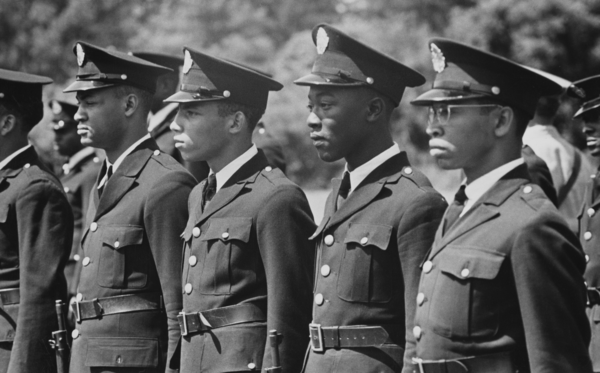
Say what you want about Tuskegee University’s new ban on hair bonnets, bedroom slippers, and do-rags in classrooms and the dining hall. But the historically Black college’s iconic first president, Booker T. Washington, would be all for it.
Born into slavery and educated at what is now Hampton University, Washington was nothing if not pragmatic. He was hired as the first principal at the school in central Alabama in 1881. Given the economic subordination of African Americans in the post-Reconstruction era, he believed that Black people needed to do whatever they could to survive.
Students dressed in uniforms and learned skills such as shoemaking, dressmaking, carpentry, and other practical trades. The renowned educator recalled in his autobiography "Up From Slavery" that ”when the students march out of chapel in the evening and their dress is inspected, as it is every night, not one button is to be found missing.”
Newly emancipated Black Americans had few rights and were often forced to work as sharecroppers. Critics might not think of Washington as having been woke, as they say, but he was convinced that, “No white American ever thinks that any other race is wholly civilized until he wears the white man’s clothes, eats the white man’s food, speaks the white man’s language, and professes the white man’s religion.”
Fast forward to today where at Washington’s beloved HBCU in rural Alabama so much has changed but other things haven’t.
Mark A. Brown, Tuskegee’s current president, recently addressed the issue of proper attire on the school’s sprawling 5,000-acre campus. In a letter to students Brown wrote that the goal is to prepare them for the workforce, adding, “Employers are less forgiving and too often presentation may overrule stellar preparation.”
Many take exception to the ban on hair bonnets and do-rags, which customarily are worn to protect Black hairstyles while people sleep. In recent years, it has become much more common for people to also wear them on airplanes, at the mall, and in classrooms.
As for me, I’m old school when it comes to this sort of thing. I don’t wear hair bonnets outside. I hate to admit it, but I low-key judge others when they do. So, even though it smacks of respectability politics — which refers to the adjustments people make to fit in with mainstream culture to shield themselves from racism — I am not mad at Tuskegee’s new dress code.
It’s about having standards and encouraging young adults to take pride in their appearance. During my days at Howard University, we tried to look as good as we could whenever we stepped onto The Yard. It’s part of the HBCU mystique. Whenever I see old photos of my parents at their alma mater, North Carolina Central University, they were dressed in what today we’d consider business casual clothes — slacks, pencil skirts, collared shirts.
Ever since the news broke about Tuskegee’s new policy, commenters have been buzzing on social media about the topic. Many see their ability to wear what they want — when they want and absolutely wherever they want — as an issue of personal freedom.
“I can guarantee you that none of these people are walking into meetings and boardrooms in their do-rags and hair bonnets,” pointed out Danyl Patterson, an attorney from West Philly. “This is no different from code-switching. We know when and how to do it.”
She brought up the issue of comfort. “When you’re a student, you drag yourself,” Patterson recalled. “You might be tired and you’re telling me this is the only food I have access to and I need to get fully dressed to go get cereal?”
She presents a great argument.
But I still cringe at the idea of people showing up for class in what I consider nightwear. It’s not too much to require college students to present themselves a little better. Tuskegee students also are now prohibited from wearing revealing clothing to class, the cafeteria, and convocation.
Isis Rodriguez, whose son is a senior at Tuskegee majoring in veterinary science, agrees with the changes. “After COVID, it seems as if people slid into a state of complacency and comfortability. We all were in bonnets and pajamas.”
That was then, she added: “But at some point, we had to get out of that rut and this is the time — because we need to send our young people into the professional world wearing real clothes.”
African Americans fare much better than when Washington presided over Tuskegee, but we continue to face widespread systemic disadvantages in the workplace. President Donald Trump and members of his administration are doing all that they can to end DEI, which helps level the playing field for Black people, women, people with disabilities, and so many others.
Newly minted graduates need to be ready to compete on day one. Preparation for that starts with them showing up to their classes regularly sans bedroom slippers, hair bonnets, and do-rags.
Besides, as Iyatunde Garrett, a registered nurse who lives in Southwest Philly, said to me: “What professor wants to sit in a classroom with a bunch of students who look like they literally just got out of bed?”
©2026 The Philadelphia Inquirer, LLC. Visit at inquirer.com. Distributed by Tribune Content Agency, LLC.




















































Comments