Commentary: 'The Odyssey' isn't real, but American diversity is
Published in Op Eds
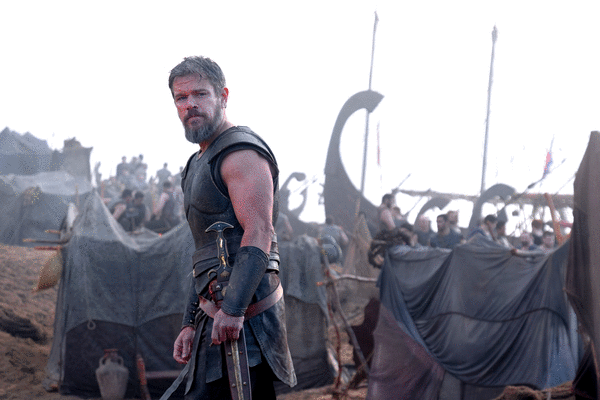
After Christopher Nolan’s "The Odyssey" was released in theaters, Elon Musk declared he would use Grok to create a more “historically accurate” version of the ancient epic poem.
The uproar over the film’s supposedly woke casting has been loud and sustained, but the people most upset have ignored a pretty significant detail: "The Odyssey" is not real. It is a story filled with gods, goddesses, and violent monsters who are apparently more historically plausible than the presence of people of color. Even the fact that Greek, Asian, and African peoples were in contact throughout the ancient world is less believable, it seems, than a sentient whirlpool.
The goal was never historical accuracy, though. It never is. The same logic that scrubs people of color from ancient epics is the logic that scrubs us from American history because in both cases, the sanitized version requires our absence. America becomes a space of prosperity and hope for all if enslavement is deleted. It becomes a benevolent nation welcoming to everyone if internment camps and detention centers are excluded. It becomes a beacon of cultural mixing if the genocide of Indigenous peoples is overlooked.
And now, erasure is becoming U.S. policy.
Take, for instance, Executive Order 14253, titled “Restoring Truth and Sanity to American History.” In it, Trump argues that the nation’s legacy “is reconstructed as inherently racist, sexist, oppressive, or otherwise irredeemably flawed.”
As part of the initiative to correct the story, the administration targeted the Smithsonian. In a 162-page report aimed at “saving America’s story,” it lambasts the museum’s goal to “create a more just future by attending to the complexity of America’s past.” That complexity includes acknowledging that the founders were also enslavers, that the pledge of allegiance instills nationalism, that Christianity has been used as a tool of oppression, and that whiteness has been an alienating force in American life. Each of these is part of our nation’s history, but the report frames this honesty as political activism. It imagines that the presence and histories of people of color, Indigenous people, and LGBTQIA+ people are not part of America’s story, that our existence is the capture.
But ideological capture has a definition. It refers to the corruption that occurs when an institution meant to serve the public interest instead serves the interests of a small, powerful constituency—when special interest displaces shared interest, leading to a net loss for society. By that definition, a report that erases the histories of entire communities of Americans to center one narrow vision of national identity is ideological capture. The Smithsonian isn’t the one doing the capturing.
If the Smithsonian report represents the administration’s vision for what stories Americans should encounter, H.R. 7661 and S. 4925 represent its plan to enforce that vision in schools. Both bills seek to amend the Elementary and Secondary Education Act of 1965 to prohibit federal funding for any materials that include “sexually oriented material, and for other purposes.” The only approved stories come from major world religions (though the bills leave “major” undefined) and three curated lists of classics: the "Great Books of the Western World" from 1990, “Classics Every Middle Schooler Should Read” by Thomas Purifoy Jr., and “Classics Every High Schooler Should Read” by Mary Pierson Purifoy. The Purifoy texts are homeschooling guides built explicitly around a Biblical worldview. Any representation of gender identity beyond girl and boy is prohibited.
Both bills operate under the premise that the mere existence of queer and gender expansive people in literature constitutes sexualization. And the phrase “for other purposes” leaves both proposals open for further censorship. Given this administration’s track record, the imagination doesn’t have to stretch far to understand what those purposes might be.
The AI remake, the executive order, and the congressional bills collectively demonstrate the very ideological capture the administration claims to oppose. Each attempts to control the national story by deciding who is allowed representation in our cultural institutions, whether that be film, museums, schools, or the halls of Congress. Individually, they are acts of erasure. Together, they represent a coordinated effort to eliminate any story that hasn’t been sanitized to suggest that life, liberty, and happiness have always been equally available to everyone in the United States.
But erasing that complexity only protects power, allowing those with the most to hide behind a sanitized past while those with the least are dismissed and discredited.
As a critical literacy scholar, I’ve spent my career arguing that the complexity of our stories is what makes us powerful. It allows us to hold how far we’ve come as a nation in one hand while acknowledging the critical work still ahead, to see that people of color and gender expansive people have always existed and that their stories add to rather than detract from who we are as a nation. When complexity is removed, it assumes we have nothing left to strive for. It ideologically captures our progress before it can ever begin.
And progress is what we’ll need if the next generation is to inherit a world filled with everyone’s stories--not a curated version of who we were, but a complete picture of who we might become.
____
Stephanie Toliver is a Public Voices Fellow and a member of the OpEd Alumni Project sponsored by the University of Illinois.
_____
©2026 The Fulcrum. Visit at thefulcrum.us. Distributed by Tribune Content Agency, LLC.



















































Comments