Commentary: Lurie is no Mamdani. San Francisco is fine with that
Published in Op Eds
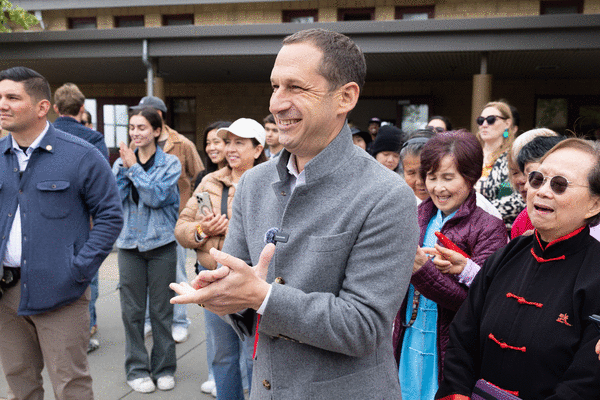
It’s hardly been lost on America’s political class that even as New York City Mayor Zohran Mamdani leads a resurgent local and national left, the famously progressive city of San Francisco, under Mayor Daniel Lurie, appears to be moving decisively in the other direction.
Yet despite their vast ideological differences, Mamdani and Lurie share some crucial attributes and approaches to politics that are at least as important as their policy positions in explaining their early successes. Politicians across America have much to learn from these commonalities.
Even as Mamdani rides high on popular left-wing ideas such as a rent freeze and city-owned grocery stores, Lurie, an heir to the Levi’s fortune, has won phenomenal approval ratings by rejecting progressive orthodoxies on crime, drug policy and housing.
While Mamdani faces off with billionaires — most notably hedge fund mogul Ken Griffin — over a tax on pied-à-terre apartments, Lurie enjoys the backing of his city’s ascendant tech overlords, and led the campaign against a new business tax aimed at big corporations that city voters rejected last month.
So what do the two men, at opposite ends of the Democratic Party spectrum, have in common?
It starts with the fact that both are relentless, upbeat and authentic cheerleaders for their cities. Mamdani simply oozes New Yorker: He can make a simple short-form video about joy for the Knicks’ NBA championship, his concern about the heat wave or his empathy for sidewalk vendors, without it seeming forced.
Lurie lacks Mamdani’s charisma, and his Instagram skills seem more practiced than intuitive. Yet he’s also a relatable San Franciscan, born and bred in the city, and a Democrat like everyone else. He’s shown how much can be accomplished with consistency of manner and a simple, friendly, slightly workaholic approach, expressed in a willingness to show up anywhere and everywhere. No ribbon-cutting is too small for the mayor, and in a modest-sized city like San Francisco, that can go a long way.
There are more than vibes involved. Both cities have very large workforces that naturally are going to be more motivated when they see positive, popular leadership from the top. This can have a political hue: San Francisco police officers were openly disdainful of prior administrations and low arrest rates reflected their attitudes, which underwent a quick adjustment under Lurie. But mostly city workers want the city to work well, ideology aside.
That’s what voters want too, especially when it comes to the fundamentals of city governance. Mamdani makes a lot of headlines with “socialist” ideas like the grocery stores, criticisms of Israel and his aggressive moves on behalf of fellow Democratic Socialists. Yet his popularity thus far is also rooted in the basics: The city did a good job with snow cleanup after unusually severe storms this winter and, crucially, overall crime continues to fall. His decision to keep Police Commissioner Jessica Tisch in her post was among the most consequential — and wisest — of his mayoralty.
Mamdani also breaks from many on the left in his pro-development approach to the housing crisis, pushing for zoning and permitting overhauls to clear the way for more construction. While classic YIMBY housing advocates don’t like his rent freeze, they support his willingness to take on neighborhood preservationists to get housing built.
It’s a popular, straightforward approach to a core problem. The relentless ideological attacks from the right, led by the New York Post, just don’t stick.
In San Francisco, Lurie has benefited enormously from the artificial intelligence boom, with OpenAI, Anthropic and other AI firms beginning to fill the oceans of empty offices that have hung over downtown since the pandemic. That’s taken the heat off the budget and allowed him to chip away at the homeless encampments, property crime and drug use on the streets that have infuriated many residents and stained the city’s reputation. On housing, Lurie, like Mamdani, is focused on rezoning and spurring new construction.
There have been few wholesale changes. Incremental moves on drug policy have allowed for “sober living” recovery centers and discouraged the distribution of drug supplies, both common-sense policies that have been opposed by advocates of so-called harm reduction. Homelessness appears to be inching downward, along with drug overdoses, and the jail population is up, but the data hardly shows that the big problems have been solved.
Yet the lawlessness that overtook some downtown streets is much less visible. Things seem to be moving in the right direction, and Lurie enjoys the credit for that.
Both mayors still have a lot to prove. Mamdani, worryingly, is devoting no small amount of energy and political capital to the broader Democratic Socialist movement. That risks elevating ideology and national politics above the nuts-and-bolts civic governance challenges that will determine whether he is a successful mayor. It’s hard to see how being outspoken about Israel and Palestine — even calling for the arrest of Israeli Prime Minister Benjamin Netanyahu for alleged war crimes — will address affordability, public safety and housing.
Lurie has promised not to repeat the sin of current California Governor Gavin Newsom, who spent much of his tenure as mayor from 2004 to 2011 positioning himself for higher office. Even if the AI boom rolls on, Lurie will need all the focus he can bring if he’s to make progress on daunting social problems and see his rezoning plan through. He also intends to push through a much-needed reform of the city charter that would limit the powers of independent bodies and make it harder to get initiatives on the ballot.
Politicians need to inspire their followers, which often means playing to their passions — Mamdani’s out-of-nowhere election being a case in point. Mayors, though, need to be sober technocrats too. Whether the leaders of two of America’s most celebrated cities can lean into that identity will have much to do with their fate.
____
This column reflects the personal views of the author and does not necessarily reflect the opinion of the editorial board or Bloomberg LP and its owners.
Jonathan Weber, author of “City on the Edge: Technology, Politics and the Fight for the Soul of San Francisco,” was the Los Angeles Times’s first-ever Silicon Valley reporter, starting in 1990. He was also editor in chief of The Industry Standard and The Bay Citizen, oversaw West Coast news and global technology coverage for Reuters, and co-founded The San Francisco Standard.
©2026 Bloomberg L.P. Visit bloomberg.com/opinion. Distributed by Tribune Content Agency, LLC.




















































Comments