Commentary: Why so many Latinos in the US are anti-immigrant
Published in Op Eds
Since President Donald Trump’s return to power, more than 60 people have died at the hands of or in the custody of immigration authorities, most recently two Latino immigrants in one week: Lorenzo Salgado Araujo in Houston and Joan Sebastián Durán Guerrero in Maine. Many Latinos have come to feel that their brown skin makes them targets, and they are not wrong.
But there is another dimension of this story that we often fail to consider: Many of those in charge of anti-immigrant operations also have brown skin, Hispanic names and links to the communities they terrorize. When the identities of the Customs and Border Protection agents who killed Alex Pretti in January were revealed as those of two Hispanic men, many people reacted with shock. The irony seemed obvious, but it reflected a mistaken assumption: that Latinos are naturally opposed to restrictionist policies. History suggests otherwise.
Latinos have been not only frequent targets of nativism and xenophobic violence but also supporters — regularly enforcers — of it. For decades, Latinos have joined the Border Patrol (and since it was established in 2003, ICE) in significant numbers. Latinos now make up a majority of Border Patrol officers and constitute about 20 to 30% of ICE agents. More broadly, Latino voters have often supported restrictionist policies and politicians who would tighten U.S. borders and target immigrant families and communities. Reactionary politics in the United States are not simply imposed on Latinos; they have repeatedly found traction within Latino communities themselves.
Why? Latinos have often occupied an uneasy middle ground in American society — subject to discrimination and exclusion, yet also susceptible to appeals that promise belonging, security and status. Like every other group, they can embrace political movements that harm others, and sometimes even themselves.
This precarity is why Latinos join immigration enforcement agencies in such large numbers. For years, scholars and historians have tried to find other explanations, including economics and stable employment, a desire to serve their communities and seeking proximity to whiteness. But these capture only part of the story.
The phenomenon began as early as the 1950s, when prominent Latino leaders and organizations supported deportation campaigns such as Operation Wetback, which sought to remove hundreds of thousands of undocumented migrants (and their citizen family members) from the country. Their support was often rooted in not entirely unfounded fears of labor competition; U.S. employers routinely used migrant labor to undermine unions, suppress wages and break strikes.
This logic persisted into the 1960s and 1970s. The United Farm Workers frequently treated undocumented workers as threats to labor organizing. Union activists routinely harassed migrants, reported them to immigration authorities and even organized their own patrols along the border, some of which resulted in violence against immigrants.
Yet attitudes were always in flux. The civil rights movement transformed American racial politics. The rise of Black power influenced Chicano activism, and many Mexican Americans increasingly shed illusions that they could be seen as white, at least legally so, and rejected assimilationist impulses. Support for restrictionist policies did not disappear, but it became less dominant in many Latino political circles.
Nevertheless, nativist undercurrents never vanished. Concerns about labor competition remained, as did anxieties about belonging, status and what new waves of immigration might mean for Latinos’ own place in American society. Latinos were ambivalent about Proposition 187, the 1994 California ballot initiative that sought to deny immigrants and their families access to social services. Although only a quarter of them supported the proposition in the end, polling suggested that nearly half considered voting in favor of it in the months and weeks leading up to the vote.
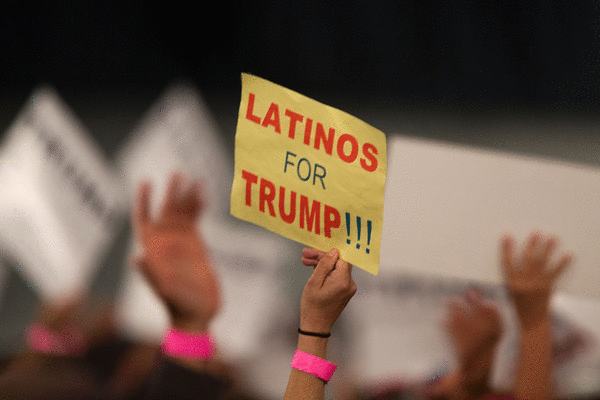
“Latinos for Trump” factions contributed significantly to the rise of Donald Trump and his MAGA movement in 2016. And when he ran for reelection in 2024, he did not merely retain significant Latino support; he expanded it. His gains were especially notable among Latino men and in heavily Latino border regions. Counties along the U.S.-Mexico border, including some with large or even majority Latino populations, shifted toward Trump.
Meanwhile, the American right was increasingly united less by biological notions of race and more by opposition to multiculturalism, feminism, LGBTQ+ rights, immigration and liberalism. Race still mattered, but the boundaries of political belonging became more flexible and expansive.
The right increasingly included prominent figures of color, from Thomas Sowell and Clarence Thomas to Linda Chavez and Marco Rubio. More recently, even parts of the far-right fringe have embraced Latino leaders and activists who share their political commitments. Consider figures like the Jan. 6 insurrectionist (and recipient of a Trump pardon) Enrique Tarrio, leader of the “Western chauvinist” Proud Boys, who is Afro-Cuban, or Nick Fuentes, the self-described white supremacist influencer whose father is Mexican American.
That evolution helps explain why some Latinos have found these movements appealing. They offer inclusion on specific terms. They allow participants — immigration agents included — to see themselves not as victims or outsiders, but as defenders of order, tradition and (admittedly vague, borderline violent notions of) American values.
The lesson here is not that Latinos are uniquely reactionary. Far from it. Every community contains contradictions. Every group produces both opponents and defenders of the status quo. And recent polls suggest that Latinos have begun to swing away from Trump and the Republicans.
The lesson is that we should stop treating Latino support for restrictionist politics as a paradox. To the contrary, this is a part of a long history, a much longer story. Understanding that history requires first acknowledging it.
____
Eladio Bobadilla is a historian at the University of Pittsburgh and author of “ Dangerous Migration: Mexican Labor and the Fight for Immigrant Rights.” This article was produced in collaboration with Zócalo Public Square.
©2026 Los Angeles Times. Visit at latimes.com. Distributed by Tribune Content Agency, LLC.




















































Comments