Abby McCloskey: MAGA or the DSA? America deserves a better choice
Published in Op Eds
Most Americans don’t want a state-run economy. But increasingly, there’s not a political party that reflects this mainline view.
On the left, democratic socialism is gaining traction. Two-thirds of Democrats view socialism positively, according to Gallup. On the right, although the vast majority of GOP voters (74%) still support capitalism, a belief in free markets has not guided Republican policymaking in the MAGA era.
It won’t surprise you that as a center-right conservative whose career spans the Koch Foundation and the American Enterprise Institute, my skepticism of socialist economics and its promises is deep-rooted. But my primary concern is what this trend does to our withering political health. If the only politically viable alternative to MAGA populism is democratic socialism, where does that leave the 54% of Americans who view free-market capitalism favorably?
The Trump era has been marked by unusually high levels of government intervention in the economy: market-swinging tweets, historic tariffs, pressure on the Federal Reserve to influence monetary policy, government stakes in private firms and active intervention in cryptocurrency.
In the Heritage Foundation’s global ranking, the U.S. now ranks 22nd out of 184 countries in economic freedom, near its lowest level in 30 years; hardly a golden era for free enterprise. MAGA populism has pushed corporations to cater to the moods of the White House or risk falling out of favor.
True, there are still glimmers of Republican policy priorities that would have been part and parcel of a free-market agenda: reducing federal bureaucracy, paring back federal regulations and cutting taxes on corporations and small businesses.
But the party that used to pledge its allegiance to the free market would do well to remember a warning from the late Austrian economist Friedrich Hayek: “An authority directing the whole economic system of the country would be the most powerful monopolist conceivable.”
Democrats desire an even more complete shift toward big government. Among young Democratic voters under age 30, nearly 40% prefer candidates that explicitly identify as Democratic Socialists, according to Pew Research.
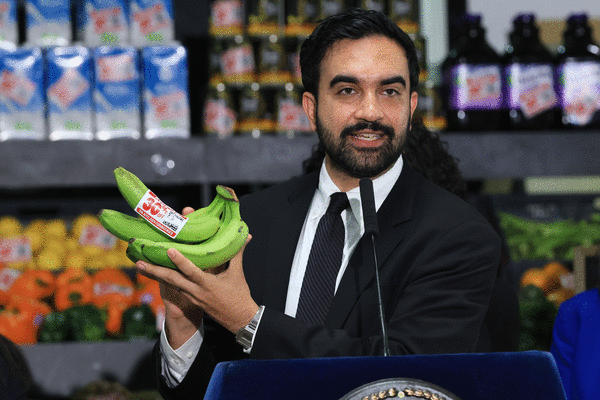
This means that when former Vice President Kamala Harris reaches out to New York City Mayor and Democratic Socialist Zohran Mamdani, she is not just repairing broken fences or seeking to widen her coalition ahead of 2028. Increasingly, politicians like Mamdani are more representative of the Democratic base’s economic ideals. Primary upsets won by Democratic Socialists like Claire Valdez and Darializa Avila Chevalier in New York, Melat Kiros in Colorado and Chris Rabb in Pennsylvania show where the party’s energy is.
Democrats’ search for a new economic script makes sense. Even in the polarizing Trump era, the Democratic Party remains historically unpopular. “More of the same” isn’t working for them politically.
And America’s economic challenges are mounting: increased wealth concentration, stagnant upward mobility, deep uncertainty around AI. Socialism might not promise dynamism and growth, but it does pledge a measure of stability: in prices, jobs, economic outcomes. (Whether it can deliver them is another question.)
But in other ways, the resurgence of socialism as an alternative ideology is ironically timed, especially for disillusioned Democrats. They are essentially arguing for giving the federal government vast economic authority — at a time when public trust in Washington is near record lows.
Even if partisans want to give their own faction that kind of power, few want the opposing party wielding it.
The result of these mirror-image developments — the rise of democratic socialism on the left and MAGA populism on the right — is that Americans are left with less economic freedom and more political homelessness.
When economic freedom goes, political freedom is never too far behind. The DSA platform includes abolishing the Senate and Electoral College, among other provisions. Tell me the political center isn’t shrinking.
The cycle feeds on itself. The more unpopular economic policies the Trump administration pursues, the more it encourages Democrats to run radically in the other direction. And when Democrats run under the banner of democratic socialism, that gives more license to the Trump administration to undertake unpopular economic policies like tariffs. The GOP can always say at least it’s not as bad as “communism” — a message the party is leaning into in the run-up to November’s midterm elections.
Partisans are forcing everyday Americans to pick from ever greater extremes. As a result, the average voter is left not only with fewer degrees of economic freedom, but also less political representation. If the only road out of MAGA populism is one paved with democratic socialism, that’s a dead end.
_____
This column reflects the personal views of the author and does not necessarily reflect the opinion of the editorial board or Bloomberg LP and its owners.
Abby McCloskey is a columnist, podcast host, and consultant. She directed domestic policy on two presidential campaigns and was director of economic policy at the American Enterprise Institute.
_____
©2026 Bloomberg L.P. Visit bloomberg.com/opinion. Distributed by Tribune Content Agency, LLC.




















































Comments