Commentary: HOAs can actually be a force for good
Published in Op Eds
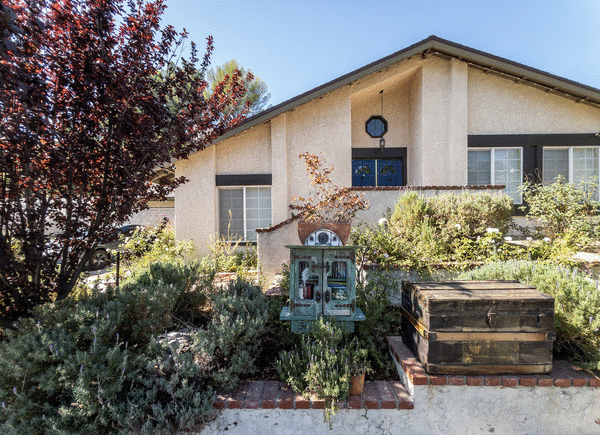
If you build a house in the United States today, there’s a good chance you’ll be living under the dictates of a neighborhood homeowners association. Roughly two out of every three new homes are in an HOA, as are a third of existing homes.
Some of these HOAs have evolved to encourage environmentally friendly yards, particularly in the desert Southwest, but many more throw up barriers to sustainability, even in communities where water is becoming more scarce, wildlife is under threat and homegrown energy could reduce pollution.
Janet and Jeff Crouch ran into the second type. They spent over a decade turning their Maryland yard into bird and pollinator habitat, with native flowering plants and trees. Then their homeowners association ordered them to replace it with turfgrass.
The expensive legal battle that followed ended with the yard mostly unchanged, but it helped inspire Maryland lawmakers to pass a low-impact landscaping law in 2021. The state declared that requiring turfgrass or restricting pollinator gardens and xeriscaping — yards designed with drought-tolerant plants and mulch or rocks rather than grass — were “unreasonable limitations.”
California has developed even stricter protections, including voiding HOA rules that ban water-resistant plants or artificial turf or require turfgrass, although the associations still can exert control over many homeowner decisions.
In many other states, however, homeowners report continuing conflicts, including over xeriscaping in Utah, native wildflowers in Texas and habitat for monarch butterflies in Virginia. Others have run into conflicts over solar panels and electric vehicle chargers.
We are conservation social scientists interested in understanding people’s interactions with their environments. Our research on HOAs has found that these private, quasi-governmental organizations are an often overlooked but influential force in environmental policy. While HOAs often act as barriers to residential environmental sustainability, we believe they could be bridges instead. Cities and states can help.
HOAs have existed since the 1800s. As suburban development began to quickly spread across the U.S. in the 1960s and ’70s, these organizations expanded with it.
Homebuyers in areas covered by them automatically become members, pay dues and agree to follow their rules as a condition of owning a home there.
Those rules are often created by developers, who initially control the HOA. Then, as homes are sold, responsibility passes to a board that interprets, enforces and sometimes amends the rules.
Because amendments often require supermajorities of homeowners to approve, developer-written rules are difficult to amend and can shape HOAs for decades.
HOAs occupy a unique position between private property and local governments. They enforce rules, collect fees, assess fines and maintain shared spaces. They also often regulate house size, building materials, driveways, yards, trees, outdoor lighting and energy production.
Their rules tend to reflect strong preferences for aesthetic uniformity, believed by some to be associated with higher home values. HOAs have considerable environmental policy power, affecting how entire neighborhoods use water, generate energy, provide wildlife habitat and respond to climate change.
Turfgrass lawns, for example, a particular American obsession, require regular mowing, fertilizing and watering, increasing greenhouse gas emissions and water use. Turfgrass is notably poor at supporting biodiversity, particularly of pollinators and bird species.
Our research team analyzed the rules of 31 homeowner associations in Ingham County, Mich., home to Lansing, to get a sense of how they influenced sustainability. We looked at 18 provisions affecting building structure, landscaping and energy and found that HOAs mostly presented barriers to residential sustainability.
For example, around three-quarters of the HOAs imposed a minimum home size. Nearly half required lawn maintenance and impervious driveways. One-third limited household energy production, such as solar panels or wind turbines. And one-quarter prohibited outdoor clotheslines.
We found comparatively few provisions that supported sustainability. Only 29% of the HOAs limited outdoor-light wattage (a hazard to migrating birds and other wildlife), 19% required residents to maintain trees, 6% constrained use of fertilizers and 3% required native plants.
In short, we found HOA provisions that impeded sustainable choices were much more common than provisions encouraging them.
In a second study, we surveyed front yards in and around Madison, Wis. Six of the HOAs we looked at required native plants in front yards, and two restricted how much yard could be maintained as conventional, turfgrass lawns. We also compared those properties with nearby yards not governed by the same rules.
The differences were substantial. Yards subject to native-plant requirements averaged 29.5% native plant cover, compared with 6.9% in yards without those requirements. Turfgrass coverage was also significantly lower where associations restricted its use. Native plants require less water and maintenance and provide food and shelter for bees, birds, butterflies and other wildlife, connecting yards to their surrounding ecosystems.
HOAs are uniquely positioned to be leaders in residential sustainability. Unlike municipalities and townships, they govern at the scale where many environmental decisions are actually made: the household.
Reasonable covenants requiring native plants, limiting turfgrass and encouraging renewable energy can produce positive changes in neighborhood landscapes. States can help by establishing guardrails that allow renewable energy, wildlife conservation and water-saving landscaping.
The greatest opportunity, however, may come before the first homeowner ever moves in. Developers, city planners and conservation organizations can work together to create model rules and provide technical assistance to HOAs as they are forming. Future neighborhoods could treat environmental sustainability as the default.
Because millions of Americans already live under HOA rules, the question is not whether these organizations will shape residential sustainability. They already do. The more important question is whether they will continue reinforcing yesterday’s aesthetic norms at an environmental cost or become partners in creating more sustainable futures.
____
Daniel Kramer is a professor of conservation at Michigan State University, where Madeline Carr is a doctoral student in fisheries and wildlife. This article was produced in collaboration with the Conversation.
©2026 Los Angeles Times. Visit at latimes.com. Distributed by Tribune Content Agency, LLC.




















































Comments