Ronald Brownstein: Democrats' 2028 map reshapes the fight between left and center
Published in Op Eds
The calendar for the 2028 primaries that Democrats tentatively approved last week flips the racial dynamics of their old presidential nominating process — and maps a path to an epic confrontation between progressives and centrists.
From 1972 through 2020, Democrats empowered Iowa and New Hampshire — two small, preponderantly White and heavily rural states — with the power to winnow the presidential field. Friday’s vote by the Democratic National Committee’s Rules and Bylaws Committee (a recommendation that still must be ratified by the full DNC in August) marks the culmination of incremental changes the party has approved since 2004 to dethrone those two states, whose privileged position rankled many party leaders as their electoral coalition, and the nation, grew more racially diverse.
The calendar the committee recommended for 2028 established South Carolina as the kickoff state on Jan. 22, followed by Nevada on Feb. 1, and then New Hampshire, New Mexico, Michigan and Virginia, each one week apart until Feb. 29.
Democrats are expecting a huge field of candidates in 2028, but history suggests that no more than two will remain viable after those states vote. From 1972 through 2020, only three candidates (George McGovern in 1972, Bill Clinton in 1992 and Joe Biden in 2020) who did not win either Iowa or New Hampshire won the nomination, and only Biden did not finish at least second in one of those two initial contests.
“Especially in a large field there is a winnowing process, and it happens really quickly,” says veteran Democratic strategist David Axelrod. “You can’t take too many losses and still raise money and go on.”
Democrats have now entrusted that winnowing role to two highly diverse states. In South Carolina, Black voters constitute nearly 60% of the Democratic electorate, according to exit polls. Nevada has substantial Latino, Black and Asian American populations that collectively cast about 35% of its vote. “This was very intentional,” says committee member Maria Cardona, a Democratic strategist.
Like a long-married couple, Iowa and New Hampshire had over the decades developed complementary roles. Heavily working-class Iowa rewarded candidates who appealed to blue-collar voters in small towns and rural communities, while more affluent New Hampshire favored those with most support among suburban college graduates.
No one can be certain yet how this new nominating system will function. At the least, it ensures that candidates cannot compete without appealing to minority voters. The ideological implications of the new calendar are less certain.
The new plan could create a more challenging pathway for centrist candidates. To be sure, South Carolina has usually been a moderating force in Democratic primaries. Only one-fifth of Democratic voters there describe themselves as “very liberal.” In 2020, the state’s large Black population played the decisive role in breaking Senator Bernie Sanders’ early momentum and setting Biden on a path to the nomination. “I don’t think the make-up of South Carolina is going to give (support) to the more extreme lane,” says Antjuan Seawright, a South Carolina-based Democratic strategist. But White moderates such as Andy Beshear, Mark Kelly and Josh Shapiro would face long odds in South Carolina if facing a viable Black candidate, particularly former Vice President Kamala Harris.
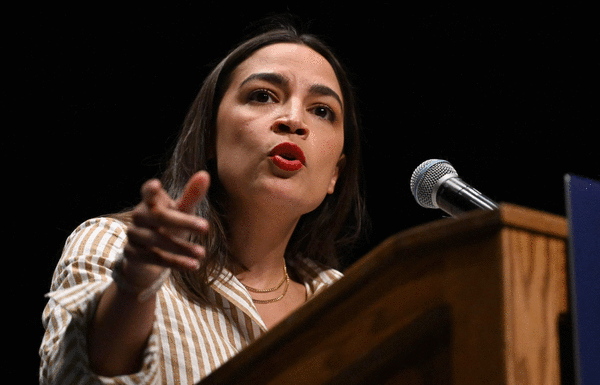
Conversely, the new map could open up a lane for a progressive. Nevada (where Sanders won in 2020) could prove favorable to a far-left candidate such as Representative Alexandria Ocasio-Cortez, if she runs. Nearly one-third of Nevada voters identify as “very liberal” — and those voters traditionally have been much more open to Sanders-type candidates than Democrats who identify as “somewhat liberal.”
New Hampshire also has a large population of liberal White college graduates who have boosted progressives in the 2026 primaries. New Mexico could be another good state for a vanguard progressive. Adam Carlson, a Democratic pollster close to the progressive wing, says “I could not design a better map” for AOC than this one.
That sets up Michigan — where Sanders beat Hillary Clinton in 2016, but Biden beat Sanders in 2020 — as the pivotal early showdown between left and center in this new calendar. Next week’s Senate primary between centrist Haley Stevens and progressive Abdul El-Sayed will offer an important measure of Michigan Democrats’ current tilt.
Virginia, in this new plan, is the final state that will vote before Super Tuesday in early March, and it has regularly seen Democrats elevate moderates such as Governor Abigail Spanberger and Senators Mark Warner and Tim Kaine. Nevertheless, if a centrist can’t capture an earlier state, he or she will likely be too deflated to win by the time Virginia votes.
Overall, Democrats have produced a thoughtful calendar that accurately represents the party’s evolving coalition. They have elevated states that are large and small, urban and rural. There are states where campaigning is cheap and states where it is expensive. As a group, the states reflect all the party’s key constituencies, with big Latino populations in Nevada and New Mexico and a substantial union presence in Michigan and Nevada.
But the hidden throughline to this early calendar is that it will most advantage a candidate who can appeal both to Black voters (who comprise a large share of the electorate not only in South Carolina but also Michigan and Virginia) and college-educated White voters (who are likely to outnumber White voters without a college degree everywhere except in New Mexico and maybe Michigan).
Potential candidates Jon Ossoff, Gavin Newsom, Harris, Shapiro and, in a different way, AOC each can reasonably aspire to combine those constituencies. But it hasn’t proved easy to do in previous Democratic primaries.
You may remember the last Democratic presidential candidate whose coalition during the primaries revolved primarily around Black voters and college-educated White voters. His name was Barack Obama.
____
This column reflects the personal views of the author and does not necessarily reflect the opinion of the editorial board or Bloomberg LP and its owners.
Ronald Brownstein is a Bloomberg Opinion columnist covering politics and policy. He is a CNN analyst and the author or editor of seven books.
_____
©2026 Bloomberg L.P. Visit bloomberg.com/opinion. Distributed by Tribune Content Agency, LLC.




















































Comments