COUNTERPOINT: Price the product, not the person
Published in Op Eds
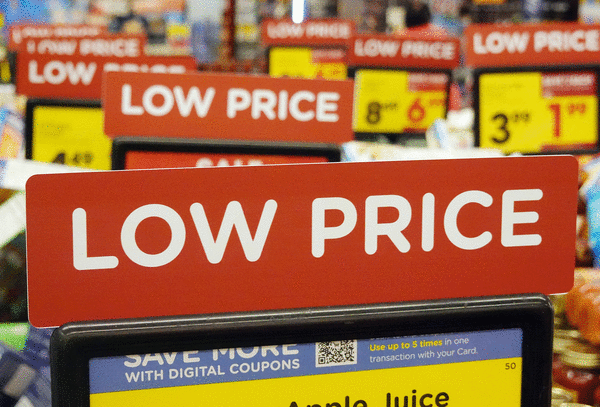
Should the price of your groceries depend on what a retailer knows about your shopping habits or your neighborhood? How would you feel if the person behind you was charged less for the same tank of gas?
That’s the reality dynamic pricing threatens to create. Dynamic pricing, often called surveillance or algorithmic pricing, allows companies to use information about us — including our location, demographics, credit history, browsing activity and shopping habits — against us to decide what products we see and what prices we’re offered. Prices can change multiple times throughout the day. While some businesses pledge not to use consumer-specific data, we still need clear protection from this harmful practice.
Dynamic pricing should be banned because it lets corporations quietly decide prices based on how much they believe they can extract from each person. It not only hurts consumers; it threatens our civil rights and undermines the principles of fairness and equal treatment that our democracy depends on.
Few of us object to a hotel room at the beach costing more in July than in January. That reflects the desirability of what is being sold. However, dynamic pricing depends on who’s buying.
Its goal is to estimate the maximum amount a person may be willing — or forced — to pay. A family buying groceries could pay more because an algorithm decides they’re unlikely to shop elsewhere. Someone urgently seeking a necessary product or service could be charged more because a company believes they have fewer options.
Most consumers never know it’s happening.
When you shop online, you can’t see the prices offered to someone on another device or in another neighborhood. You may not know whether someone else got a better deal or whether a discount was withheld because a company predicted you’d buy anyway.
That secrecy turns a basic principle of consumer protection on its head. Comparison shopping means far less when websites can show different prices and products to different people.
In the digital age, technology must work for us, not be used to take advantage of us. Price differences between neighborhoods were once visible. Today, companies can make those distinctions instantly and privately, one person at a time. Data collection and predictive algorithms have made individualized pricing easier to implement and much harder to see.
And the consequences go far beyond an unfair grocery bill. Consumer protection has never been only about protecting our wallets. Instead, it’s about creating fair rules of the game, so we can all build our lives, families and communities without a constant fear of being taken advantage of.
Dynamic pricing raises questions about who holds information and power — and whether people can recognize and challenge unfair treatment. It can deepen income and wealth disparities and produce discriminatory price differences connected to things such as your race or gender.
A democracy that works for all of us can’t allow powerful corporations to sort people into categories secretly, determine what each person can be made to pay, and deny consumers the information they need to challenge unequal treatment. Fair participation in our economy and democracy requires transparency, accountability and equal protection from discrimination.
We should be able to rely on our government to guard against the predatory misuse of personal data. Some of these practices may already violate the law, but the lack of transparency means that the unfair treatment is hidden. And, to make matters worse, the federal agencies with the expertise and authority to act, like the Federal Trade Commission and the Consumer Financial Protection Bureau, have been kneecapped by the Trump administration.
Stronger protections for consumers are needed. States are now trying to fill that void. New York has required disclosures when personal data is used to set prices. Other states have pursued stronger restrictions and bans on surveillance pricing.
Congress has a duty to protect people from corporate abuse. Instead, it’s considering laws that put corporate power above the rights of states to protect their residents from exploitative pricing practices. Businesses should be free to compete. They shouldn’t be free to discriminate or decide that two people have to pay different prices for the same product because of an algorithm.
When corporations rig the system to feed their bottom line, privacy, fairness and accountability disappear. Dynamic pricing doesn’t just hurt consumers’ wallets; it gives powerful companies another hidden tool to deepen inequality and weaken the promise that our economy and democracy should work for everyone.
____
ABOUT THE WRITER
Carol Evans is vice president of Common Cause’s policy team. She formerly was deputy fair lending director at the Consumer Financial Protection Bureau. She wrote this for InsideSources.com.
___
©2026 Tribune Content Agency, LLC





















































Comments