Commentary: Sending armed agents to reporters' homes is a threat to free press and whistle-blowers
Published in Op Eds
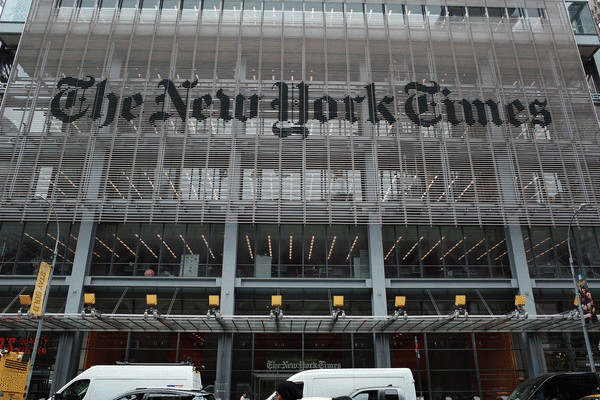
Last week, the U.S. Department of Justice withdrew subpoenas that would have required reporters from the New York Times to turn over phone records and testify in court about their sources on security concerns related to President Donald Trump’s new Air Force One. The move came during a hearing in which a federal judge sharply criticized the department for violating its own rules limiting prosecutors’ use of subpoenas and other tools to demand information from journalists.
While the withdrawal of the subpoenas is certainly welcome news, it doesn’t erase the damage that has already been done.
It’s troubling enough that the federal government issued these subpoenas at all. What’s worse is the way in which they did it: by showing up on reporters’ doorsteps.
Indeed, armed FBI agents served the subpoenas at the homes of three Times reporters, including one who, according to NPR, was “watching the new movie 'The Sheep Detectives' with his elder son” when they arrived.
It’s not the first time that the Trump administration has sent government agents to reporters’ residences. Earlier this year, the FBI executed a search warrant at the home of Washington Post reporter Hannah Natanson and seized her electronic devices as part of an investigation into a government contractor.
Government searches, subpoenas and other legal demands targeting journalists’ materials, sources and communications represent extraordinary government overreach. That these incidents both involved armed federal agents showing up at the homes of reporters signals a systemic, intentional effort to intimidate the press.
The decision by the Justice Department and the FBI to serve subpoenas at the homes of reporters instead of to their lawyers is not appropriate.
Both the New York Times and the Washington Post are represented by legal counsel. In addition to in-house newsroom lawyers, they retain outside law firms for any number of issues that arise in the course of news operations. These are well-known facts, and certainly the Department of Justice is intimately familiar with those relationships — because both newsrooms are in court challenging government policies and actions.
The Post challenged a similar subpoena issued to national security reporter Ellen Nakashima, which the government withdrew after a court hearing. And the Times has successfully challenged the Pentagon’s onerous credentialing policy, which led virtually the entire Pentagon press corps to give up access to the building rather than agree to the policy.
Moreover, Justice Department policy requires advance negotiation in investigations that may involve reporters. As such, and at a minimum, the government should have reached out to lawyers for the outlets and sought an agreement that would have avoided armed agents showing up at the reporters’ doors. The relevant criminal rule also permits service by anyone over the age of 18; the government could have used a private process server if for some reason it seemed necessary to give subpoenas to the reporters at their homes.
The heavy-handed tactics of sending armed agents to homes are chilling. They seem aimed at instilling fear in both the reporters who are doggedly pursuing stories in the public interest and the sources who are shining a light on things the public needs to know. The message it sends is that the government is always watching, and that if you report things the administration doesn’t like, agents will come after you and your families.
The details reported by the Times about Trump’s new Air Force One, which was given to the president by the Qatari government, are of significant public interest. As the Times reported, the plane lacks certain anti-missile defense systems, making it risky for international travel.
U.S. taxpayers have already poured hundreds of millions into retrofitting the donated plane, with no clear accounting for how any of it is being spent. Dozens of people travel on Air Force One with the president and rely on the government for their safety and security. That the Secret Service raised serious concerns about the plane’s fitness to carry the president, crew, security, staff and press is clearly in the public interest.
The government’s response sent a dangerous message that it will go to extremes to silence reporting that it dislikes. That will almost certainly come at a cost to the American public — which may remain in the dark about future misconduct by officials and threats to the nation.
____
Gabe Rottman is the vice president of policy at the Reporters Committee for Freedom of the Press.
©2026 Los Angeles Times. Visit at latimes.com. Distributed by Tribune Content Agency, LLC.















































Comments