Editorial: Can private screeners do the job of the TSA?
Published in Op Eds
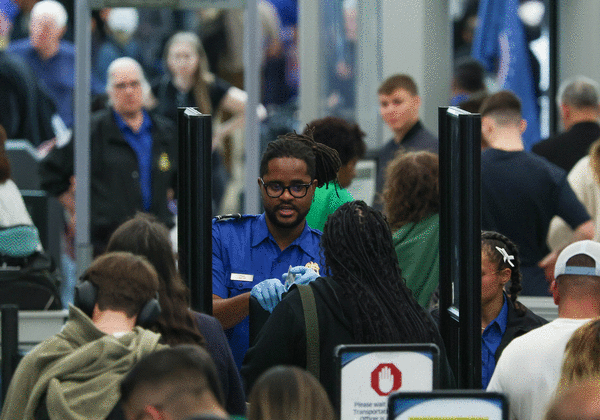
Those of us of a certain age remember the grainy security videos on Sept. 11, 2001, when bored and inattentive private screeners let murderers and hijackers through checkpoints. That led Congress to create the federal Transportation Security Administration with widespread support from Americans who never wanted to see that happen again.
But that was nearly 25 years ago. A very different era when it comes to screening technology.
Tampa International Airport, Des Moines International Airport and Charleston International Airport now say they plan to transition throughout 2027 to the TSA’s new Gold+ program, a voluntary public-private partnership program that allows airports to use private security screeners, and eventually private investment in screening technology, under TSA oversight.
TSA remains the regulator, which is crucial, but not the operator. The federal government still writes the rules, sets the standards, oversees compliance and enforces security requirements. Private companies simply manage the checkpoints and the screening workforce. It’s privately operated, but federally regulated airport security.
The prospect of seeing their membership rolls and their jobs pipeline diminish is unwelcome news to labor unions. The American Federation of Government Employees, which represents nearly 50,000 TSA employees, must see the writing on the wall for numerous union jobs should Gold+ be taken up more widely.
We are unsurprised that unions would resist any such whiff of further privatization with every fiber of their being.
Union leaders can fight for their workers’ job security. These three airports, however, are within their rights to try something new.
But is it really that new?
The discussion over privatizing airport security hasn’t taken root widespread across the country, but the seeds were planted decades ago. What many travelers don’t realize is that this isn’t a brand-new idea. The TSA already has a privatization option airports can pursue — its Screening Partnership Program — which launched in 2004. The legal framework for SPP is even older, being part of the Aviation Transportation Security Act of 2001 that established TSA. Twenty airports leverage it already, the largest being San Francisco International Airport, typically among the busiest airports in the country.
This should largely dispel concerns about the novelty of such ideas, in our view. Gold+ is merely the expansion and enhancement of a program that was built into the U.S.’s post-9/11 airport security model.
And for the folks who argue, “if it ain’t broke, don’t fix it,” sure — with big change, especially in an industry as big and important as aviation, comes risk. What if what follows further privatization is dysfunction and danger for travelers?
Again, however, this is not the far-reaching change some would have you believe. After the ATSA passed, Congress required TSA to run SPP as a pilot program with five airports, including San Francisco International and our fellow Midwest hub Kansas City International.
These airports have operated under TSA oversight since that pilot began in 2002 without demonstrating that the model itself compromises security. During the most recent shutdown in the spring, San Francisco International Airport — where private contractors have staffed checkpoints for more than two decades — continued operating relatively normally while some federally staffed airports struggled with long security lines and staffing shortages.
Finally, as we pointed out in March, countries such as Canada and the United Kingdom structure airport security in ways that make screening less dependent on the kind of federal budget standoffs that repeatedly disrupt U.S. airports.
Some promote a solution to shutdown airport security gridlock that would require Congress to pass legislation providing that TSA security workers continue to get paid even in the event of future issues.
That’s one reasonable option.
Gold+ and the SPP are another, and one that’s available to test right now without having to wait for the slow wheels of federal legislation to grind into gear. We suspect private companies could get the latest technology in place far quicker than a TSA that has to deal with federal procurement rules.
That said, we generally are impressed with the improvements TSA has made with its PreCheck and Touchless ID options, and we rarely wait in line for an overly long period at Chicago’s O’Hare and Midway airports. And the security record speaks for itself. We’re aware of the many dedicated employees.
Still, Washington has repeatedly demonstrated it can’t keep airport screening insulated from political dysfunction. Rather than arguing endlessly over theories, we are open to further experimentation to find out what actually works. If Gold+ succeeds, we say: expand it. If it doesn’t, don’t. But safety has to be always the top priority over every other factor.
_____
©2026 Chicago Tribune. Visit chicagotribune.com. Distributed by Tribune Content Agency, LLC.





















































Comments