Anita Chabria: This California Republican has a plan for controlling AI. Can he make it happen?
Published in Op Eds
SACRAMENTO, Calif. — Last week, news broke that an artificial intelligence thingamajig broke free from the constraints of its maker, OpenAI, and committed what could be considered a string of white-collar felonies if it were human.
Because the AI thingamajig is in fact not human, the incident raised a big kerfuffle but is largely being treated as a giant oopsie we can learn from, without needing the pesky intervention of new rules or laws to stop it from happening again.
Such is the state of AI regulation in America right now.
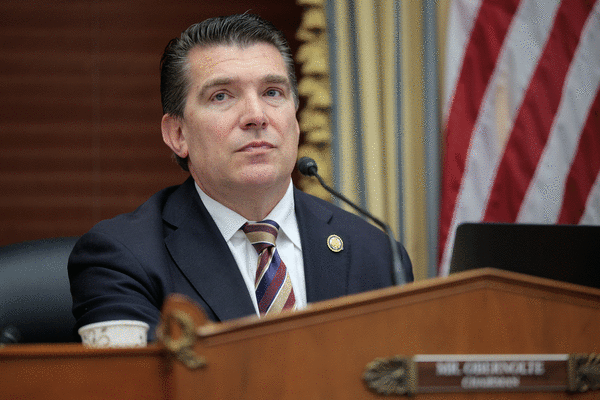
California Rep. Jay Obernolte, R-Big Bear Lake, would like to change that. Last week, he introduced the bipartisan Frontier Act with Rep. Lori Trahan, D-Mass. While the bill might not make either safety advocates or big tech companies entirely happy, it offers up the most comprehensive and strongest regulations of this dangerous industry that we’ve yet seen at the federal level.
Roman Yampolskiy, an AI expert and professor at University of Louisville, called the Frontier Act a “positive step because it acknowledges that frontier AI presents risks requiring dedicated oversight.”
Now, the challenge becomes passing it, and passing it in a meaningful, not-watered-down form — no easy task in a dysfunctional Congress driven by money and Donald Trump, and paralyzed by its own sycophancy to both.
If anyone has a shot, though, it’s Obernolte, who is that rarest of birds, a legislator who understands science, and his colleagues.
Obernolte represents Inland Empire areas around San Bernardino, but grew up in Fresno back in the era when the movie “War Games” was just hitting theaters.
Those of a certain age will remember how far-fetched it seemed when Matthew Broderick’s high school genius character accidentally breaks into a military AI system to play chess, but “Joshua,” the computer, takes it too far and tries to blow up the world. Now, of course, that just sounds like a regular Tuesday.
By the time he was in high school himself, Obernolte was giving that Broderick character a run for his money. An apparent computer savant, Obernolte was competing in artificial intelligence contests as a teenager, back when most of us were still playing Pong on Atari. Then he headed off to Caltech and then UCLA for advanced AI degrees. He said AI was his “first calling,” sparked when his father bought him an Apple II computer when he was 8.
He ended up dropping out of UCLA after getting his master’s because his side hustle making video games, including “NFL ’95,” turned out to be more lucrative than being a starving student. He ended up founding his own video game company, FarSight Studios, and building up a personal net worth close to $100 million.
Not bad for a kid from Fresno. In Congress, he has stuck close to the MAGA power base and was one of seven California legislators to vote against certifying the 2020 election results, a vote he took in his first days in office. He has been endorsed by Trump multiple times, and now sits on a bunch of committees and subcommittees of relevance.
For the past few years, he has pushed hard, if unsuccessfully, to create a framework for regulating AI, combining his deep understanding of the technology with his equal understanding of MAGA distaste for intervening in business.
Now, though, we’re in a moment, thanks to more than one big oopsie by technology companies. Just a few months ago, Anthropic and the Pentagon had their own tense encounter after Anthropic questioned how its AI was being used by the military. Huffy Pete Hegseth is still huffing over that one.
The public is increasingly skeptical of allowing the AI industry to govern itself, which is pushing legislators to rethink their hands-off approach, even as AI money pours like Niagara Falls into elections. Even Trump seems more inclined to consider it, signing an executive order recently that largely called for voluntary restraints on AI companies.
The introduction of the Frontier Act “shows how far the Overton window has shifted just in the past few months,” wrote Charlie Bullock, a senior research fellow with the nonpartisan Institute for Law & AI. “Not too long ago, a bipartisan bill this good and serious would have been a pipe dream. But things change quickly.”
Obernolte said the bill has been “a long time in the making,” but he hopes to package it with other legislation and is “cautiously optimistic” he can get something passed and signed by the end of the year.
As written now, the bill would allow the federal government to set minimum safety requirements and set up a framework for licensed, independent auditors to monitor compliance. That third party verification has been a key push by safety experts.
The bill would also give the government emergency powers to pause an AI model if it has a “present or impending catastrophic risk.”
It also borrows from state laws including California’s Proposition 53 that require some (not enough) transparency on the part of AI companies when things do go wrong.
To the consternation of some, the bill still contains curbs on what states can regulate on their own — basically carving out AI regulation as federal turf. This has been a huge sticking point in the fight over AI regulation because AI companies hate state laws and want them squashed. Their argument is that a patchwork of rules across states is too complicated.
“You don’t want to have 50 different state requirements for every single product that gets sold on a market, and that is particularly true of AI,” Obernolte told me.
To some extent that’s reasonable — but the problem so far has been that states such as California and New York have been the only level of government willing to try at regulation. California in particular has created some of the most comprehensive AI regulations to date and has about 30 pending bills on this issue this legislative season. The Frontier Act threads the needle on this by creating lanes where states can still pass their own laws — such as around consumer safety that would protect children or stop pornography.
But preventing catastrophic risk would largely be dependent on the federal oversight, which is great when the federal government is up to the task. Currently, we can’t even keep measles in check. So that’s a bit worrisome.
And Obernolte’s bill isn’t the only one vying for attention. Another Californian, Rep. Ted Lieu, introduced a bipartisan measure of his own with Nathaniel Moran, R-Texas. Dubbed the AI Kill Switch Act, it would give the Department of Homeland Security the authority to shut down problematic models.
Yampolskiy, the Louisville professor, said that bill had promise as well, because it’s important for companies to have a way to “rapidly disable or contain systems that exhibit dangerous or unexpected behavior.”
But, he warns, that’s just one part of the “complete solution” we need. Regulation is going to require more than one law.
For Obernolte’s part, he’s shown a willingness to work on a practical solution, not just a political one. That alone is worthy of notice. The Frontier Act is a genuine attempt to govern a nascent industry that is too powerful and unpredictable to be left to its own devices.
“I’m hoping that we’ve landed somewhere that everyone can understand and be happy with,” Obernolte said. “AI is not something that needs to be a partisan issue, and I don’t think it should be.”
_____
©2026 Los Angeles Times. Visit at latimes.com. Distributed by Tribune Content Agency, LLC.
















































Comments