Editorial: Don't rebuild the tariff wall. Demolish it
Published in Op Eds
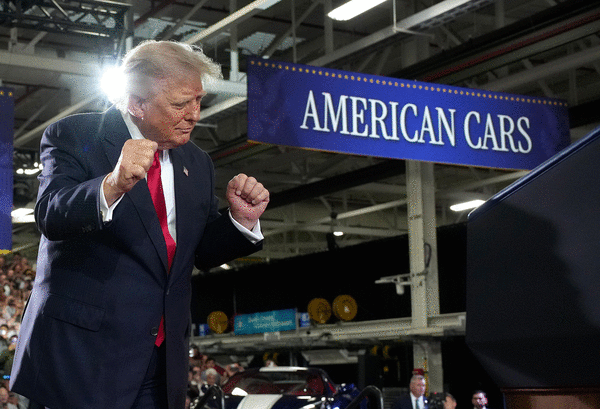
Since the Supreme Court struck down its “Liberation Day” tariffs earlier this year, the White House has been turning to other ways of getting trade policy all wrong.
Its first idea was a 150-day tariff of 10% applied to almost all imports. When that measure expired last week, officials were ready with yet another scheme. This one may prove more durable — and hence far more damaging.
The new policy essentially replicates the old under a more creative legal interpretation. It imposes so-called Section 301 tariffs of up to 12.5% on U.S. trading partners that have failed to pass or enforce laws banning products made with forced labor. According to the White House, that covers almost all the goods the US imports. The pretext strains credulity for sure. But the measure might nonetheless pass legal muster and comes with no automatic expiration date.
Further investigations are now underway, with a view to punishing China and other countries for “overcapacity” that harms the US. Combined with the new forced-labor measures, this battery of extra taxes could plausibly raise the average effective tariff rate from 11%, where it’s stood in recent months, back to 14%, restoring most of the impact of the Liberation Day schedule.
That’s not all. Earlier this month, the administration imposed new 25% tariffs on certain imports from Brazil, accusing it of unfair trade practices. Last week, it announced new duties of 50% on $20 billion of imports from Canada — counterretaliation for Canada’s earlier retaliation against other U.S. barriers. These are so-called Section 338 tariffs (aptly enough, a disinterred provision of the 1930 Smoot-Hawley Tariff Act).
They have fewer procedural requirements and would apparently override the exemptions built into the U.S.-Mexico-Canada Agreement that have so far shielded most North American trade from the protectionist onslaught.
This escalation is bewildering for many reasons, not least because the tariffs imposed up to now have so visibly failed. Setting aside the harm to America’s alliances and its standing as a global leader, consider only the narrower economic and political costs. With mid-term elections approaching and voters preoccupied with affordability, new and higher tariffs will push prices up yet again.
If inflation picks up, the Federal Reserve might have to raise interest rates. Mounting costs and chronic uncertainty will continue to suppress investment. Meantime, the promised benefits — a smaller trade deficit and higher manufacturing employment — are nowhere to be seen, just as most economists warned.
Granted, the tariffs have raised some badly needed revenue. But this apparent benefit is misleading, because taxes that suppress growth — as tariffs do, especially when imposed so erratically — undermine the economy’s ability to support public debt. In fact, the risk that Washington will come to rely on tariffs to postpone a fiscal calamity might be the most insidious of all the dangers posed by this approach.
An addiction to tariffs will make the eventual fiscal reckoning very much worse.The White House needs to swerve away from this danger as soon as it can. And whatever it decides, Congress must belatedly bring tariff policy back where the Constitution says it belongs, with the legislature. The longer this reckless experiment goes on, the worse the damage will be.
____
The Editorial Board publishes the views of the editors across a range of national and global affairs.
©2026 Bloomberg L.P. Visit bloomberg.com/opinion. Distributed by Tribune Content Agency, LLC.














































Comments