Commentary: A Columbus Day question -- Have we finally stopped distorting our past?
Published in Op Eds
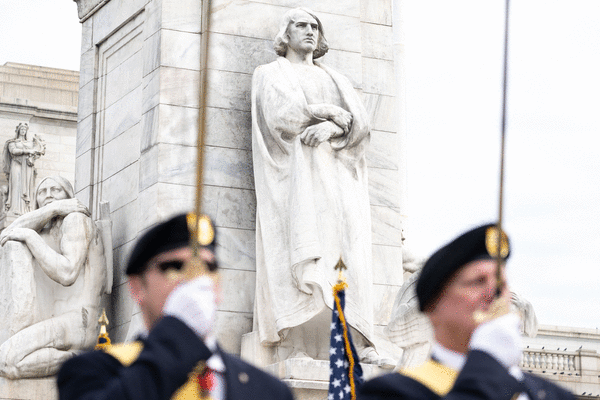
Dilapidated artwork says a lot about a society. Restoring it can breathe fresh life into a culture. A timely case in point: the Christopher Columbus fountain in front of Union Station in Washington, D.C.
It’s a reminder of our history and of our connection to the old world. Yet it was left to ruin for nearly 20 years. The water didn’t flow, the marble was vandalized and dirty, and the statue was defaced with graffiti during anti-American protests.
This reflects our larger societal problem: the ignorance and hatred of our Western inheritance. We’ve neglected important symbols like the Columbus fountain because we’ve neglected the history behind them. The fountain of the Western intellectual tradition hasn’t flowed for some time, and we must restore it—not just by cleaning up fountains and statues, but by supplementing our own education.
Our intellectual neglect developed over time. In 1952, Robert Maynard Hutchins, an editor of the Great Books of the Western World, warned against education that emphasized vocational training and specialization at the expense of the classics—the great texts of our civilization.
In true Orwellian fashion, “progressive” education of our own day has proven to be regressive. The energy is toward disdain and criticism. Progress cannot be built on contempt of the past, otherwise each generation would be restarting.
Contempt, abandonment, or just plain neglect of the past is standard fare for many schools. We shouldn’t have been surprised then when 33 Columbus statues were removed or destroyed in 2020: Union Station’s was vandalized, Baltimore’s was thrown into the harbor, Philadelphia’s was temporarily covered with a box, and many more were simply removed.
For the sake of our posterity and Republic, we must make a major change beginning with ourselves. For those of us who went through education detached from history or hostile to our shared inheritance, we can make up for lost time. We need more warriors ready to defend our heritage.
For multiple generations the academy has been infected with critical theory and over-specialization, while K-12 miseducation has contributed to the fact that about a third of American adults are unable to name all three branches of government and 64 percent believe racism is widespread in the United States.
Fortunately, our predecessors left us with a great well to draw from. Hutchins’s collection is a fine place to start; even beyond those volumes, we are blessed with nearly unlimited access to resources.
Our work at the Heritage Foundation is designed for this very purpose. Major projects like our Heritage First Principles series, Guide to Historical Sites, and the Essential Constitution collection, are not designed for the ivory tower, but for the kitchen table. Our work is for everyday Americans with busy lives who want to learn and defend our country.
Beyond these resources, Americans have access to libraries of free books online, free online courses from Hillsdale College, podcasts and YouTube videos, and group programs like the Colson Fellows.
The self-taught life is demanding, yet essential in our efforts to restore the Republic. We should be encouraged by the example of Ben Franklin, the son of a candlemaker with only two years of formal education who became a consequential founding father. It was Franklin who famously quipped that we have a Republic, if we can keep it. Yet we can’t keep what we don’t know.
The stakes couldn’t be higher. As long as apathy reigns, the radical left will keep ripping apart our history and unity. The revival of the D.C. Columbus statue by President Trump should give us hope that we can reverse the trend.
Beyond the statues, the decades-long campaign against Columbus Day has always had broader civilizational goals. The renaming of Columbus Day and the removal of his statues were framed as “honest discussions about Columbus’s flaws.”
This Columbus Day, we should reflect on the story of his exploration and its significance for our country. We should honor and respect this bridge to the old world. In 534 years, we have a lot to be grateful for, such as how many ventured here in search of freedom, and how true progress eventually eliminated the scourge of slavery that was imported from the old world.
Some 534 years from now, will our posterity look at us as the generation that righted the ship, preserved the Republic, and restored our Western intellectual fountain? Or will they even know the name Christopher Columbus?
There is still hope. It begins with us, with our minds informed by the past, our actions emboldened in the present, and our eyes fixed firmly on the horizon.
Like our fight for “Merry Christmas,” be sure to unapologetically wish those you see a happy Columbus Day.
_____
Derrick Morgan is Executive Vice President, and Matthew Schick is an Executive and Research Assistant, at the Heritage Foundation.
_____
©2026 Tribune Content Agency, LLC.


















































Comments