Commentary: Cornell case shows #MeToo is still changing the world
Published in Op Eds
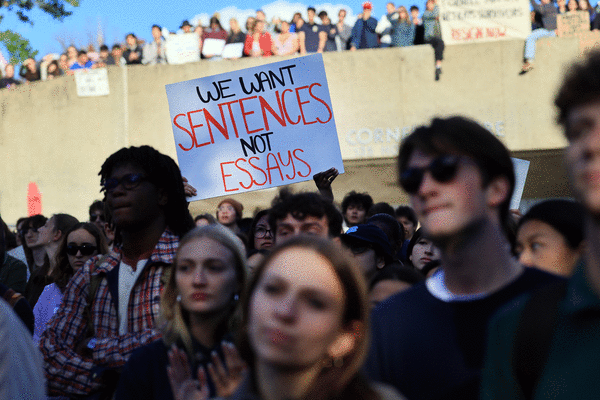
Not long before the #MeToo hashtag erupted in 2017, two young women, who said they’d been raped while studying at the University of North Carolina, organized a national movement to stop campus rape and confront the colleges that did little to punish it. Ten years later, here we are, consumed with national outrage over yet another alleged alcohol-fueled fraternity gang rape, this one at Cornell University.
Sometimes it seems that no matter what women say or do, nothing changes. A minority of men, it seems, can morph in an instant from trusted acquaintances or dance partners into hunters who regard us as sexual prey. And chances are, they’ll get away with it. But the Cornell case shows that something significant has changed.
Since I was a college student in the 1970s, women have organized rape speak-outs and Take Back the Night marches. Researchers have compiled grim statistics. (According to the documentary “The Hunting Ground,” 100,000 young college women a year can expect to be forced into unwanted sex.) An avalanche of abuse memoirs have described rape’s long-lasting, traumatic effects. And yet, it seems, predatory men, even repeat offenders, frequently escape justice.
Take, for example, the outcome of famous criminal trials since 19 million women worldwide tweeted #MeToo in 2017, when two female reporters at the New York Times exposed Harvey Weinstein’s long trail of slime. Only two criminal convictions against Weinstein have survived repeated trials, appeals and partially hung juries.
Bill Cosby, accused by scores of women, was released from prison in 2021 after his sole criminal conviction was overturned on a procedural error.
Last year, Sean “Diddy” Combs was acquitted of the most serious charges against him (sex trafficking and racketeering) and convicted of only two relatively minor Mann Act violations.
With each defeat in the criminal courts, someone in the media (most recently, Helen Lewis in the Atlantic ) declares that a backlash has resulted in the death or “total abandonment” of the #MeToo movement.
I take a longer view. #MeToo is not dead, any more than the civil rights movement is dead because of recent Supreme Court rollbacks, or the reproductive freedom movement is dead because Roe vs. Wade was overturned. Looking back, I am filled with hope. There is no going back.
In the late 1960s, when I was 16, I brought home a friend from boarding school for a weekend at Wesleyan University, where my father taught and informally coached the rugby team. He took us to a game and then to a fraternity house on College Row where we were introduced to college men, drinking songs and thumping good cheer. The next day, my friend went to the dorm room of a rugby player she’d met. She quietly told me later that he had raped her. I was heartsick. In my naivety, I thought that rape was committed not by nice college boys but by “others” — motorcycle gang members and strangers lurking in bushes.
It did not occur to me to tell my father. Her rape was just one more secret for us teenagers to keep. In those days, out of a justified fear that we would be stigmatized, shamed and blamed, sexual abuse was a secret women kept, often even from each other. We didn’t recognize that the rugby player had done something morally wrong, much less something criminal.
That has definitely changed. Fast forward to 2024, when rumors of an alleged, messy, alcohol-and-drug-fueled gang rape swirled through social media at Cornell University. The independent Cornell Daily Sun is run almost entirely by women students. They refused to let the story die after the university’s unsatisfying Title IX investigation and the local district attorney’s decision not to prosecute. Editor in Chief Sophia Dasser and reporter Cereese Qusba had their hands on levers of power unthinkable to my generation of young women.
Late last month, they decided to print the names of the young men accused after the alleged victim filed a civil suit against them using the pseudonym Jane Doe. The seven names ricocheted nationally across social media. All have denied wrongdoing. One has been fired from his job.
Dasser and Qusba were children nine years ago, when the #MeToo movement hit Twitter. They grew up in a culture that has changed for the better. Support for Jane Doe crosses gender lines. The code of fraternity omerta, or mutually protective brotherly silence, has broken down. It was a male student who first used the term “gang rape” to condemn the young woman’s alleged sexual degradation. It was another male student who took screen shots of the fraternity’s disgusting group chat declaring “free pussy upstairs” and gave them to investigators and to Jane Doe. Two of the accused were immediately kicked off the Cornell rugby team. “As a team it was important for us to support this victim,” one member of the team told NBC. “We are extremely, extremely distraught.”
To be sure, vigilante justice and internet shaming are double-edged swords. The seven young men named were not, according to the lawsuit, all accused of engaging in sexual contact with Jane Doe but all are equally tarred. Like most acquaintance rape cases, this one is messy. Jane Doe went to the fraternity deeply intoxicated. Her memories of the night are spotty. At least one of the men has argued that in her drunken state, she voluntarily engaged in sex with the first two men. Her lawsuit charges that she was then plied with more drugs and offered up, against her will when she was barely conscious, to the entire fraternity, many members of which afterward slut-shamed her. New York state law, unlike California’s, does not presume that an intoxicated person is incapable of consenting to sex. (In the aftermath of this case, that law may be changed.)
Nothing can take away the devastating long-lasting effects of sexual trauma. But in the aftermath of #MeToo, civil suits against Weinstein, Jeffrey Epstein and Combs have been settled for tens of millions of dollars. More than a dozen states, including California, have lengthened or eliminated statutes of limitation for civil or criminal charges involving child sexual abuse and/or adult sexual assault. It is doubtful that without #MeToo, the Miami Herald would have assigned Julie K. Brown to investigate Epstein’s 2008 sweetheart plea deal, leading to his renewed prosecution and successful bipartisan demands for release of the Epstein files.
“MeToo changed the cultural landscape,” said Sam Dordulian, a prominent Los Angeles victims’ rights lawyer who served as a sex crimes prosecutor in the L.A. County district attorney’s office until 2008. “Look at the Cornell case. Yes, she probably didn’t get justice back then that she probably deserved. But look at what is happening now. The D.A. rejected the case — and now you have the governor appointing a special prosecutor.”
Now that women’s voices have escaped from “whisper networks” and entered the public square, our society is doing better. “We’re starting to have an understanding of how sexual trauma works,” Dordulian told me last week. “There’s more openness, more willingness to give her a fair chance than there was before the MeToo movement started.”
The veteran victims’ rights attorney Gloria Allred believes that those who repeatedly announce the death of #MeToo are indulging in wishful thinking. “Women are empowered in a way they have never been before,” she said. #MeToo was a handy hashtag, a king tide. But the movement boiling beneath it represents a sea change in the consciousness of women — and many men. Women who are victimized are less likely to be shamed into silence. Online, we can find each other. We have reason to believe that what we say will be taken seriously. Our willingness to speak out began gradually, decades before the hashtag surfaced, and it will continue until sexual justice becomes an ordinary reality in the lives of women.
____
Journalist Katy Butler is the author of “Knocking on Heaven’s Door” and “The Art of Dying Well.”
©2026 Los Angeles Times. Visit at latimes.com. Distributed by Tribune Content Agency, LLC.
















































Comments