Commentary: What makes a college civics requirement work
Published in Op Eds
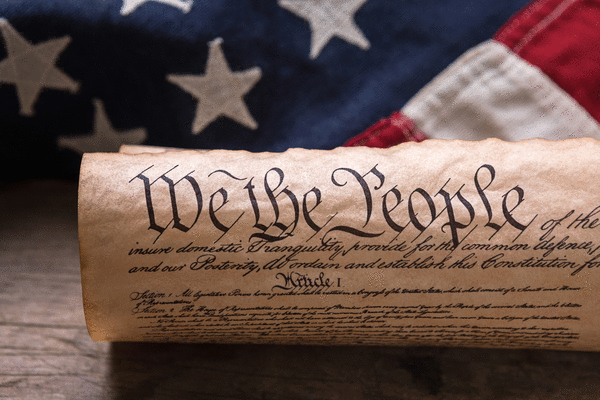
Students entering Ohio’s public universities this fall are the first four-year cohort expected to graduate under the state’s new American civic literacy requirement. Beginning with the spring 2030 graduating class, students must complete an approved three-credit course built around the Constitution and other foundational texts, with limited exemptions for equivalent coursework.
Ohio is not alone. More than a dozen states now have some form of undergraduate civics course requirement, and Iowa has recently enacted a two-course requirement for undergraduates entering four-year programs at its three public universities beginning in 2028. As more states adopt these requirements, faculty and lawmakers need workable models for putting them into practice.
The best civics requirements establish a limited common foundation that students should encounter while leaving faculty responsible for how those materials are taught, interpreted, and placed in context. South Carolina’s REACH Act offers one workable version of that balance, and I have spent several years teaching American Government under it.
The law took effect in 2021 and requires undergraduates at public institutions to complete three credit hours in American history, government, or an equivalent course. All students read the Constitution, the Declaration of Independence, and the Emancipation Proclamation in their entirety. Instructors also select at least five Federalist essays and one or more documents foundational to the African American freedom struggle. In my course, I usually assign Martin Luther King Jr.’s “ Letter from Birmingham Jail.”
The REACH Act establishes a required core, not an entire syllabus. Instructors may assign additional primary sources and organize the required texts within a broader course. That division of responsibility is appropriate at a public university. The state may reasonably expect graduates to know the documents on which American government rests. Faculty decide how those documents fit into a course and what students need in order to understand them. Requiring students to study these documents ensures that this part of their civic education does not depend on which electives they happen to choose.
The REACH Act determines some of what students encounter. It does not determine what they must conclude. That distinction is important because civic education should help students make political judgments for themselves. In life beyond the classroom, citizens regularly hear competing claims about what the Constitution permits and how public officials should exercise their power. Students are poorly equipped to evaluate those claims if they know the nation’s foundational documents only through political rhetoric. Reading the documents themselves gives them direct access to the texts on which so many public arguments depend, as well as a stronger basis for judging which claims those texts actually support.
The required documents introduce students to both the principles and the conflicts that have shaped American government. The Declaration articulates claims about equality and consent; the Constitution creates governing institutions; the Federalist essays reveal how contested that design was from the beginning; and later documents show Americans struggling over the meaning and reach of the nation’s stated commitments. Teaching these works together helps students see American constitutional development as an extended conversation rather than a settled creed.
This approach demands more than memorization. Students should know when the Declaration was written and what powers the Constitution assigns to each branch of the national government. Students benefit from having these facts as a base of civic knowledge, but impactful civic education teaches them to use that knowledge to evaluate competing claims, a skill that will serve them well in both private and public life.
Developing that kind of judgment depends on how faculty teach the assigned texts. In my experience, the REACH Act leaves instructors considerable room to build a course around its required core and teach the documents in context. During our unit on the founding, for example, students handle reproductions of founding-era documents and examine the political choices, conflicts and compromises that produced the constitutional system. The mandate establishes common material for students to encounter, while leaving me substantial freedom to determine how that material fits into the larger work of the course.
As more states adopt college civics requirements, South Carolina offers a useful model. States can establish a meaningful civic foundation while faculty shape how those materials are taught to deepen students’ civic understanding. The result can be a shared civic foundation that better prepares students to participate thoughtfully and effectively in public life.
____
Justin Vaughn is a professor of political science and director of the Center for Applied Civic Leadership at Coastal Carolina University.
_____
©2026 The Fulcrum. Visit at thefulcrum.us. Distributed by Tribune Content Agency, LLC.


















































Comments