Mark Gongloff: Florida's dengue fever outbreak is a national warning
Published in Op Eds
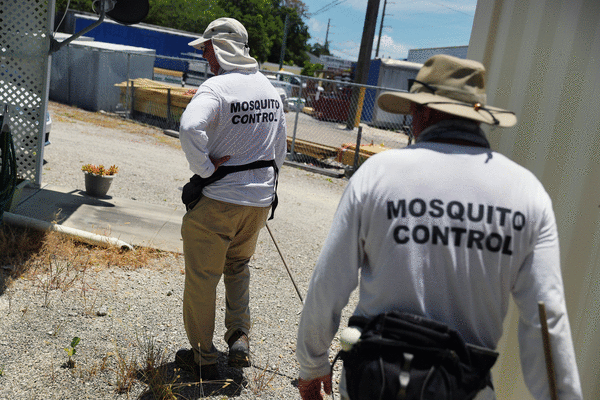
For a state whose government officially doesn’t believe climate change is real, Florida remains our nation’s busiest climate-change laboratory.
The latest test for the Sunshine State is an outbreak of dengue fever, the largest in the U.S. since the 1940s. The numbers are relatively small: 485 cases as of the latest count from the Centers for Disease Control and Prevention, largely concentrated in Tampa’s home county. But any case of the disease — sometimes called “break-bone fever” because of how it makes sufferers’ bones feel — was rare in the U.S. not long ago.
It’s too soon to attribute this particular episode to climate change because Florida can certainly be hot enough for a dengue outbreak under any circumstances. But a warming planet is making broader swaths of the planet friendlier to disease-carrying mosquitoes, which spread dengue fever. Florida’s experience today will be an example for places at higher latitudes in the near future.
The Aedes aegypti and Aedes albopictus mosquitoes that spread dengue are most dangerous in sustained temperatures of 26 to 31 degrees Celsius (79 to 88 degrees Fahrenheit), according to a study published this week in the journal Science Advances by researchers from Monash University in Australia. These insects also love high humidity and rainfall (though they can also deal with drought because it means people keep more open containers of water).
Florida has always been hot and humid. And the U.S. struggled repeatedly with dengue-like outbreaks before World War II. (1) But a global effort to end yellow fever quashed many mosquito-borne illnesses here for generations. Dengue didn’t return to Florida until 2009, when a handful of people caught it in Key West.
Since then, the state has been the mainland’s runaway dengue leader, with 606 locally acquired cases and nearly 4,200 travel-associated cases between 2010 and 2025, according to the CDC. Second on the list is California, with nearly 2,600 mostly travel-related cases. None of them approach Puerto Rico, with more than 42,000 cases. But there’s plenty of time to start gaining ground.
As my Bloomberg Opinion colleague Lara Williams has documented many times, global heating has expanded the territory of the mosquitoes that carry dengue, malaria, chikungunya, Zika and other diseases. Dengue was endemic to just nine countries 50 years ago. Now it’s in 140. A hotter planet is also boosting the numbers and range of ticks that carry Lyme, encephalitis, anaplasmosis and other horrors. All of these are vectors by which climate change attacks human health and economic well-being beyond the usual floods, wildfires and heat waves.
And the hotter the planet gets, the more land these pests can conquer. Even under less-than-extreme greenhouse-gas emissions scenarios, the number of humans at risk of dengue will be 2.3 billion greater in 2080 than in 2015, according to the Monash study. That means 6.1 billion people, roughly the entire global population in 2000, will be regularly exposed to the disease by 2080.
But human behavior and climate-change effects also reinforce each other. The steady rush of people into hot places like Florida and Texas helps explain the recent and expected future rise in dengue exposure, the Monash study noted. The (justified) end of widespread DDT spraying gave mosquitoes another tiny toehold.
That means people also have the means to fight back, as we learned with yellow fever. Decades of education and billions of dollars of investment in prevention and treatment have helped slow the scourge of malaria, the global incidence rate of which fell by more than a third between 2000 and 2016, while the death rate fell by 60% (though population growth means the number of malaria cases is still rising). Increasing urbanization and economic well-being also help curb that disease.
“Houston should be a malaria zone,” Columbia University professor Jeffrey Shaman, a climatologist and infectious-disease specialist who studies mosquito-borne diseases, told me. “It’s swampy, warm, and has lots of opportunities for mosquitoes to do their thing. But they don’t, and the reason is development.”
But the Aedes mosquitoes actually thrive in urban environments, Shaman and the Monash study pointed out. Fighting dengue will require different weapons.
Alphabet Inc.’s Google, Monash University’s World Mosquito Program and other groups have programs to infect and release mosquitoes with a bacteria called wolbachia, which can curb bug populations, at least temporarily. The Environmental Protection Agency has been sitting for months on a Google request to release infected mosquitoes in California and Florida. But President Donald Trump last week ordered his government to speed up any efforts to rein in all the mosquito- and tick-borne diseases terrorizing boggy Washington, DC, and eventually the rest of the country, which could help.
Florida is already running its own experiments. Lee County, home of Fort Myers, has been releasing wolbachia-infected mosquitoes since 2017, the Miami Herald reported. It’s also using radiation to sterilize male bugs and delivering them to unsuspecting mates by plane and drone. The county currently has just 11 dengue cases, though it’s 120 miles south of Tampa.
Wolbachia isn’t a perfect solution and isn’t effective everywhere. People also tend to get weirded out by the idea of Frankensquitoes buzzing around, as the Florida Keys discovered when it proposed using genetically modified bugs to curb populations.
The best approach, then, is all of the above, as Williams has written. That starts with slowing down mosquito-friendly global heating. And it includes surveillance and warning systems to go along with bacteria, radiation, drones, (safe) pesticides, mosquito-eating fish and whatever else is handy. People need to get in the habit of drying out bird baths and other water containers where mosquitoes breed.
Anything that gives humans and mosquitoes fewer chances to interact is worth trying, Shaman said. “That’s the name of the game for controlling outbreaks.” And if it works in Florida, it’s worth trying anywhere.
____
(1) Dengue wasn't isolated as a disease until 1943, though it certainly existed long before that.
____
This column reflects the personal views of the author and does not necessarily reflect the opinion of the editorial board or Bloomberg LP and its owners.
Mark Gongloff is a Bloomberg Opinion editor and columnist covering climate change. He previously worked for Fortune.com, the Huffington Post and the Wall Street Journal.
©2026 Bloomberg L.P. Visit bloomberg.com/opinion. Distributed by Tribune Content Agency, LLC.


















































Comments