Commentary: What does the 26th of July Movement mean now for Cubans?
Published in Op Eds
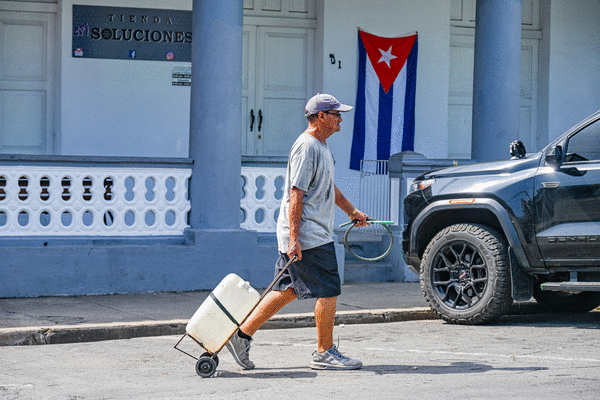
For the few enthusiasts of the revolution, July 26 meant celebrating once more the attack on the Moncada Barracks in 1953 to try to overthrow Fulgencio Batista’s dictatorship. The assault failed, but it catapulted Fidel Castro into being the leader of the 26th of July Movement and the Cuban Revolution. On Jan. 1, 1959, Batista fled the island and Fidel became the commander-in-chief of the revolution. It was a time of joy and hope for most Cubans, especially for Afro-Cubans who finally saw the revolution vindicating their equal, civil and political rights. For those in the diaspora whose businesses were expropriated, whose family members were summarily executed, or some of whom spent years imprisoned, 26 th of July has always been a dark chapter in their lives. Millions had left the island in search of freedom and a better life elsewhere, especially, but not only, in the U.S.
The promises of the revolution were short-lived. The subsidies from the former Soviet Union allowed for unprecedented investment in socialized healthcare and education, but the illusion of a socialist utopia became progressively nightmarish. Improving the lives of those who were worst off came at a cost: innumerable individuals incarcerated without respect for the rule of law, and colossal mismanagement of the economy resulting in the deprivation of goods and services for most average citizens.
For dissenting Cubans, the 26th of July means living under an authoritarian system whose leaders have broken their promises for a better and fairer society. Governing elites, such as the military conglomerate of Grupo de Administración Empresarial S.A., or GAESA, enjoy their privileges while ignoring the penury of ordinary individuals. After the crumbling of the former Soviet Union in 1989, the reality of an ill-managed economy became evident. The so-called Special Period resulted in a cataclysmic descent into ubiquitous poverty and misery.
Despite the costly U.S. embargo, Cuban officials have found ways of circumventing it. However, the tightening of the current oil blockade and the effects of President Donald Trump’s Executive Order 14404, which sanctions domestic conglomerates tied to the military, such as GAESA, and foreign companies operating in Cuba, have made the life of the average Cuban unbearable. Moreover, the lack of fuel and medicine is jeopardizing their lives. This has prompted U.N. High Commissioner for Human Rights Volker Türk to call for the lifting of U.S. sanctions. And yet, rather than concede the evident, namely that their inept policies are mostly responsible for the lack of goods and services, Cuban officials insist that the U.S. blockade is to blame for their past and current ills.
After the U.S. operation extracting former President Nicolás Maduro from Venezuela, U.S. military presence in the Caribbean is a foreshadowing what might happen next in Cuba. Moreover, Raúl Castro’s indictment in a U.S. federal court for the killing of four members of the exile organization Brothers to the Rescue and the sanctions against Cuban President Miguel Díaz-Canel, his wife, and other members of Raúl’s immediate family together with the executive order are exerting extreme pressure on the governing elites. Recent visits to the island by CIA Director John Ratcliffe and by Secretary of Defense Pete Hegseth to the U.S. naval base at Guantánamo Bay conveyed an ominous message to Cuban officials: Make a deal with the U.S. and begin tangible reforms or else all cards are on the table. Despite the newly announced market reforms by Cuban authorities, the Trump administration finds these insufficient to change course. Rather than lift their procrustean sanctions, Washington has imposed new sanctions on Cuba’s Ministry of Tourism and paramilitary groups.
What does this 26 th of July mean for the Cuban leadership? It means an existential crisis. After 67 years of a one-party dictatorship, only a few hardcore defenders of the ill-fated revolution remain vociferous anti-imperialists. Government officials are in a bind: Either they initiate a substantive constitutional reform abandoning the monolithic power of the Communist Party, allowing for fair multiparty elections, and for substantive market reforms, or the likelihood of an internal uprising would be virtually unavoidable, precipitating perhaps an unwelcome U.S. intervention.
Lastly, but most importantly, what does mean for ordinary Cubans on the island? In the interim, it means more agonizing hardships. But for the first time in over 67 years, they have reason for a glimpse of hope as the end of the one-party system is becoming a real possibility. If that were to be the case, most Cubans could have reason to celebrate. The requiem for the Cuban Revolution is on its way. Of course, let us hope that with the cooperation of the international community, including the U.S. and Cubans in the diaspora, it will be orderly, peaceful and genuinely democratic rather than violent and chaotic.
____
Vicente Medina is full professor of philosophy at Seton Hall University where he has been teaching since 1990. In the past, he has served two terms as chairperson of the department. His areas of specialization are social and political philosophy, applied ethics and Latin American philosophy.
___
©2026 Chicago Tribune. Visit at chicagotribune.com. Distributed by Tribune Content Agency, LLC.
















































Comments