Commentary: Nicaragua slides further into dictatorship
Published in Op Eds
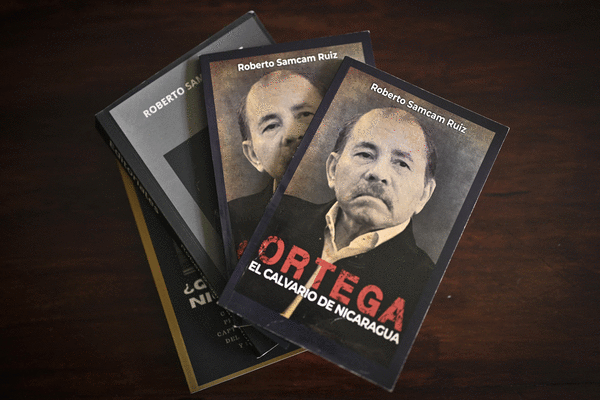
When most people think of dictatorships or autocracies, they usually point to countries like North Korea, Iran, Russia and China. Yet there is a nation just as repressive as those on this list, and it just so happens to reside in America’s own hemisphere.
Nicaragua, whose politics have been upended by former Sandinista fighter-turned-strongman Daniel Ortega and his wife, Rosario Murillo, is now arguably the Western Hemisphere’s most insular political system. Ortega’s declaration last week that the Central American nation will no longer be holding elections is the culmination of years in which the old anti-American leftist has barred political challengers to his rule, handcuffed anyone deemed disloyal to the state and confiscated the assets of political activists banished from ever entering Nicaragua ever again. A man who was an integral part of overthrowing the U.S.-backed dictatorship of Anastasio Somoza in the late 1970s has effectively transformed his country into an ever more strident, and far less wealthy, family kleptocracy.
Although U.S. officials and democracy proponents were aghast as Ortega canceled future elections, it shouldn’t have been a surprise. Ever since the 2018 anti-government protests that erupted after Managua sought to modify Nicaragua’s social security and pension policies, Ortega has gradually expanded the power of the state and taken proactive measures to ensure large-scale protests — or any protests at all — don’t happen again. He’s done this by trying to arrest his way out of the problem. Nicaraguan opposition figures have been thrown into prison, only to be released and excommunicated from the country altogether. Those who are deemed threats to the state have seen their citizenship revoked and their property seized. Thousands of activist organizations and nongovernmental organizations have been declared illegal and shut down — even the Catholic Church hasn’t been immune to the clampdown.
The United States has responded to all of this with diplomatic censure and a mountain of sanctions on Nicaraguan officials deemed complicit in the authoritarian tactics. In 2022, the administration of President Joe Biden enacted an executive order that laid the groundwork to target Nicaragua’s gold sector, which is a significant revenue source for the Ortega-Murillo government. The administration of President Donald Trump has slapped individual sanctions and visa cancellations on more than 2,300 Nicaraguan officials and their family members. Secretary of State Marco Rubio recently responded to Ortega’s universal no-elections decree by urging the international community to come together and show the regime that such an action would not be tolerated.
The Trump administration has options at its disposal if it really wanted to increase the pain on Nicaragua’s economy. The U.S. is Nicaragua’s largest export market; Nicaragua participates in a free trade deal with the U.S. and other Central American nations; and roughly 80% of the remittances that enter Nicaragua on a yearly basis originate from the United States. If Washington truly sought to make Ortega’s life miserable, it could issue new regulations capping the amount of money Nicaraguan workers could send to their family members back home, much as it does with Cuba. Trump could label Nicaragua as a violator of the free trade pact, paving the way for higher tariff rates on Nicaraguan goods entering the U.S. market. Or he could suspend trade altogether and sanction anyone who does business with certain sectors of the Nicaraguan economy.
Sanctions and pressure, however, aren’t a panacea — and while Nicaragua may be the second poorest country in the Western Hemisphere after Haiti, Ortega isn’t without cards to play.
The first lever he could pull in retaliation is weaponizing migration, as he has done in the past. There was a time not so long ago when Ortega opened up Nicaragua as a chief transit point for Cuban, Haitian and African migrants who sought to enter the United States. The open-door policy wasn’t because Ortega had sympathy for those who wanted a better life but rather because the scheme could kill two birds with one stone: the regime would make a profit by issuing travel documents to migrants who departed from Nicaragua, and Washington’s migration headaches would worsen as more people trekked north to the U.S.-Mexico border. The Ortega-Murillo regime clamped down on this practice after the Trump administration deposed Venezuelan dictator Nicolás Maduro, partly by eliminating visa-free access to Cubans. But if its back is against the wall, reverting to its earlier stance would be a low-cost, high-impact way of fighting any punitive measures Trump authorizes.
Additional U.S. sanctions on Managua would hurt the Nicaraguan government’s pockets. But it would likely hurt the pockets of ordinary Nicaraguans even more. We have seen this story play out time and time again whenever the United States institutionalizes a broad-based sanctions regime. Most of the time, it’s the most vulnerable that suffer the most, not those in positions of power who can afford to stash away their ill-gotten gains in overseas bank accounts, engage in corrupt money-making ventures to compensate for the lost revenue and call on international partners for support. Venezuela’s decade-long economic collapse, for instance, was no doubt aided in part by U.S. sanctions on its oil industry. The ongoing humanitarian misery playing out in Cuba today is driven in large measure by the U.S. blockade of fuel to the island as well as the secondary financial sanctions that have forced foreign hotel operators to depart the country, lest they be prohibited from using the U.S. financial system or operating in the U.S. market.
Would Nicaragua really be any different in this regard? History suggests it’s unlikely. In which case U.S. officials would be putting themselves in the awkward position of penalizing the Nicaraguan population for the sins of their leaders, all while trying to convince people around the world that the United States truly cares about the welfare of those living in autocratic societies.
Nicaragua’s democratic erosion is one of those difficult problems without a perfect solution. And the solution certainly isn’t going to be found in Washington, D.C.
____
Daniel DePetris is a fellow at Defense Priorities and a foreign affairs columnist for the Tribune.
___
©2026 Chicago Tribune. Visit at chicagotribune.com. Distributed by Tribune Content Agency, LLC.



















































Comments