Commentary: How Dean Martin and Jerry Lewis forever changed comedy
Published in Op Eds
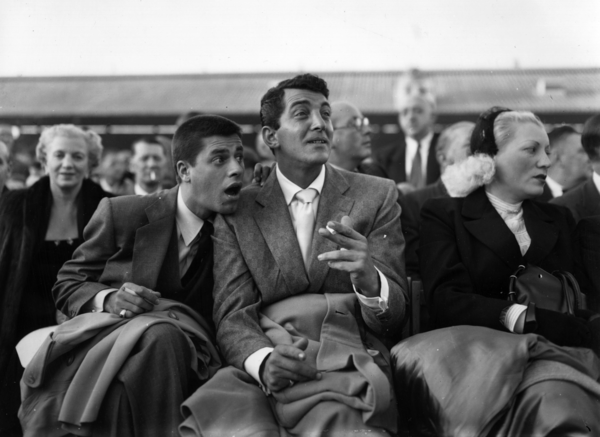
Eighty years ago, though the Arsenal of Democracy had vanquished the Axis and weathered a withering Depression, the recovering American people found themselves rich in bills but short on laughs. Enter Dean Martin and Jerry Lewis, who debuted together on July 25, 1946.
Unlike Laurel and Hardy, Abbott and Costello, or Hope and Crosby, who relied on tightly scripted setups, this disparate yet kindred duo captured America’s heart by being viscerally, uproariously and unpredictably wild.
Martin and Lewis were the founding fathers of an anarchic, side-splitting brand of comedy that combined pratfalls, ad-libbed wordplay and a sustained demolition of the fourth floor. Orson Welles observed that the duo’s combustible zaniness was so hilarious that it made you wet your pants.
The boys cavorted about the stage, kibitzing with bandleaders and the audience alike. In between trading impromptu quips, Martin and Lewis overturned tables, cut ties, sheared suits and spritzed seltzer on one and all.
The suave, dashingly handsome Italian crooner clowning around with his gawky, rubbery Jewish buddy brought the house down every time. It was nonstop, jocular pandemonium: Commedia dell’arte 2.0.
“ Saturday Night Live,” Second City, David Letterman, Jerry Seinfeld and Adam Sandler all owe a debt to the artists who started life as Dino Crocetti and Joseph Levitch.
Martin and Lewis created a novus ordo seclorum, in its way innovating like America’s founders, spawning a new comedic order of the ages.
Their alchemy was as ineffable as it was infectious. Variety’s first review of the act noted, “All they do cannot be detailed, but virtually every bit of it is good for solid laughs.” Carl Reiner similarly declared: “I saw what I thought was the funniest ad-libbed thing I had ever seen. It was a riot, and we never stopped laughing.”
In their own madcap way, Dino and Jer epitomized Cicero’s notion that comedy is the imitation of life, the mirror of custom and the image of truth.
Martin and Lewis became the monarchs of all media, conquering radio, nightclubs, television and the silver screen. In 1948, they appeared on Ed Sullivan’s first television show, “Toast of the Town.” From 1950 to 1955, the Martin-and-Lewis-hosted “Colgate Comedy Hour” frequently bested Sullivan in the ratings.
When Hollywood beckoned, the boys answered the call, cavorting, cutting up and reconfiguring reality on the silver screen. They starred in 16 films, bringing their boisterous bromance to capacity-crowd movie theaters.
Though their big-screen adventures could not capture the comedic chaos of their stage act, Martin and Lewis transformed even the most pedestrian screenplay into box-office gold. As film critic Ciara Maloney explained, “Their brilliance shines through the weakest material: the ineffable, bewitching something between them — an intimacy, an immediacy, an ingenuity — frozen in amber for those of us who would never see it in the Copacabana.”
The essence of this duo was the outré interplay between the Prince and the Putz, the Leading Man and the Monkey. Though he was the comedian by trade, Lewis fully credited Martin as the “genius” of the pairing: “He kept the center. He was the spine of the act. And the monkey was constantly attached to that spine, on the spine, next to it.”
From “Sailor Beware” to “The Stooge,” “Living It Up” and “Artists and Models,” theirs was a comedy partnership that came to symbolize America. It is little wonder that presidential historian Tevi Troy called the 1950s “ The Martin and Lewis Decade.”
However, many Americans didn’t see these two celebrities as distant icons. Film critic Jenna Ipcar has described how “a perfect comedy duo will make their audience feel like a lucky participant instead of just a passive observer, a welcome guest in a secret world.” Martin and Lewis embodied that ideal.
The boys’ bittersweet final performance took place at New York’s Copacabana on July 25, 1956. Exactly 10 years after their debut in Atlantic City, New Jersey, Dean Martin and Jerry Lewis had pioneered a new brand of comedy, soothed postwar America’s psyche and made a nation laugh again.
____
Rosario A. Iaconis, chairman of the Italic Institute of America, writes about Italy and its cultural influence. He is at work on a novel about Harry S. Truman.
©2026 Los Angeles Times. Visit at latimes.com. Distributed by Tribune Content Agency, LLC.

















































Comments