Mark Z. Barabak: His nickname was 'Satan.' His political influence was immense
Published in Op Eds
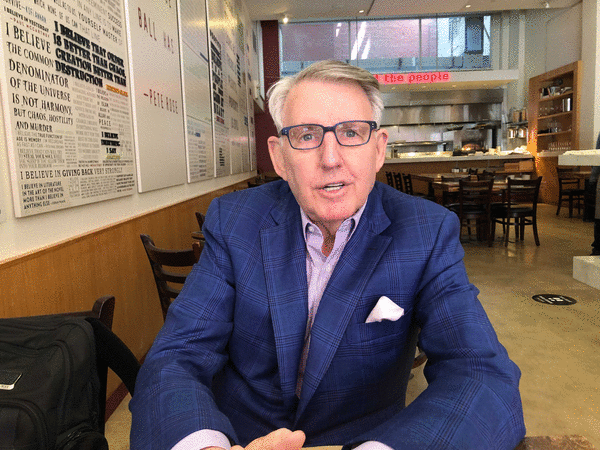
SAN FRANCISCO — Every election produces a campaign strategist whose victory bestows upon them, for at least a little while, the unofficial title of reigning political genius.
James Carville, Karl Rove, David Axelrod and Stephen K. Bannon have all worn the crown.
For many years, and many election cycles, California's reigning political genius was Clint Reilly.
In an age before the internet, before social media, before the cable-TV chat shows and before Carville and the like, Reilly came as close to celebrity as a political operative possibly could. He was the subject of fear, admiration, contempt, envy and lengthy newspaper and magazine treatments.
His cherry-red Jaguar, Italian suits, designer eyewear and seaside mansion made Reilly an influencer before there even was such a thing. (A connoisseur of the finer things, he served visitors coffee in bone china when they called on his San Francisco office.)
"It used to be that political consultants and political mechanics were something that only a handful of people thought about," said Eric Jaye, one of generations of campaign strategists who were trained or inspired — directly or indirectly — by Reilly. "Clint was the original star consultant who made news himself and shaped the political discussion."
Reilly, a working-class product of Oakland who crossed the Bay and scaled the heights of San Francisco business, culture and politics, died earlier this month at age 79.
For someone who never held political office — a 1999 bid for San Francisco mayor was a notable flop — Reilly wielded considerable influence.
A list of the many Democrats he helped elect — among them Nancy Pelosi, Dianne Feinstein and Barbara Boxer — reads like a scroll of modern California history. At one time, the sitting mayors of both San Francisco and Los Angeles were clients of Reilly.
He wasn't flawless as an election strategist. Like any political operative, he had his share of defeats.
Reilly's particular genius lay in the methodology — vertical integration — he brought to campaigns. Typically, one consultant would handle television advertising, another direct mail, another polling, another big-picture strategy, and so on.
"Everything was in-house with Clint and, at least in San Francisco, he was the first to do that," said Jerry Roberts, who was a scruffy reporter for the city's alt-weekly when he met a shaggy-haired Reilly more than 50 years ago. At the time, campaigns were a sideline for Reilly, who supported himself selling doodads and other salvaged wares in a movable flea market he operated on Fisherman's Wharf.
"It was a smart business model," said Roberts, who went on to lead two major California newspapers.
It made Reilly very rich.
In 1988, he managed what, at the time, was the most expensive political campaign in California history, a $64-million effort by the insurance industry to beat back a Ralph Nader-inspired reform initiative. Reilly lost, but his firm cleared at least $6 million on that contest alone — or about $17 million in today's dollars.
"So that's where our premiums went," one guest observed with a low whistle as he arrived at the state-of-the art headquarters Reilly built not long after the Proposition 103 campaign. (Naturally, he threw an open house; for all his affluence, Reilly never did entirely shake the proletariat chip on his shoulder.)
A onetime seminarian — he left three years shy of being ordained a Catholic priest — Reilly was no saint.
He was hot-tempered, profane and egotistical. He embraced the nickname "Satan," which a former client affixed after Reilly went to work for an archrival, as a reflection of his reputation for intimidation and mastery of the political dark arts.
In one fit of pique, Reilly took the unheard step of firing a client — Feinstein — via faxed press release because, he said, the former San Francisco mayor lacked the requisite fire to run for governor. The two eventually reconciled, though Feinstein stuck with members of the team that replaced Reilly and helped guide her to successive terms in the U.S. Senate.
If Reilly was at times overbearing — and known for being the kind of hellacious boss who gave employees night sweats — he was also generous and a genuine bleeding heart.
Before his career took off, Reilly volunteered for the United Farm Workers and lived an ascetic life, sheltering in church halls, as he ministered to the poor. Once he established his high-end consulting firm, Reilly retained his political staffers at no small expense, even during the lull between campaigns, rather than hiring and firing them as seasonal workers, which was the norm.
After leaving professional campaign consulting in the mid-1990s, and making a substantial fortune in real estate, Reilly gave prolifically to various charities and assorted civic caucuses. He started a charitable foundation of his own, Bay Scholars, which helps poor and underserved youth attend Catholic high schools throughout the area.
In 1987, when Reilly arguably resided at the height of his power and influence, he took on Pelosi as a client.
She was running for a rare open congressional seat in San Francisco and, though well known in political circles as a prodigious Democratic fundraiser and high-level activist, Pelosi was a blank slate to many voters. Reilly came up with a slogan that played on Pelosi's Washington connections and many important friendships: "A voice that will be heard."
More than that, he made a key tactical decision in the waning days of the campaign.
Pelosi was one of 14 candidates, several of them well-known Democratic officeholders. Ignoring Pelosi's objections, Reilly sent out a mail piece to the city's vastly outnumbered Republicans suggesting that a Democrat was bound to win the congressional seat and arguing that Pelosi was the best — or, at least, not the worst — of the bunch.
On election day, Pelosi lost the Democratic vote to Harry Britt, who succeeded Harvey Milk on the Board of Supervisors after Milk's assassination. Still, Pelosi prevailed, by less than 4,000 votes out of nearly 108,000 cast. The winning margin was her Republican support.
The rest, as they say, is history.
_____
©2026 Los Angeles Times. Visit latimes.com. Distributed by Tribune Content Agency, LLC.



















































Comments