Commentary: Don't eat your hosts this summer
Published in Op Eds
Summer is the season of beaches, lakes, bays and family vacations. We head to the shore to swim, kayak, paddleboard and enjoy the beauty of the water. But while we’re busy making memories, it’s worth remembering one simple fact: When we’re in the water, we’re visitors in someone else’s home.
Beneath the surface lives an astonishing community of animals. Fish communicate with one another using clicks, squeaks and other sounds. Some build nests and carefully protect their young. Others carry their babies in their mouths until danger passes. Scientists have discovered that fish are far more intelligent than most people realize, with impressive memories and complex social lives.
Spend enough time learning about marine life and you’ll find stories that seem almost unbelievable. Some fish visit underwater “cleaning stations,” patiently waiting while smaller fish remove parasites from their skin and even clean their teeth. Male pufferfish spend days creating elaborate geometric designs in the sand—underwater works of art intended to attract a partner. Tuna can travel more than 100 miles in a single day, crossing vast stretches of ocean with ease.
Crabs are fascinating, too. They learn from experience and adapt to changing conditions. Some species are devoted parents who clean and maintain nurseries for their young. Scientists have even observed neighboring fiddler crabs helping one another defend their burrows from intruders.
Then there are lobsters. These remarkable animals can live for more than a century and travel long distances through the ocean during their lifetimes. Researchers describe them as sophisticated animals who use a variety of signals to explore their surroundings and interact with others.
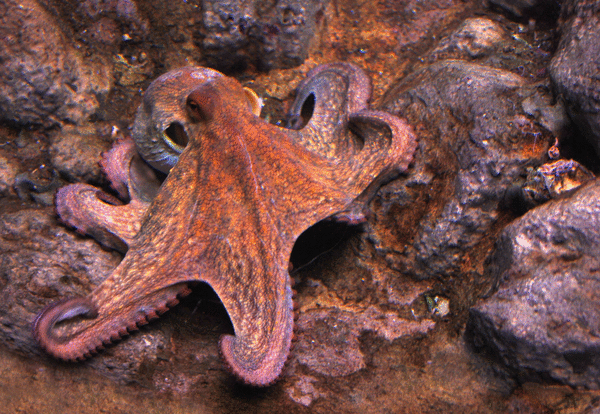
And, of course, there are octopuses, often called the geniuses of the sea. They solve puzzles, use tools, recognize individual humans and sometimes display a mischievous streak. One famous octopus named Inky escaped from an aquarium by slipping through a drainpipe and making his way back to the ocean. Another learned how to short-circuit an annoying light by squirting it with water.
The more scientists learn about marine life, the harder it becomes to dismiss these animals as mere “seafood.” They are individuals with their own lives, families, preferences and ways of experiencing the world.
Yet billions of aquatic animals are killed for food every year. Fish are dragged from the water, where they slowly suffocate. Crabs and lobsters are boiled alive. Octopuses—among the most intelligent animals on Earth—are routinely captured and killed for meals that last only a few minutes. Countless other marine animals, including dolphins, sea turtles, sharks and seabirds, are accidentally caught in fishing gear and often die as a result.
Summer offers us a chance to see these animals differently. Instead of viewing them as menu items, we can appreciate them as neighbors whose world we’re privileged to visit. Watch fish dart through the shallows. Observe crabs tending their burrows. Marvel at the diversity of life beneath the waves.
Good guests treat their hosts with respect.
This summer, one simple way to show that respect is to leave fish, crabs, lobsters, octopuses and other sea animals off your plate. After all, when you’re enjoying a day at the beach, the ocean isn’t just a vacation destination—it’s somebody else’s home.
____
Scott Miller is a staff writer for the PETA Foundation, 501 Front St., Norfolk, VA 23510; www.PETA.org.
_____
©2026 Tribune Content Agency, LLC.





















































Comments