Commentary: Will the Iran war kill OPEC?
Published in Op Eds
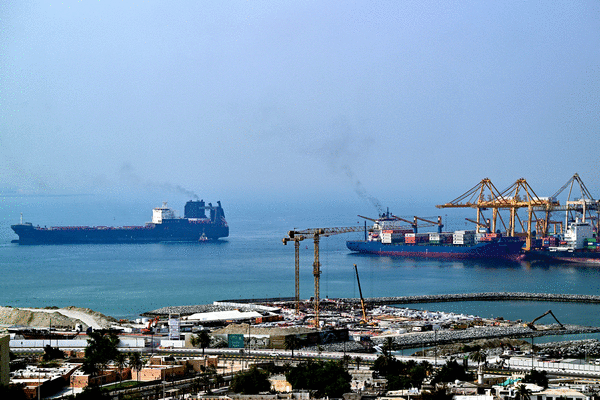
OPEC looks like it might be coming undone. Major members have threatened to leave, and one already has. This could eventually mean more global oil supplies, which will mean lower gasoline prices here at home.
OPEC started in the 1960s explicitly to keep oil prices high by cartelizing production. Its members intentionally pump less oil to create predetermined shortages that keep prices high.
Like any cartel, this coordination is tricky — every country wants to cheat and pump extra. Sure, the additional volume will reduce prices slightly, but the cheater sells so much more oil that the higher volume makes up for the slightly smaller margins.
This incentive means every cartel needs an enforcer. For OPEC, that was Saudi Arabia. The problem is that this isn’t the 1960s anymore — in two big ways. First, oil production in non-OPEC countries has soared over the last six decades. Second, while OPEC never liked each other much, they now like each other a lot less after four months of mutual bombings.
When OPEC started, it was roughly 80% of world oil exports, but when the war with Iran started, that market share had fallen to just over half. And since the war, production has jumped by millions of barrels in the U.S., Canada, Brazil, Kazakhstan and virtually anywhere people could pump more oil. That means OPEC is now well below half of global market share.
The obvious driver behind other nations increasing production is the Strait of Hormuz being closed again, but OPEC’s weakness was actually exposed during the weeks in June when the strait reopened. The way Saudi Arabia behaved might be the last straw for many OPEC nations.
In short, Saudi Arabia has a pipeline to the Red Sea, which goes around the Strait of Hormuz, reducing concerns of Iranian bombs or mines. They could still get a lot of oil — about 40% — out and keep making money. But members like Kuwait, Iraq and Bahrain are all trapped in the gulf, so they sold virtually nothing.
This left multibillion-dollar holes in their budgets, and during the ceasefire they wanted Saudi Arabia to give them extra quota to make it up, with Iraq wanting a 50% hike. Meanwhile, one of the biggest surprises of the war is that China slashed oil demand, perhaps because many of their factories work on razor-thin margins so it was cheaper to just shut down.
Saudi Arabia's fear is that the Chinese slowdown and lower demand could be permanent, so they want OPEC to lower production to prevent oil prices from crashing if a glut emerges. More non-OPEC production, depleting global reserves and lower Chinese demand have absorbed much of the war’s oil shock. Toss in 50% quota hikes, and that potential glut could become reality.
But while OPEC is still a major player, it’s not as big as it used to be. When OPEC cuts production now, it's not strangling the world. It’s simply handing the money to Americans, Canadians and Russians.
When the smoke clears on Iran, one of the most important consequences could be the 60-year U.S. objective of breaking OPEC. In April, OPEC's second biggest producer, the UAE, announced it was leaving and then promptly increased production. Iraq and Kuwait could go next. And every member who leaves raises the cost of staying as even more countries drink OPEC's milkshake.
Another war might now be speeding along the cartel’s dissolution too. Ukrainian strikes on Russian refineries have sent crack spreads (the price difference between a barrel of oil and the petroleum products made from it) exploding higher. So even if there’s enough oil, there’s not necessarily enough refining capacity to turn that oil into gasoline, diesel and jet fuel.
With non-OPEC production on the rise and infrastructure in Russia being damaged, the bottleneck will likely shift away from pumping crude to refining it, meaning refiners are the ones with real pricing power, not drillers. Regardless, more oil production and refining capacity here at home would better protect American consumers from shocks abroad.
And it would speed the end of OPEC, which would transfer trillions of dollars per year from Middle East dictators to largely Western consumers. Pretty slick.
____
Peter St. Onge, Ph.D., is senior economist and E.J. Antoni, Ph.D., is chief economist at the Heritage Foundation.
_____
©2026 Tribune Content Agency, LLC.

















































Comments