Commentary: Connecting flight? Good luck
Published in Op Eds
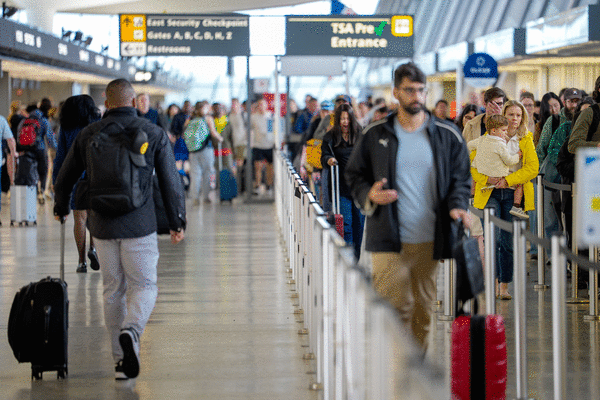
The summer travel period is here, with high passenger volume keeping airplanes filled, even as jet fuel prices remain high and ticket prices have spiked.
To add more angst to air travel, the first half of 2026 gave air travelers a rollercoaster ride of delays and disruptions. Whether it was Transportation Security officers not being paid due to government shutdowns, air traffic controller shortages or inclement weather, air travel appears to have become less predictable — and perhaps even subject to more risk. The collision of an American Airlines regional jet with an army Blackhawk helicopter back in January 2025 gave many people time to pause, thinking that they could have been on that flight.
Maintaining the National Airspace System is a complex operation, with multiple stakeholders.
The Federal Aviation Administration is responsible for numerous aviation safety operations and oversights, including aircraft certification, pilot certification and air traffic control. The TSA is responsible for all aspects of aviation security, including setting the standards for airport screening technologies and TSA officer training.
Aircraft manufacturers like Boeing, Airbus and Embraer provide the equipment that moves people across the national airspace. Airlines operate the equipment and set schedules that permit travelers to select and book their travel itineraries. And then there are nearly 20,000 airports in the United States with more than 16 million flights handled by the FAA annually.
Despite all this complexity, the National Airspace System functions remarkably well. Careful planning and organization by each of these stakeholders, both individually and collectively, provide what has been a safe, secure, and reliable system.
The one factor that impacts air travel nearly every day is the weather. When the skies are clear, air travel generally functions as planned. In fact, on fair weather days, flights often arrive earlier than scheduled. This is not due to any special talent of the flight crew, but rather because airlines build slack into their schedules to accommodate both expected and unforeseen delays, including taxiing time prior to take off and landing. The FAA tracks flights delays, which typically impacts around 25% of flights. Given that there are around 25,000 scheduled flights on average every day, that means that over 6,000 of them arrive late on average.
But what constitutes a late flight? The FAA defines any flight as late if it arrives 15 minutes or more after its scheduled arrival time. This means that a flight that arrives 14 minutes after its scheduled arrival time is classified as on-time, while adding just one minute to this time flips the classification to late.
The 15-minute time may appear somewhat arbitrary. However, given the large number of travelers that connect to a flight through a hub airport, with connection times running as little as 30 minutes at some airports, every extra minute that an airplane must taxi before passengers deplane can make the difference between some passengers making their connections and others missing them.
More than 60% of the people flying out of Atlanta Hartsfield (a Delta hub) are connecting passengers (based on 2018 data). Charlotte Douglas (an American Airlines hub) was the connection champion, with more than 70% of their travelers connecting to another flight. Other hub airports like Chicago O’Hare (American and United), George Bush Intercontinental (United), Washington Dulles (United), Detroit Metro (Delta) and Minneapolis St. Paul (Delta) were all above 40%.
For passengers without connections, late arriving flights are a nuisance and inconvenience. For passengers with connections, late arriving flights may be highly disruptive, resulting in interruptions that may delay their arrival to their final destinations by several hours, or even days.
For hub airports, what would be more informative for travelers is to report the percentage of connecting passengers who miss their connections. Given that such data is available within the airline reservation and tracking system, reporting such information for all originating airports and through the hub airports where they connect passengers would provide travelers with a more transparent picture of the risk that they are taking when connecting through a particular airport.
Such data would also give the FAA information if they wish to impose air traffic capacity limitations, which they did this summer at Chicago O’Hare. This data would also inform passengers of which airports to connect through if choices are available.
The percent of flights that arrive late only provides a useful measure of problems faced by air travelers on direct flights. For connecting passengers, they want to know when they will arrive at their final destination, which is not captured by flight delay data alone.
If the FAA wants to support air travel and advocate for air travelers, asking each airline to report this measure for all airports that feed into their hub airports will go a long way to add much needed transparency to air travel. Adding such transparency to an industry that often feels shrouded in darkness by the traveling public will help passengers make informed travel choices, so they are more likely to arrive on time — which, after all, is the goal.
____
Sheldon H. Jacobson, Ph.D., is a computer science professor in the Grainger College of Engineering at the University of Illinois Urbana-Champaign. As a data scientist, he uses his expertise in risk-based analytics to address problems in public policy and national security. This piece was originally published by The Hill.
____
©2026 Tribune Content Agency, LLC.




















































Comments