Commentary: Why the US should consider making voting compulsory
Published in Op Eds
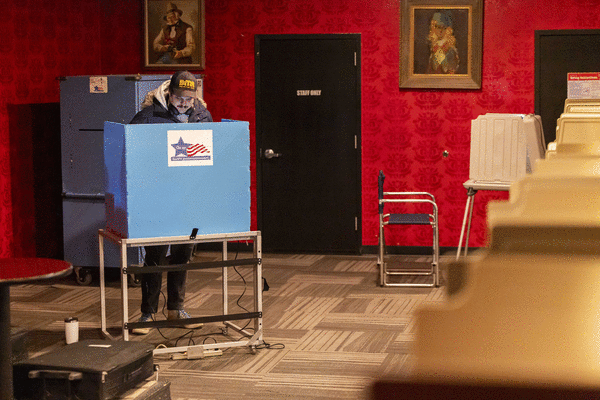
The United States — like all democracies — is centered around the basic premise that a representative system of governance reflects public preferences. This is not and has never been true, however.
As the left and right argue, the disproportionate influence of a select few suppresses the will of the majority. Interest groups play an outsize role in national elections, politicians spend their time on calls with wealthy donors instead of meeting constituents and parties increasingly focus on themselves rather than average Americans. These concerns are not new: There is a well-documented increase in polarization among the political elites at the same time the gulf between those elites and average voters is widening. The standard policy prescription to combat these problems focuses on lobbyists and elites. It fails to account for an uncomfortable reality, however: The U.S. government is unrepresentative because the electorate that puts it in power is also unrepresentative.
Voter turnout in the United States is notoriously low compared with other democracies. The electorate is also heavily skewed toward being rich, white and educated, t he very “coastal elites” whom politicians on the right (and left) have been complaining about for a decade. With an electorate that does not match the masses, even the most robust governance system cannot deliver democratic representation.
There is, however, a politically and legally feasible path to greater representation: compulsory voting.
Of course, the idea of forced voting sits uneasily with Americans’ love of freedom and fear of compelled speech. But compulsory citizen participation in self-governance has a long and distinguished history. Citizens serve on juries, respond to the census and pay taxes. Voting should be no different. And it retains a fundamental liberty: choice. Each voter is free to leave their ballot blank. All they have to do is to show up to vote.
Evidence suggests compulsory voting would reduce elite political influence. If everyone votes, everyone’s voice is heard — not only that of ideologically motivated elites. University of Georgia professor Shane Singh’s work demonstrates that compulsory voting increases turnout, reduces party reliance on friends and social networks and increases the influence of moderates, thereby reducing issue cherry-picking and party efforts to cater to extremes.
Compulsory voting would allow Democrats and Republicans alike to appeal to the average American, who currently feels disconnected from governance.
To be clear, compulsory voting is the opposite of the poll taxes, which are prohibited by the 24 th Amendment and that were once used to disenfranchise. Implementing it would be a full circle moment for U.S. democracy.
Moreover, compulsory voting is not unusual elsewhere in the world. Australia provides the most useful blueprint for compulsory voting in a large, two-party democracy like the U.S. Turnout is often over 90% in Australian national elections, and extremist forces are few and far between — the populist right has won only a handful of seats in the last two national elections, and the far left is virtually nonexistent. While the government sanctions those who do not vote, often with small fines, it also allows people to provide excuses to opt out of voting. Despite this, few choose to abstain.
The desire for compulsory voting in the U.S. is also not unusual. It even has a pre-revolution history. More recently, however, the idea has been floated by a variety of actors ranging from Republicans in the late 19th century to Barack Obama in 2015. A well-designed contemporary effort is perhaps the most agreeable and politically neutral way for the U.S. to overcome its present elite- and primary-driven polarization.
What would such an effort look like? A fine for failing to vote would be expensive to collect. Alternatively, a tax-system-based incentive would likely be effective and low-cost. This is not a new idea. In 1889, Kansas City, Missouri, implemented a tax on nonvoting. In 1898, North Dakota’s voters approved the country’s first statewide compulsory voting rule. At the federal level, Republican U.S. Sen. Arthur Capper in 1926 proposed a 1% tax on income for nonvoters. Such systems are unlikely to pass judicial scrutiny at this point, however.
This does not mean that no system would. A modern, national-level effort could, for instance, allow only citizens who have voted to take the standard tax deduction on their annual return. As voting happens in November and taxes are filed almost six months later in April, it would be a relatively simple system to administrate, though it would require counties to submit a list of all voters to the Internal Revenue Service. While the wealthy might not be induced to vote by such a system, nor the poor, who owe no taxes and arguably would be most burdened by compulsory voting, the financial benefit of voting for the vast majority of U.S. citizens would be sizable and likely to appeal.
Moreover, a tax benefit for voting is much more likely to pass constitutional muster than a tax penalty. This is particularly true because using the standard deduction is a procedural benefit; it saves you from having to itemize your deductions. All citizens would still be free to claim all owed tax deductions; they would simply have to do more work to claim them. And, of course, voters do not have to vote for any party. All they have to do is show up, something far less onerous than serving as a juror or paying taxes.
Arguably, compulsory voting isn’t just feasible for U.S. democracy. It has become necessary. This straightforward policy solution would bring more people into the democratic project.
The U.S. now has a democratic deficit — many believe that it is not working, with almost 40% of adults saying that neither party “fights for people like them,” NBC News reported last year. But if people are required to vote and parties are forced to represent them, voters will likely realize that the government is representative.
In a country desperate for a less divided polity, compulsory voting could be the solution we need.
____
Susan L. Ostermann is an associate professor of global affairs and political science at the University of Notre Dame. Pradeep Chhibber is a professor of political science at the University of California Berkeley. Will Halm is a graduate student in political science at the University of California Berkeley.
___
©2026 Chicago Tribune. Visit at chicagotribune.com. Distributed by Tribune Content Agency, LLC.



















































Comments