George Skelton: Californians sour on Newsom's push to ban gas-powered cars
Published in Op Eds
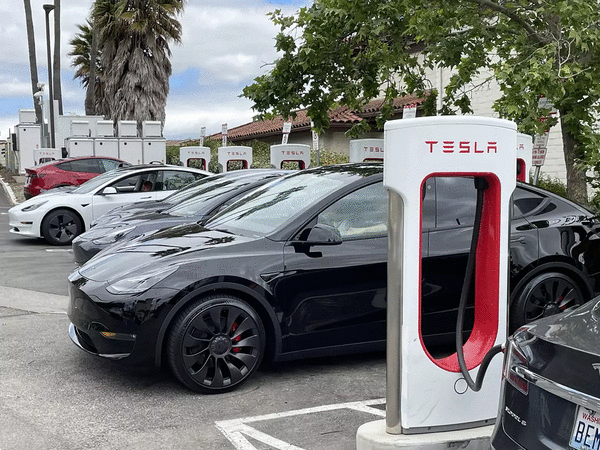
SACRAMENTO, Calif. — Gov. Gavin Newsom will soon leave office without gaining the support of fellow Californians for his most ambitious climate project: the banning of new gas-burning car sales by 2035.
Newsom issued an executive order in 2020 taking new fossil-fueled passenger vehicles off the California market nine years from now.
But roughly two-thirds of Californians think that’s a lousy idea, according to a poll released last week by the nonpartisan Public Policy Institute of California.
Among likely voters, 65% oppose the termed-out governor’s edict and just 34% support it. The opposition among infrequent or nonvoters is even stronger.
Negative attitudes are especially stiff in inland California — particularly the Central Valley — and among middle-class people with incomes between $40,000 and $100,000, those over age 55 and Republicans.
Opposition to being denied new gas vehicles has grown substantially since 2021, when Californians were evenly divided over the issue.
But the state’s anticipated next governor, moderate Democrat Xavier Becerra, is more in line with Californians’ thinking on gas cars than is Newsom.
Becerra told me during his primary election campaign that Newsom’s 2035 goal is not realistic.
“We can’t make it by ‘35,” he said. “But we can make it.” Sometime in the future.
The fact is lots of people can’t afford electric vehicles because they tend to cost more than cars fueled by gas.
Besides, there’s an inconvenience of having to pull off the road for a 40-minute recharging stop on a long trip — if you can find a vacant recharger.
And “electricity is not cheap. It often depends on the time of day,” notes PPIC Polling Director Mark Baldassare, who owns an electric vehicle and says he likes it.
Newsom has been hawking electric vehicles since he came into office, like some slick TV pitchman — his goal being to greatly reduce climate-warming greenhouse gas emissions.
The governor and the Legislature recently appropriated $135 million to motivate Californians to buy new or used electric vehicles.
First-time EV buyers will receive $3,500 rebates on vehicles with manufacturer’s suggested retail prices of $50,000 or less. Used car buyers will get $1,750 off if the sale price is $25,000 or less.
Automakers will pay for half the incentive costs — obstensibly, at least, if they don’t just secretly add their tab to the vehicle price.
This smacks of a huge taxpayer giveaway to manufacturers if the state isn’t careful. Is it really the state’s job to sell cars? Shouldn’t it be the automakers’ responsibility to offer competitive prices? Whatever.
Newsom’s plan partially replaces a $7,500 federal tax incentive for new EVs that President Donald Trump and the Republican-led Congress allowed to expire last year.
California already leads the nation in EV ownership, with around 1.3 million vehicles registered. That’s more than five times the No. 2 state, Florida. And it’s not just because California’s population is much larger. We also lead in per capita ownership.
There’s plenty of contradiction and hypocrisy in the divided minds of Californians, as highlighted in the lengthy PPIC survey into their views on environmental policies.
People strongly favor fighting climate change — at least in concept — until it adversely affects them directly. That’s just human nature.
Asked what they consider the most important environmental issue facing California, those surveyed placed wildfires first, followed closely by global warming.
Baldassare says what struck him in the poll was “the disconnect between what people support in policies and what they’re prepared to do.”
“Two things are going on in California now,” the pollster continues. “People have their long-standing concerns about the environment. But they also have immediate concerns about affordability.
“When it comes to what people are willing to do, they’re worried about living costs and particularly the cost of energy. It’s something we’ve noticed even more this year. It affects the political and economic landscape.”
Nearly two-thirds of those surveyed support Newsom’s goal of reducing greenhouse gas emissions to zero “as soon as possible, but no later than 2045.”
And there’s overwhelming support for taxing corporations based on the amount of carbon emissions they produce.
Roughly 60% favor requiring all electricity to be generated with renewable energy — such as wind and solar — by 2045, although support for that state edict has dropped by 15 percentage points in the last six years.
Paradoxically, people aren’t willing to pay more for electricity produced by renewable sources. Roughly 60% reject that idea. Ten years ago, almost that many told PPIC pollsters they were willing to pay extra.
And today they’re not nearly ready to surrender their option of buying a new gas-fueled automobile.
For one thing, they’re not convinced there’ll be enough charging stations to handle a lot more EVs. Twice as many people are not confident of that as are confident, the poll found.
The California Energy Commission reported in January that there were more than 200,000 public and private EV charging stations in the state, plus 800,000 chargers in homes. The state is helping to add more along highways.
Becerra has pledged to take a fresh look at several controversial Newsom projects, including the pokey bullet train. There’s much uncertainty about the pending new governor.
But there’s one pretty good bet: In 2035, sales of new gas cars will still be getting a green light.
©2026 Los Angeles Times. Visit at latimes.com. Distributed by Tribune Content Agency, LLC.


















































Comments