Allison Schrager: Expect more data center moratoriums -- and slower growth
Published in Op Eds
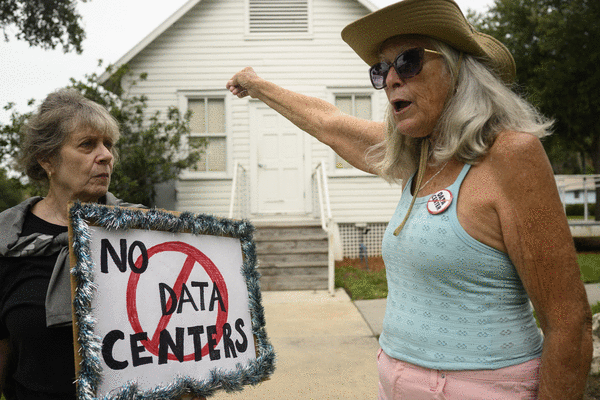
If you are an AI doomer, as a majority of Americans are, then you might find New York’s one-year moratorium on new data centers reassuring: No matter how fast technology progresses, humans will do all they can to slow it down.
Restrictions on data centers, which are almost certainly coming in other states as well, illustrate what we economists call friction. As usual, it comes from a place of fear — in this case, that data centers harm the environment or increase electricity prices. Friction is also enabled by a belief that government can exert some control over technology. At least when it comes to data centers, the control is largely an illusion; if one state doesn’t build data centers, another will. Still, expect more moratoriums and other regulations that aim to manage the path of technological progress. Some will matter more than others, and some may even be prudent.
But make no mistake: Friction reduces economic growth. Friction is anything that may slow, divert or stop economic activity. The U.S. has a capitalist economy, and market activity is routinely diverted by frictions we choose to adopt — some good, some bad. As a pro-growth economist with poor social skills, I am generally anti-friction.
Most of the time, the goal should be to get rid of friction. When it comes in the form of land or labor regulations, friction helps explain why the U.S. can’t build more, faster and cheaper housing. Technology usually aims to reduce friction, not only in the economy but also in people’s lives. It allows us to book a flight, rent a car, or order groceries without having to deal with another human, or even to find that old family recipe instead of calling grandma.
Nevertheless, there is some value to friction. Many jobs exist to create friction: university administrators, most HR departments, much of the legal profession, a lot of the DMV, to name a few. These frictions can be both annoying and useful. When HR makes employees watch those cringe-worthy videos about sexual harassment, for example, it is enforcing professionalism — forcing workers to abide by behavioral norms is form of friction. Even time spent at the DMV can help prevent identity theft and ensure some minimum standard of driving competence.
Soon, so people say, the blockchain will offer seamless and instantaneous financial transactions that currently take hours or days and carry high fees. But transferring assets costs time and money because the banks have processes to confirm identity and reduce criminal activity.
Social interactions benefit from a little friction, too. Dating apps have made it easy to meet people. But — precisely because they make it so easy — they may also devalue existing relationships. AI offers the promise of even more frictionless social interactions.
Of course, we humans are not helpless when it comes to which frictions we want to keep or eliminate. The problem is that one person’s economic friction can be another’s livelihood. America could, in theory, greatly reduce the number of college administrators or building regulations. That it doesn’t could be a reflection of the power of various vested interests, or of the simple fact that people want more process and a slower economy.
AI is both unusual and threatening because it has the potential to eliminate frictions previously thought permanent. It will force people to come to terms with the fact that friction is a choice. AI may well be approaching a point where it becomes self-improving, which could transform the economy at an exponential rate.
I myself would not bet on this happening — not because the technology won’t be capable, but because America’s economy and culture love friction and want more of it. By one survey, 80% of Americans want more friction to slow down AI. Some people are even willing to forgo a cure for cancer to slow down AI.
In the best-case scenario, AI will force all of us to take stock of the frictions in our lives, removing the unnecessary and harmful ones and keeping the ones that provide some value. Many prominent economists think if we study this question carefully, we’ll gain the wisdom to know the difference on a larger scale as well. Then the economy will grow more smoothly with fewer disruptions.
Unfortunately, that’s not how innovation works. It is a messy process, provoking both hope and fear, while vested interests at odds with the wider economy vie for influence. If the U.S. can’t even get local zoning right, how can it possibly manage a technology that affects every part of the economy?
The backlash against data centers suggests that Americans prefer greater friction over higher growth. Maybe the illusion of control is more appealing than no control at all.
____
This column reflects the personal views of the author and does not necessarily reflect the opinion of the editorial board or Bloomberg LP and its owners.
Allison Schrager is a Bloomberg Opinion columnist covering economics. A senior fellow at the Manhattan Institute, she is author of “An Economist Walks Into a Brothel: And Other Unexpected Places to Understand Risk.”
©2026 Bloomberg L.P. Visit bloomberg.com/opinion. Distributed by Tribune Content Agency, LLC.




















































Comments