Michael Hiltzik: Trump's transgender-based attack on the CHIPS Act is his most unhinged yet
Published in Op Eds
Given the difficulty of identifying the most egregious assertions from President Donald Trump's latest outbursts of pique and petulance, it's unsurprising that perhaps his weirdest and most despicable diatribe has gone under the radar.
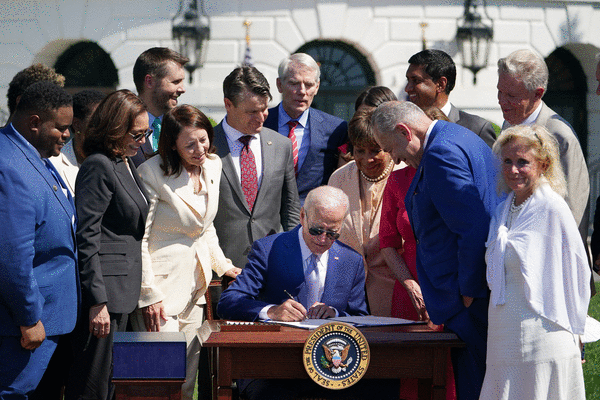
It came on July 15, at a "Defense and Innovation Summit" in Pennsylvania hosted by Sen. Dave McCormick, R-Pa. Trump chose this occasion to carry on about the 2022 CHIPS and Science Act, which authorized $280 billion in government funding for semiconductor research and manufacturing.
For some largely inexplicable reason, Trump has been railing against the CHIPS Act for years. This time around, he combined his general critique of the act with a flight of fancy aimed at another of his favorite targets, transgender people.
Here's what he had to say:
"We had this ridiculous CHIPS Act. ... Of course the standards were so high. If you weren't transgender, as an example, you didn't qualify [for funding]. So, they get the money that hired to look all over for transgender people to run the company. Large portions. They couldn't find them. They weren't into the chip-making business, I guess, right? They had other things on their mind. But this was the Biden fools, those idiots that almost destroyed our country."
There's more, but that will do for now. Let's make something clear: There is absolutely nothing in the CHIPS Act about transgender persons. No mention at all. Nothing about transgender management being a prerequisite for funding.
Nor is there any government policy implementing the act that mandates transgender management. I asked the White House to identify any language in the act or in its implementation that Trump could have been citing. The White House didn't provide me with any.
Instead, spokesman Kush Desai responded, "President Trump is right: the Biden administration infused left-wing, DEI priorities in the CHIPS program through non-statutory policies that mandated creating construction jobs for women, adding day-care facilities at construction sites, using costly renewable energy sources at manufacturing facilities, and other ideological provisions."
A couple of things about this. First, the CHIPS Act passed with bipartisan support — 24 House Republicans and 17 Senate Republicans in favor. In other words, whatever "left-wing, DEI priorities" were in the bill could hardly have been the exclusive handiwork of the Biden administration.
Second, it's unclear what Desai meant by "non-statutory" policies and provisions. If it's non-statutory, it's not in the law. When I asked Desai to identify the specific policies and provisions he mentioned, he told me to go hunt them down myself.
That said, let's unpack Trump's spiel.
First, the transgender bit. This is part and parcel of Trump's long campaign against transgender rights, which I've reported on before. His July 15 remark is part and parcel of another excursion into fantasyland he embarked on during his 2024 presidential campaign, when he spun a yarn at an event sponsored by the book-banning group Moms for Liberty conference about schoolchildren being kidnapped and subjected to gender-changing surgeries.
"Your kid goes to school and comes home a few days later with an operation," he said. "The school decides what's gonna happen with your child. And you know, many of these childs [sic] 15 years later say, 'What the hell happened? Who did this to me?' They say, 'Who did this to me?'"
None of that existed in the real world, either.
Since coming into office, Trump's attacks on transgender rights have been unrelenting. In an executive order issued the day of his inauguration last year, he declared an end to what he called "gender ideology extremism" and said that the U.S. recognizes only "two sexes, male and female."
He has ejected transgender service members from the armed forces. His secretary of Health and Human Services, Robert F. Kennedy Jr., threatened to terminate Medicaid and Medicare funding for hospitals that provided gender-affirming care for minors.
A federal judge blocked that effort, and other federal judges have pushed back on many of Trump's anti-transgender initiatives. Sadly, however, the Supreme Court has waved some through.
What about the CHIPS Act itself? What makes Trump's distaste for it hard to fathom is that its purpose is specifically to shore up America's semiconductor manufacturing capabilities and foster research in artificial intelligence, both of which goals Trump supports — indeed, he cites them as essential for national security.
Yet in his 2025 State of the Union address, Trump called the CHIPS Act "a horrible, horrible thing," and advised House Speaker Mike Johnson (R-La.) to "get rid" of it. He asserted that the government doles out "hundreds of billions of dollars, under the act. ... They take our money, and they don't spend it."
He made a similar claim in his July 15 tirade. Yet his administration has made numerous announcements of corporate grants of CHIPS Act funds totaling more than $5 billion, according to a list published by the Commerce Department's National Institute of Standards and Technology, including a $225-million grant to Bosch Semiconductor announced just two days before Trump's talk.
Since its enactment, the CHIPS Act has been the target of anti-DEI campaigners in the far right. (The initials stand for "diversity, equity, and inclusion.") In March 2024, for example, two officers of Strive Asset Management, a firm with an explicit anti-DEI pedigree co-founded by conservative politician Vivek Ramaswamy, called the act "a jobs program for favored minorities" in an op-ed in The Hill.
The act, they wrote, forced applicants "to recruit heavily from every population except white and Asian men already trained in the field." (Ramaswamy, who mounted a stillborn presidential campaign in 2023, is currently the Republican nominee for governor of Ohio.)
This assertion was a typical misrepresentation of diversity efforts. It's true that the act contains numerous provisions aimed at opening access to STEM education and training (that is, science, technology, engineering and math) that have been relatively inaccessible to women and minorities. It established the post of chief diversity officer for the National Science Foundation, something that would be almost tailor-made to rule the anti-woke camp.
But that officer's mission was saddled with bureaucratic ambiguity. He or she was to "implement and study innovative approaches for building research capacity in order to engage and retain students from a range of institutions and diverse backgrounds in STEM." These efforts were to be aimed at historically black colleges or universities, tribal higher educational institutions and "minority-serving institutions."
The CHIPS Act requires grant applicants to set forth the outreach they plan to do. But it sets no quotas and doesn't forbid the recruitment of "white and Asian men already trained in the field."
Rather, it aims to expand the pool of scientists, technical experts, engineers and mathematicians beyond the traditional candidates. DEI critics have never explained what's wrong with that, other than increasing competition for white and Asian males in the workplace.
The most common complaint heard from high-tech corporate executives is that they can't find enough trained candidates to fulfill their needs. So why not train more people?
As for Desai's parade of horribles, the act doesn't mandate construction jobs for women. Its only mention of anything resembling "day-care facilities at construction sites" is a provision requiring federal research agencies to establish policies to accommodate researchers and trainees who have "caregiving responsibilities, including care for a newborn or newly adopted child."
Renewable energy? Sure, the CHIPS Act authorized nearly $6 billion in appropriations for research into renewable power. But no language in the act mandates that manufacturing facilities operate with renewable energy — manufacturers don't need to be goaded into using renewables, because they can see that it's cheaper than fossil-based sources such as oil and coal. Desai's labeling such energy sources as "costly" is just Trumpian sloganeering.
The CHIPS Act hasn't been an unalloyed success. Even under Biden, Congress failed to appropriate all the funding authorized by the act, falling short by some $3 billion in fiscal 2025 and $5 billion last year. With Trump's all-out assault on U.S. scientific research, it's certain to have fallen further behind.
But its goal of supporting research and development in advanced technology remains crucial for America's national security, as Trump would know if he only paid attention and stopped obsessing about transgender individuals.
____
©2026 Los Angeles Times. Visit at latimes.com. Distributed by Tribune Content Agency, LLC.



















































Comments