John Rash: The cultural odyssey of 'The Odyssey'
Published in Op Eds
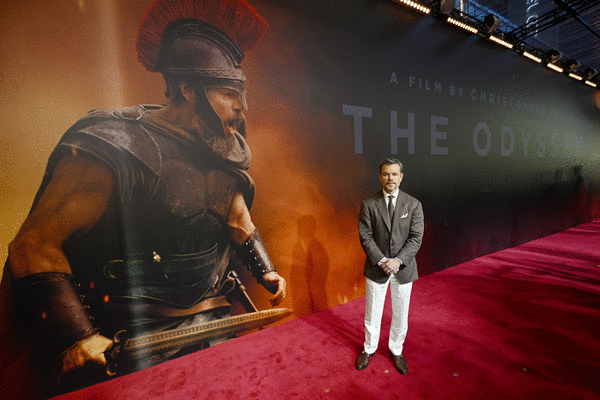
“The Odyssey” is on its own odyssey.
The epic poem from ancient Greece about the mythical Ithacan King Odysseus’ ordeal getting home after the Trojan War wandered into America’s culture wars after some prominent conservatives concluded that Christopher Nolan’s film version, which premiered last week, was “woke” because of the multicultural casting.
While they had not yet seen it, these conservatives’ consternation came amid casting news that leads like Matt Damon as Odysseus and Anne Hathaway as Penelope would share the screen with Lupita Nyong’o as Helen, Zendaya as Athena as well as transgender actor Elliot Page playing a soldier and rapper Travis Scott cast as a bard. (The Americanized dialogue and even the accuracy of costume design were derided by other critics.)
Led by Elon Musk’s reposting on his X platform that Nolan’s version was “an insult” to Homer, other conservative commentators amplified the attack, with Matt Walsh calling Nolan “technically talented but a coward.”
Walsh is wrong about his fortitude. But right, fortunately, about Nolan’s noted technical talent. Indeed, “Oppenheimer’s” Oscar-winning director has made what Hollywood used to call a spectacular into a spectacular (although uneven) film shot entirely in IMAX, maximizing the images and the sound of the mythological gods, monsters, men and women in the action-packed story.
But Musk intuiting an insult to Homer doesn’t square with the ever-evolving nature of “The Odyssey,” said Simone Oppen, a University of Minnesota assistant professor whose scholarship includes a focus on Greek literature.
“I am so grateful to the generations who have kept this epic poem alive and around for us to appreciate for nearly 3,000 years, and I do think that the multigenerational oral composition that most scholars agree was the genesis of the poem is really responsible for that,” said Oppen. “We’re talking about at least a 200-year process of oral composition, performance, memorization, passing it down in families and tinkering with the poem” which she believes is “so responsible for its staying power today.”
Recalling a similar casting controversy over David Gyasi, a Ghanaian actor cast as Achilles in a 2018 BBC treatment of “Troy: Fall of a City,” Oppen said that “it’s complicated material. And I think it’s crucial for these stories to remain relevant, that artists and directors be allowed to cast actors of African heritage in roles like Achilles and Helen of Troy.” Casting Nyong’o as Helen “can be seen as culturally appropriate,” Oppen said, “in particular for the way that Nolan’s choice in casting her can be seen as a translation of her legendary beauty.”
Emily Wilson’s more modern translation of “The Odyssey,” which Nolan reportedly based his script on, is replete with references to beauty — female and male — but not to race. Some translations, however, suggest Helen as Caucasian, which is just one of the reasons Wilson’s translation itself became unwittingly enlisted in the current culture war.
And yet Wilson’s version has become an unlikely literary hit this summer, jumping 40% in sales as people try to read “The Odyssey” before seeing it.
“I rejoice in it,” Oppen said of intensifying interest in the poem on pages or the big screen. “I’m not sure it will be enough to stanch the flow of students out of the humanities and introductory ancient-Greek courses, but I think of it as proof of the story’s deep staying power, and I think of it also as proof of the story’s accessibility in that it wasn’t written for an elite and highly literate audience. It wasn’t even written down at all originally, right?”
So even if it doesn’t translate into campus classics revival, every boost to books is welcome. Especially as the percentage of adults reading for pleasure fell from 28% in 2004 to 16% in 2023, according to an American Time Use survey referenced in a recently released Atlantic magazine article titled “The end of reading is here,” which detailed a decline in reading across gender, generation, education and other demographic distinctions.
Those who do pick up Wilson’s translation — or the work of any other translator — are treated to an accessible, universal poem that transcends time to be relevant to today, let alone to ancient Greece. “I really appreciate and defend (Wilson’s) and Nolan’s choices as artists to form ‘The Odyssey’ that they find most relevant to continue to help this poem — as if it needed any help — to find new audiences today,” Oppen said.
And the new audiences are part of the poem’s odyssey itself, according to Carol Donelan, a Carleton College professor of cinema and media studies.
From Kyoto, Japan, where she’s teaching a course on film analysis at Doshisha University, Donelan said in an email interview that “Homer’s ‘Odyssey’ is a myth but mass popular films are also myth. Myth functions culturally to synthesize disparate individuals into a unified collective whole, in effect, ‘birthing a new nation’ with a new set of values in every moment.
“The controversy over the casting of Helen is rooted in the struggle for control over the myth. Who gets to tell the story and how is it to be told? Which values do we carry forward and which do we leave behind? Bottom line, myth is the imaginative space within which we negotiate who we are, individually and collectively, across time. Who were we in the past, who are we in the present, and who will we become in the future?”
Homer, Donelan concluded, “birthed a new nation in his time and Nolan is birthing a new nation now. However, the ‘Odyssey’ myth goes beyond the film itself. The myth also includes all the discourses about ‘The Odyssey’ from the past as well as all the discourses being generated by critics and viewers now. Everyone who weighs in on Nolan’s film is participating in authoring ‘The Odyssey’ myth, helping to carry the myth across time for future generations to debate and enjoy.”
To some, Nolan’s film is a Trojan horse of liberalism; for others, literacy, as an ancient Greek poem inspires 21st century readers. No matter the individual interpretation, just like Homer’s timeless tale, the reaction to “The Odyssey” seems more like an enduring journey than an end destination.
_____
©2026 The Minnesota Star Tribune. Visit at startribune.com. Distributed by Tribune Content Agency, LLC.





















































Comments