Commentary: Government-owned AI is a terrible idea
Published in Op Eds
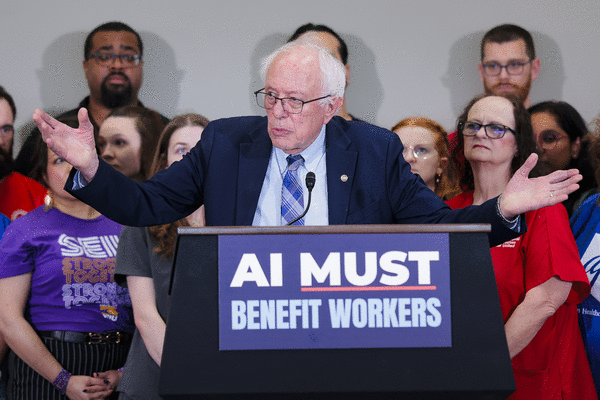
In the push to regulate artificial intelligence, a dangerous idea is gaining ground in Washington: handing the government ownership stakes in the biggest AI companies. Both parties see immediate dollar signs. Neither is thinking longer-term. Somewhere, Karl Marx is smiling.
It’s not surprising that Vermont’s socialist senator wants to require the big AI labs to fork over 50% of their equity to a “sovereign wealth fund,” but the president also seems to like the concept, saying that it “would be a beautiful thing” for the government to take an equity stake in AI companies. Democrats and Republicans have offered little criticism of their party comrades, increasing the possibility that some form of this terrible idea may come to pass.
The president said that government ownership would ensure that “the American people can benefit from the success of AI.” But the fact of the matter is: The American people already benefit from the success of AI, whether that’s individuals using chatbots, banks using it for fraud detection, doctors using it to fight diseases, small-business owners using it to help with bookkeeping and marketing, farmers using it to maximize yields, pension funds and other investors using it to optimize their portfolios, or any of the other nearly endless uses for which it may be deployed. And we are still only in the very early stages of realizing the full range of benefits.
As technology improves, the public benefits should continue to expand, through rising productivity, faster economic growth and greater innovation. New AI companies being formed will help spur the formation of other new companies, generating jobs. And as AI companies go public, their profits will be diffused even more broadly.
All of this should generate greater tax revenue for governments, allowing for more investment in essential services, including education, job training and a stronger safety net for those who lose their jobs due to AI. If AI companies aren’t paying into the public fisc, the answer isn’t to take ownership of them. It’s to fix the tax code.
Just as we are only beginning to reap the benefits of AI, we are still in the early stages of learning its downsides. But they will be infinitely greater if government becomes a part owner of the industry.
When the government becomes a shareholder in a private-sector entity, the positive effects of market competition can break down. Politics trump profits, favoritism and cronyism take root, innovation suffers, competitiveness erodes, and regulation is corrupted.
Instead of a meritocracy where the best products and services compete to win, the market becomes a smoke-filled backroom where success is determined by political connections, lobbying budgets and electoral considerations, all of which will corrupt regulatory decisions, stifle competition and diminish innovation. And the more taxpayer money that’s on the line, the greater the incentives will be for companies to stick with politically safe decisions rather than take risks that could reap large rewards.
As if all that isn’t bad enough: When the companies become too big and bloated to fail, the public will be on the hook for the bailouts.
The history of governments and industries getting into bed together — including America’s inefficient defense-industrial base — should serve as a warning. Likewise, OpenAI’s reported offer to the federal government of a 5% ownership stake is less a validation of the idea than a red flag. The biggest firms, with their armies of lawyers and lobbyists, are already too likely to entrench their advantages over startups, shaping the rules in their own favor. If government is to become not just a regulator but also a part owner, it will be even easier for the big firms to block out smaller ones, hurting innovation and consumer choice, depressing wages and raising prices.
American AI companies have become the envy of the world because they’ve been able to nimbly experiment, test far-out ideas, tolerate failure and shoot for the moon without undue interference from the government. That the federal government has already become a part owner of a variety of tech companies across numerous industries does not mean it should expand the list. The rationale for these agreements has varied — bolstering supply chains, protecting national security, getting a “piece of the action” — but they’re all misguided. And with AI, the risks of these arrangements will be greatly amplified.
Consider the fact that AI companies are often speech platforms. In addition to concerns about censorship or surveillance, the likelihood that politics will start to infect AI output is alarmingly high. Free speech activists are rightfully ringing alarm bells about government ownership.
Whatever one’s view of the current administration, the possibility of government dictating and distorting AI outputs — information, data and knowledge itself — should send chills up the spine. The potential for propaganda would make George Orwell blush. And the more capable AI becomes, the more worrisome this possibility will be.
To put it plainly: The White House is contemplating granting the government enormous new powers by taking an ownership role in companies that may well shape the future of technology, science, education, warfare, communications and much else — endangering not just the nation’s economy, but also our freedom and democracy.
Marx would love it. The rest of us should demand that both parties reject it.
____
Michael R. Bloomberg is the founder and majority owner of Bloomberg LP, the parent company of Bloomberg News, and the founder of Bloomberg Philanthropies.
©2026 Bloomberg L.P. Visit bloomberg.com/opinion. Distributed by Tribune Content Agency, LLC.




















































Comments