Commentary: RFK Jr. received compassion when he was arrested for heroin, but my patients do not
Published in Op Eds
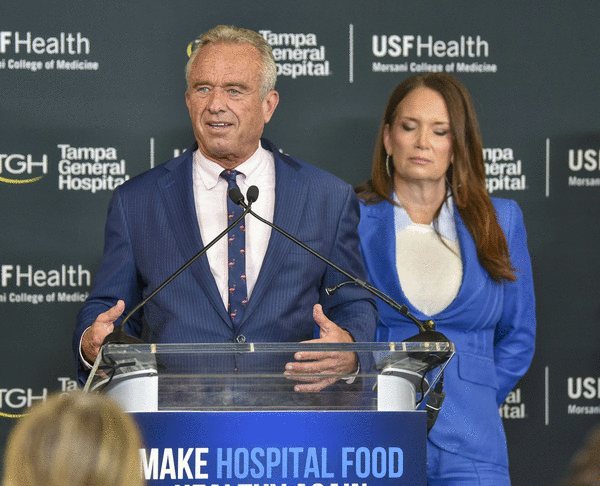
In 1983, while on a flight to South Dakota, a 29-year-old Robert F. Kennedy Jr. was reported to have developed profuse sweating, pallor, and a weak pulse. Authorities searched his luggage and discovered two-tenths of a gram of heroin.
He pled guilty to a felony charge, and the judge ordered him to two years of probation instead of a possible jail sentence. He entered rehabilitation for substance use and shared that since then, he has been in recovery for 43 years.
Robert F. Kennedy Jr. is now the U.S. Secretary of Health and Human Services (HHS). He has shown tremendous courage in sharing the story of substance use, including his LSD, methamphetamine, and heroin use. I cannot imagine the amount of stigma he has endured. I hope that his success encourages others to seek treatment. Yet as an addiction medicine physician, I am also struck by how different my patients' experiences are from those of Kennedy.
Many people in the United States who want voluntary treatment cannot access care. Even though an estimated 48.4 million Americans over the age of 12 have had a substance use disorder within the past year, less than 1 in 5 of those people received medication treatment.
And when my patients encounter the legal system, few are offered the privilege of probation and treatment instead of incarceration. Far too often, judges apply a punitive approach to a medical disorder, often with deadly consequences.
Shockingly, 85% of those in U.S. prisons either meet diagnostic criteria for a substance use disorder or were incarcerated due to a situation influenced by substances. However, over half of jails do not treat with medications for opioid use disorder, like buprenorphine or methadone, and only 12.8% of jails offer medications to everyone who has opioid use disorder, which is the standard of medical care.
One North Carolina study found that within the first two weeks after release, formerly incarcerated people had a 40 times increased rate of death from an opioid overdose compared to other state residents. This is likely largely driven by inconsistency in treating opioid use disorder during incarceration, as medications dramatically reduce the risk of overdose death.
In stark contrast, in a study of correctional facilities in Massachusetts, those with probable opioid use disorder who received medications such as buprenorphine or methadone while in jail had approximately a 50% lower rate of fatal overdose when compared to those who did not receive these medications.
Kennedy knows what needs to be done. In his own words: “We need Suboxone. We need methadone. We need naltrexone. We need Narcan. We need good fentanyl detectors that can detect it on pills, etc., so that kids are less likely to overdose. We need prevention. We need education.”
Yet harm reduction and more broadly addiction treatment services are being targeted in the very department that Kennedy leads. In January, funding termination notices were sent out regarding the sudden cancellation of $2 billion in grants for addiction and mental health. This was reversed after a public outcry, but grantees have significant concerns about delays in funding, clawbacks, and the sustainability of federal funding, myself included, despite funding initiatives announced this summer.
In late April, the Substance Abuse and Mental Health Services Administration (SAMHSA), an agency within the HHS, declared that federal funding can no longer be used to pay for drug testing strips that check for deadly additives and contaminants in the drug supply, such as fentanyl, that contribute to overdoses. Kennedy knows firsthand the grief of losing a loved one to an overdose: his younger brother died from this. This funding restriction continues the administration’s stance against harm reduction.
Harm reduction efforts that have science-based support for efficacy must not be cut. This includes programs that prevent, screen, and treat people with HIV and hepatitis C, and programs that fund drug testing strips and naloxone, a medication that reverses opioid overdoses. Per a New York Times report, Secretary Kennedy himself was treated for hepatitis C from intravenous drug use, which untreated can cause cirrhosis and liver cancer.
We need to stop seeing addiction as a moral failure deserving punishment and start seeing it as a treatable medical condition. Secretary Kennedy had the privilege of treatment instead of incarceration, and I call upon him to use his role to pay forward the compassion he was afforded by increasing addiction treatment resources for Americans.
____
Dr. Cara Borelli, DO is an addiction medicine physician who trained at Icahn School of Medicine in New York City. She teaches in New Haven, Connecticut. She can be found on Twitter/X@BorelliCara. She is a Public Voices Fellow at The OpEd Project. This opinion piece reflects her personal views.
_____
©2026 The Fulcrum. Visit at thefulcrum.us. Distributed by Tribune Content Agency, LLC.



















































Comments