Lisa Jarvis: The cyclosporiasis outbreak is a master class in miscommunication
Published in Op Eds
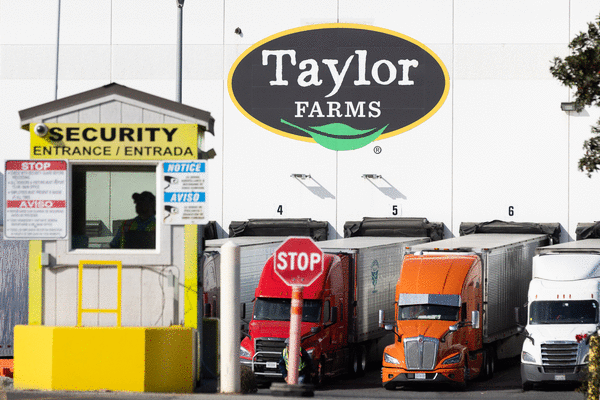
Over the weekend, the Food and Drug Administration sent Americans trying to navigate the cyclospora outbreak into a tailspin. A day after Taylor Farms announced a voluntary recall of iceberg lettuce in 27 states — generating one set of alarming headlines — the FDA said that a test linking the company’s lettuce to the parasite had been wrong, leading to seemingly contradictory coverage.
Americans are understandably confused. What exactly is going on?
One crucial thing to understand is that the false positive doesn’t mean Taylor Farms is in the clear. Evidence from infected people still points to its iceberg lettuce as the likely source of at least part of the nationwide outbreak of cyclosporiasis, which has sickened thousands with “explosive” diarrhea. Taylor Farms hasn’t walked back its recall.
But you might not know that from the latest round of agency communications.
While some uncertainty is inevitable in a fast-moving outbreak, confusion on this scale is not. When consumers want to understand how to protect themselves, the FDA and CDC should serve as reliable guides. Now, though, Americans too often feel they’re muddling through on their own. Rather than proactively explaining to the public what they do and don’t know, federal health agencies are reacting only after confusion has taken hold. This mixed messaging has left people unsure what to eat — or who to trust.
The false positive itself shouldn’t shake anyone’s trust. Cyclospora poses a “notorious” challenge for disease detectives, Kalmia Kniel, an expert in microbial food safety at the University of Delaware, told me via email. Because cyclospora is a parasite, it can’t be grown in a petri dish (like, say, E. coli), and its complex genome means researchers rely on snippets of DNA to confirm its presence in a sample.
A false positive could have occurred for several different reasons, Kniel said. For example, the test looks for fragments of genetic material and could have picked up a close relative of the parasite. And researchers looking for oocysts — the spheres that eventually mature to infect people — contend with a lot of background noise. Meanwhile, false positives are sometimes declared when researchers can’t confirm a result through genetic sequencing.
But the false positive isn’t really the problem. The issue is how that result was unceremoniously dropped onto the agency’s website without enough context. (We should also wonder whether the FDA rushed its initial conclusion amid a high-pressure outbreak, rather than taking a beat to double-check its work — a possible misstep that’s now giving the company some cover for its potential role in the outbreak.)
On Monday afternoon, the agency explained what happened: The US has ramped up produce screening at the southern border, and one of those samples came back positive for cyclospora on Saturday. Regulators chose to publicize the result because the lettuce wasn’t part of the active recall, Donald Prater, the FDA’s acting deputy commissioner for food, told reporters. A subsequent quality check led the agency to backtrack.
But by the time that explanation arrived, the phrase “false positive” had already dominated the morning news cycle. It understandably made people wonder if Taylor Farms was exonerated — again, to be crystal clear, it was not — and, if so, what was now putting them at risk.
Over the past several days, consumers have had to decide who they trust more — a battered FDA and CDC, or a food company that might have more latitude to provide information, but not necessarily the incentive to tell consumers everything. That’s not a sign of a well-functioning public health apparatus.
Of course, all of this was predictable. When DOGE last year made indiscriminate cuts to the CDC and FDA, hobbling their ability to operate normally, public health experts warned that the consequences would be felt by everyday Americans. This is just the latest example — one that has us all questioning what’s on our dinner plates.
What’s worse, the more often Americans question whether health agencies are offering the full truth, the harder it will be to one day win back their trust.
The irony, of course, is that this administration’s health leadership rode in on a wave of Covid criticism and a promise to restore trust in public health. They seem to be finding out just how hard it is to communicate nuance in an emergency — especially when many agency experts have left the building.
____
This column reflects the personal views of the author and does not necessarily reflect the opinion of the editorial board or Bloomberg LP and its owners.
Lisa Jarvis is a Bloomberg Opinion columnist covering biotech, health care and the pharmaceutical industry. Previously, she was executive editor of Chemical & Engineering News.
©2026 Bloomberg L.P. Visit bloomberg.com/opinion. Distributed by Tribune Content Agency, LLC.



















































Comments